109. Why recycling labels are about to get more confusing


 Apple Podcasts
 Spotify
 YouTube
 Amazon Music
 Castbox
 Podcast Addict
 PocketCasts
 Key Takeaways
- The European Union's proposed PPWR packaging and packaging waste regulation introduces a complex new system of 24 different material-specific pictograms for recycling labels.
- While EU-harmonized recycling labels aim to reduce confusion across member states, they may create complications for the UK since local council bin systems will not match the new European pictograms.
- The UK's existing On-Pack Recycling Label (OPRL) system relies on simple 'recycle' or 'do not recycle' instructions, which consumers process in under two seconds compared to decoding 24 material types.
- Mandatory recycling labels in countries like France, Spain, and Italy mean global brands will likely adopt the EU format, potentially phasing out familiar UK-specific consumer labels.
- Beyond packaging labelling, vapes continue to be a major waste management challenge due to improper disposal and the difficulties consumers face when trying to return them for recycling.
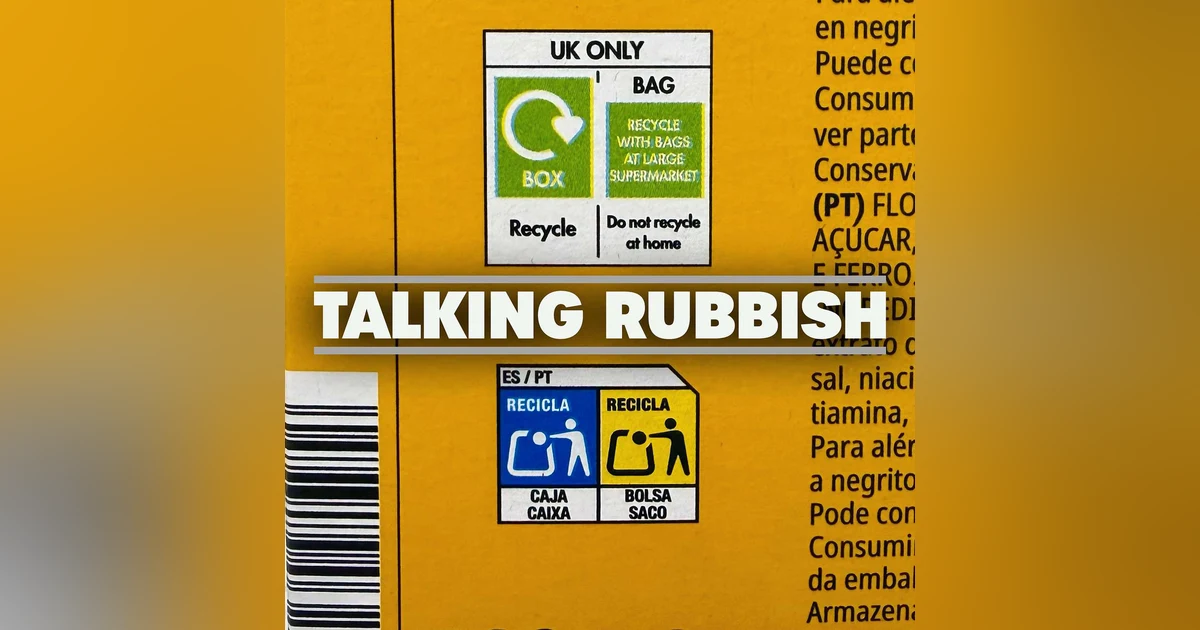
Recycling labels are about to change, but will they actually make recycling easier? In this episode, we look at the EU’s plans for harmonised packaging labels, including a proposed system of 24 different pictograms. Harmonisation sounds like a good idea, but what happens when those labels appear on packaging in the UK without matching labels on our bins? And are we moving from a simple instruction telling us what to do with our packaging, to a system that simply tells us what it’s made from?
Plus, are vapes rubbish or not, how much household flexible plastic is actually recycled, how will sandwiches be packaged in our dream shop, and why has James found a security breach in some litter?
Join hosts James Piper and Robbie Staniforth as they delve into the world of recycling, hopefully having fun along the way. One thing is for sure, they will talk absolute rubbish from start to finish.
Please take a moment to complete the Simpler Recycling tracker
We would love you to join our community on Discord
Special thanks to our sponsor, Ecosurety
To get exclusive videos and clips, follow us on Instagram, TikTok, Threads or Facebook; @rubbishpodcast or YouTube: @talkingrubbishpodcast
Or you can contact James and Robbie with questions or just general rubbish musings using the email address talkingrubbishpodcast@gmail.com or by texting them via WhatsApp on 07356 069 232
Relevant links and reports mentioned in the programme can be found on the Talking Rubbish Linktr.ee
Transcripts and episodes can be found on the Talking Rubbish website
Timestamps:
Why recycling labels are about to get more confusing - 1:40
Additions and corrections - 20:45
Rubbish or Not: vapes - 27:00
Rubbish News - 35:16
How much household flexible plastic is actually recycled? - 44:02
Green Grocer: sandwiches - 45:57
Residual Rubbish - 53:19
Music licence ID: 6WPY8Q4O2RPFIOTL
Frequently Asked Questions
Why are recycling labels becoming more confusing?
The EU is introducing a harmonized system featuring 24 different material-specific pictograms under the PPWR, moving away from simple binary instructions like 'recycle' or 'do not recycle'.
How will EU recycling labels affect the UK?
Because brands selling across Europe will adopt the unified EU labels, UK packaging will likely display these new pictograms even though UK local council bins will not be updated to match them.
What is the On-Pack Recycling Label (OPRL)?
The OPRL is a UK-specific labeling system created by supermarkets that provides consumers with clear, simple instructions on whether packaging can be recycled.
Are vapes recyclable?
Yes, vapes are recyclable, but they cannot be put in curbside bins because they contain electronic components and batteries; instead, they must be returned to retailers or recycling facilities.
James Piper
Hello, welcome to Talking Rubbish, a weekly podcast delvede deep into the world of recycling and discussing the truth behind snappy headlines and one-sided stories. In this episode, we will discuss packaging labelling. Are vapes rubbish or not? I have a question about how much flexible plastic is actually recycled and how will sandwiches be packaged in our dream shop. I'm James Poper and I'm joined by Robbie Staniffel, my far from rubbish friend. Good morning, Robbie. Morning, James. How are you today? Really good, yeah, very good. I'm just gonna pause there because we had a review from someone.
Robbie Staniforth
Oh, okay. Is this gonna make me not very good?
James Piper
Well, this person asked to be anonymous, and the review will be a review of the week soon. So then not this week's, then there'll be a review soon. But I thought I would pull out a small part of this review because they said the only concern I have negative feedback. This is negative feedback. Everything else perfect. Everything perfect. The only concern I have is why at the beginning of the podcast, Robbie never asks how James is. So this reviewer said, How are you, James? Tired. It's really early in the morning.
Robbie Staniforth
It's nice for someone to consider your well-being for a change.
James Piper
Yeah, it is. Thank you so much. Thank you to that listener, anonymous listener. We um I don't know why we do that. I've sort of got into the rhythm of saying how are you, and then just starting off. Do you want to start saying how are you? How are you, James? I think it will always be tired though. Young son, early mornings. Yeah. Lots of trash talk. So today I wanted to ask the question why is recycling labelling about to get a lot worse, particularly for the UK.
Robbie Staniforth
Wow, okay. So we we think it might get worse.
James Piper
I think it's gonna get a lot more complicated. And just to give a bit of a history, in 1970 we got the Mobius loop. In 1988, the resin identification code was born. In 2009, in the UK, OPRL, which is the on-pack recycling label, was created, which has developed into recycle and don't recycle. And now the EU, as part of PPWR, is introducing harmonized labelling. And I guess I just wanted to explore what this could mean for our packaging and why it might make recycling harder for the average consumer. But before we get into the future of labels, let's look back a bit. So that 1970 Mobius loop, you've got one. Oh, right there on the car. Isn't that helpful? So if you're on video, there's a Mobius loop next to Robbie. Ahead of the very first Earth Day in 1970, there was a competition that was launched to design a symbol to raise environmental issues and awareness of environmental issues. And someone called Gary Anderson won that competition with the Mobius loop. Wow, okay. It was a competition. It makes it sound like he was an eight-year-old or something. I think it was like I think he was 23. I think this is a university design student or whatever. I think he won $2,500 scholarship, which 1970, that's gonna be a lot of money, isn't it?
Robbie Staniforth
Yeah, sure.
James Piper
Yeah. So uh the symbol is three, if you're not on video, the symbol is three arrows that chase each other around in a loop. And many, many people associate that with recycling today. In 1988, the Plastics Industry Association in the US wanted to identify then the different types of plastic, and this is where they created the resin identification code. So we've talked about this before. This is the numbers one to seven. Oh, yes, in the early days of the podcast.
Robbie Staniforth
You have to go to some of the first 10 episodes or so, I'm sure it's in there somewhere.
James Piper
So the numbers one to seven tell us what type of plastic it is. Sure. Now I don't this isn't really used in the UK. I think it's used quite a lot in the US. I think we said this at the time because in the US they dictate plastic recycling by numbers. So they say, in this, in this state, you can recycle number five. Oh, okay. So they will look at the resin code.
Robbie Staniforth
That never happens in the UK.
James Piper
I think so. I think that's what happens in the US. It's way more about the numbers because when I go on Reddit and I can tell where where someone's from, depending on whether they say, Can I recycle this plastic bottle or can I recycle this number one plastic bottle? Uh, that's how I can tell. I guess the criticism of that is what they did was they took the number and then they put it in the three chasing arrows. So they made it look like a recycling instruction. So even if you had PVC as your identifying number, you still had it within three chasing arrows. And because those three chasing arrows as the Mobius loop had already been linked to recycling, now you're making it look like your PVC or polystyrene can be easily recycled when it can't. And so the criticism I have, I it's interesting. Lots of people have a criticism that the plastic industry developed it. And my my argument back is well, who the hell is going to develop it if it's not the plastic industry? That's a fair point. No one's gonna come in and say, oh, what we need is a resin identification code. You know, that is going to be the plastic industry.
SPEAKER_02
Yeah.
James Piper
The criticism I think can be leveled at them is then making it look like it's recyclable. Mabius Loo, plastic resin identification code, those are very US-started initiatives. In the UK, in 2009, the supermarkets got together and created the on pack recycling label, which we know as OPRL. We've talked about a lot on this podcast. And over time, that has developed into a very simple recycle or do not recycle.
Robbie Staniforth
And we have to say that this is a great example of collaboration, isn't it? You know, you sort of the throwaway sentence of the supermarkets got together and decided they needed clear instructions and to all be to some degree singing from the same hymn sheet. And if one grocery retailer is saying it is recyclable, it's darn unhelpful for the average person if the next one says it isn't recyclable.
James Piper
Yeah, and you'll find it on most packaging. Now, I think it was, I think Alice said in her episode, greater than 90% of groceries now you uh grocery brands now use it. Okay so you find that on an awful lot. Full disclosure, I sit on the board of OPRL. So while we talk about labels and OPRL, I have to disclose that.
Robbie Staniforth
I'll I'll be the one who's complimentary then because I really love it and I don't sit on the board. Exactly.
James Piper
But I but it is worth saying, uh, whether I sat on their board or not, I am so passionate about consumer labelling and consumers having the right information. I mean, that's why we do this podcast. And I am very proud and protective of how simple we made it in the UK. In episode 101, we started our exploration into PPWR, but we did leave out the detail on labelling, and this is because we focused on things going live in August 2026, things have just gone live, whereas labelling is in August 2028. However, changing labels is not an easy task. For sure. And August 2028 sounds like a long way, but it's gonna come around so fast. Okay, so why is labelling gonna get complicated? It's mainly because the EU want to move to pictograms, which will identify the material. Sounds fun. It's very fun, it's very, very, very fun.
Robbie Staniforth
As soon as you say pictogram, I'm like, this seems more interesting for the average people.
James Piper
Version of picture. Oh, is it composite paper B? Spoiler. Composite paper B. We'll find out. Well, I'm not even gonna be able to tell you what that is. Um, the proposed EU system uses pictograms to identify the material. And in January, we got our first look at what that might look like, what the labels might look like. The European Commission's Joint Research Centre published its technical proposal with drum roll, please. Very good, 24 labels. Oh gosh. We are moving from recycle or don't recycle to 24 labels.
Robbie Staniforth
So cards on the table, I saw leaked versions of these like last year. So I've seen this coming down the pipeline. And uh when it was actually this sort of draft was kind of released at the beginning of the year, I was like, this looks like it's got even more complicated than the already quite complicated earlier drafts that had been leaked. So I must admit I was a little bit amused when it came out.
James Piper
Yes. So now for comedic effect, I will read all 24 as fast as I can. You ready?
Robbie Staniforth
Yeah, go.
James Piper
Cardboard, paper, uncoloured glass, coloured glass, green glass, brown glass, rigid plastic, flexible plastic, beverage cart and paper composite A, paper composite B, metal, home compostable, industrially compostable, textile, ceramic, wood, cork, hazardous, and residual. Then there's four drinks labels, cardboard and paper, glass, plastic, and paper composite A, paper composite B. That's amazing. Did you say cork in there? Yeah. There's a cork one. There's a cork one. I don't remember seeing that. There is a cork one. And none of that includes deposit return packaging, which is treated separately. So you've then got your deposit return labels, which will also be harmonised. The good bit of this is it's going to be harmonised. Every country in the EU will have the same label. Same colour, same picture. That's great.
Robbie Staniforth
So whether you're drinking a Rysling in Germany or uh what shall I go for? Uh Pinot Noir in uh France, you'll know where to put your cork.
James Piper
You'll know where to put your cork, yes. Are they gonna have cork bins? I can't imagine it, but maybe that is a really interesting question. I actually have no idea. So part of this labelling is the EU or now this is where the I've I'm completely with the EU, okay? So part of this is the label on the packaging has to be a certain, has to look a certain way. And if it's coloured, it has to be a certain colour, and if it's black and white, this is how it looks in black and white. And they are expecting bins to be updated so that the bins will match the packaging. That is be I would love that. Yeah. No, me too, yeah. Problem is in the UK, which is where we're talking about, we're gonna have our packaging with the pictures on it. They are not gonna update our bins. We're not in the EU. No, sure. So there's no reg the only reason we're gonna have the Pittsgrams on our packaging is because our product is sold in the EU. It's much like tethered caps. Sure. Brands will just do it. There's no way they're gonna create a UK only packaging. Councils aren't gonna go, oh well, and we'll put those pictures on the bins because they just don't have the incentive to do that.
Robbie Staniforth
This will be on most British packaging, whether we sort of like it or not.
James Piper
100%. Yeah, definitely. And I guess one of my biggest criticisms is what doesn't it have? So in those 24 labels I read out, there is not food waste, electricals, batteries, light bulbs. And that is because PPWR only applies to packaging. And if you look through the proposal from the EU, it actually says, the authors of the proposal say, this limited scope creates challenges for developing a comprehensive and fully coherent waste sorting labelling system, and consumers encounter many non-packaging items made of similar or identical materials that also require proper sorting, but will not carry harmonised EU waste sorting labels. This limitation may reduce the system's overall effectiveness in improving sorting behaviour. Really? Wow, that's an interesting declaration. So I'm sure influencers now are thinking, well, this is okay. We'll just have the pictures and recycle, do not recycle. But the EU have been very clear that they want to remove any confusion. Pause for laughter. They want to remove any confusion by saying you are not allowed any other label that could cause recycling confusion. And so the way they I mean, this is worded way more legally, but in the wording that they've given, so this is guidance they published in June, the European Commission said national rules which add sorting instructions are not allowed based on the principle of primacy of EU law. Member states will not be allowed to keep their national labels next to the EU harmonised labels after the 12th of August 2028, or 24 months from the date of entry into force of the Act.
Robbie Staniforth
But is that just the EU nations that can't have their own national symbol, or is that any nation in the world outside of the EU isn't allowed to put their symbol on something that's being sold in the EU, obviously as well as in their own country?
James Piper
I think the interpretation we have, because it's not 100% clear, the interpretation we have is if you're going to sell something in the EU, you cannot have a second mark on it that's going to confuse consumers. So it raises a really interesting question on OPRL. Because I do not think that the recycle, don't recycle label will be allowed on packaging.
Robbie Staniforth
It would be allowed on packaging if it's just sold in the UK. That's such a limited amount of packaging, though. If you think about some of the stuff that's made domestically, perhaps for the grocery retailers, that would be fine. But all of these very big brands, all of the kind of branded food and uh drinks, they're gonna be sold in the EU as they are in the UK, and therefore they're just gonna have one unified labelling um for all of their packaging.
James Piper
Let's say the loophole was actually you're in the UK, so you can have your recycle, don't recycle. You're competing for space on that label. If you've got to have the pictogram, you would have the pictogram, you would have the EU compliant bit, and then not really have space for anything else. So it is a very, you know, we as consumers have got really used, I think, to recycle don't recycle. I think APRL said four or f four-fifths of people recognise and act on that label. So this is a big shift to move from that to paper composite B.
SPEAKER_02
Yeah.
James Piper
Which which means nothing. I don't know what paper composite B means as a consumer.
Robbie Staniforth
There's going to be a big uh education piece needed in the EU itself as well as for anyone else trying to comply with the product that goes into the EU. But if influencers want to think, how big a problem actually is this, all you need to do is turn over a piece of packaging and look for how often it has ingredients and things not just listed in English in any foreign language, you then sort of know, right, the this has got French and German on it, therefore it's gonna be sold in the EU, therefore the OPRL is not going to be allowed.
James Piper
And it also led me to think about the resin identification codes that we talked about at the start, because I started thinking, well, hang on a sec. Particularly in the US, because of the three chasing arrows, they are seen as a recycling instruction. Sure. And I don't know whether that will be allowed or not. I actually asked the question on LinkedIn, and you can tell it's an interesting question when it gets more comments than likes. Yes. Because everyone's got an opinion.
Robbie Staniforth
They just dive straight in. Yeah.
James Piper
I don't even have time to like this. I've got to leave my comment.
Robbie Staniforth
Yeah, I like those ones.
James Piper
And so uh yeah, that's what happened with this one. And and the summary was, I guess I got responses from all angles, and uh so my summary is we don't know. Yeah. Um, but I think one thing is is probably sure that you will not have the three chasing arrows around the resin code. You might just have the number. And even then, I mean there was lots of discussion about whether the number is actually useful because there's so many different take PET bottles, there's so many different types of PET that distilling it down to a one is actually unhelpful.
Robbie Staniforth
Yeah.
James Piper
Hubbub, and we've we've talked about hubbub a lot, they're an environmental charity. We interviewed Alex uh for episode 15, I think. And they've done lots of studies on how we interact with our bins, and they previously decided that we spend less than two seconds deciding which bins something belongs in. If I imagine myself as a consumer in 2028, right now I can look at a sandwich pack and see recycle. And I okay, recycling minute. And that took me less than two seconds. What am I gonna see now? You know, fibre composite, paper board, I'm not sure. And then in the UK, I'm not gonna have a bin that matches, I might just have a recycling bin because I'm on the go. Or I might be at home where I'm definitely not matching what the pictogram says. Am I really in two seconds is my brain gonna be able to decode one of 24 pictures and put it in the right bin? I think arguably the recycle-don't recycle works better in that context of how long we spend hovering over a bin.
Robbie Staniforth
Yeah, and really that label is trying to sweep up people who are genuinely confused that recycle-do not recycle. It's trying to make it absolutely binary and straightforward for the average person who frankly has probably not done much recycling in their lives. It's not for people like you and I and the BIMFluencers who broadly know about recycling but just need a little nudge. It's that clear so that one can instantly engage with it with almost zero background understanding. Whereas this label, this new label in the EU, is kind of expecting a bit more base understanding from the label user, the average citizen.
James Piper
And I tell you, my residual rubbish in 2028 will be Robbie, I've just been to France and it's amazing. You know, the plastic tray matched the bin that I was putting in, the picture was the same. Like, I love it. But will I experience that in Bristol? I don't think that's likely. And in the UK, OPR Rail is not mandatory, it's voluntary. That's why we don't have it on everything. But there are schemes in other countries that are mandatory. So France, Spain, and Italy all have mandatory recycling labels. So those countries now are going to have to unpick their national requirements to move to the harmonised system. And that is, I mean, that's not a small task. In June, eight EU countries: Czechia, Bulgaria, Italy, Latvia, Poland, Romania, Slovakia, and Slovenia, all formally raised concerns with the EU about PPWR and specifically highlighted packaging labelling. And that basically their problem was that it's too uncertain. So the rules governing the final European labels are still being developed. And their biggest fear, and everyone's biggest fear, is that brands will redesign their packaging, print billions of packs, only to find they're not compliant with whatever the rules of them become, and then they'll have to redesign them.
Robbie Staniforth
Okay, like a minor change means it wasn't printed correctly or whatever, yeah.
James Piper
Yeah, exactly. And with this stuff, you've got to it's years of build-up to change your labelling.
Robbie Staniforth
Yeah, I think it's well-meaning, isn't it? I mean, it's exciting in a way that they're trying to do this and make recycling easier for citizens across the whole of the EU, but it just doesn't feel like it's got to a position where it's ready for them to say, right, this is it, now everyone change, and you can see why those countries are nervous, uh dwitchy about it.
James Piper
To wrap this trash talk up, I'm standing in my kitchen holding a packet. OPRL says recycle. The EU are saying flexible plastic. Which one actually answers the question I'm asking? Which bin does this go in? That I think remains to be seen depending on how good my bin system is, I guess. But it but it's not giving me the answer. I don't think the words flexible plastic are not giving me the answer. The EU has identified a very real problem that we can't have 27 countries developing 27 different recycling labels and expect consumers to understand them. Harmonisation of all things makes complete sense. Labels, bins. How many times do you speak to someone and they say, I wish every council just collected the same? And here we are with the EU doing it just across the EU. But my concern is that when I pick up a packet, the question in my head isn't, oh, what material's this? It's what bin does it go in? And if we haven't carried the bin over into the UK, which I don't think we will, I haven't had that question answered. You can harmonise a label, but harmonising every bin, every collection, every recycling facility across Europe is a much bigger challenge. Additions and corrections. Robbie, what have we started?
Robbie Staniforth
What have we started?
James Piper
I really wish you'd read the notes. People have been sending him their toothpaste residue weight. Wow, okay. So we've got more stats. So just as a reminder, Tony kickstarted this whole thing by saying he cut the end of his toothpaste tube and managed to get 8% of toothpaste out. You did the same thing and you were at 1% residue. We've now had Ian. So Ian had just finished a hundred mil tube of Aquafresh and he had an unopened tube to compare it with. Now Tony was 8%, you were 1%, Ian was 4.16%. So I think we now have our average: 4%. 4%, there we go. Which is great. Ian knows a lot about packaging, so he did a lot of work in terms of his issues, his limitations with the system. So he said, look, I use my kitchen scales, which are uncalibrated.
Robbie Staniforth
Yeah, mine too. I did think that being a guy in packaging and having used calibrated scales in warehouses around the country over the last few decades, when I put it on my kitchen scales, I was thinking, This is not scientific enough.
James Piper
We need the talking rubbish calibrated scales. Um he assumed the new. Tube and the old tube are the same weight to work out what the differences were.
Robbie Staniforth
Okay.
James Piper
And he assumed the fill of the toothpaste tube was 100% of the declared fill. And it can easily be 2.5% higher or lower and still be legal.
Robbie Staniforth
Oh, that's the tolerance. There you go. I always wondered, like with things like when you're buying fresh meat or something, and it's they're all 450 gram packs or something. I always wondered how can they get the meat to be exactly 450 grams? So there's a tolerance either way.
James Piper
Yeah, Ian's in retail, so he's gonna know better than us, but I think um two and a half percent seems to be what we're going with. Every day is a school day, interesting. There we go. Now, linked to this, we need to talk about the Dutch the Flessen liquor. Uh, the fless and liquor. Do you know what the flessen liquor is? Is that the squeezer thing? The fless and liquor, yeah. I think it literally means bottle liquor. Oh the fless and liquor is a Dutch bottle scraper. So this is a like a stick, a wooden stick or pole with a half circle at the end made of silicon or plastic. Yeah. And this is very popular in the Netherlands. It came up on Discord a while ago, a few months ago, shared by Cy72. So thank you for this, who told us they had a Dutch flat mate in Australia who could not understand why everyone doesn't use one. Um, they went and brought one on a work trip, and now everyone enjoys it. You know, it's like super useful. And basically, it's to get residue out of bottles. You push the fles and liquor into the bottle and you scrape out the residue, and that's how you get it empty. And apparently, most Dutch people use this. And can you get what hold of one in the UK? Yeah, you can order one online definitely.
Robbie Staniforth
Oh, right, okay.
James Piper
Now, Lonely Planet described it as an example of Dutch thrift. Apparently, the Dutch are very famous for being thrifty. Oh, they, okay. And during the financial crisis, there was an exponential growth in the sale of Flessant liquors in the Netherlands.
Robbie Staniforth
Gotta get the last scrapings out. Well, I love it. I mean, it's making sure that we use all the products. I'm all for it. I know what you're getting for Christmas.
James Piper
We'd like to take a moment to thank our sponsor, EcoSurety, who are on a mission to rid the world of unnecessary packaging. They help brands navigate the tricky world of extended producer responsibility, but that is not all. They also collaborate on some incredible recycling projects and consumer awareness campaigns for those tough to recycle materials. If you're an organization looking to make smarter packaging choices, check them out at ecosurety.com. And the best thing you can do to help her podcast to grow is to tell your friends and family about it, or you can leave us a review. And if you leave us a review, you'll be Robbie's review of the week.
Robbie Staniforth
And this one comes in from the Full Freezer. Yes. It's a five-star on Apple.
James Piper
So the Full Freezer is actually a lady who runs an Instagram account. Okay. Which is the I mean, if you want some freezer inspiration, you've got to go to this Instagram account. Oh boy. She freezes everything. Like everything. Baked beans, I've seen them in her freezer. Whoa, okay. And she has drawers that all have like fruit, vegetables, you know, everything's labelled. And then you open it, and literally there's hundreds of um the I think they're IKEA freezer bags. It's a full freezer. It's amazing. It's absolutely amazing. And she's appeared on like the BBC and ITV and all sorts of places talking about this. So I reached out to her to say thank you very much for the review. And uh she sent me a voice note saying how much she was enjoying the podcast and what we need to cover on freezer. So that was super helpful. So thank you so much, Full Freezer. Thank you for that.
Robbie Staniforth
Anyway, the review says I am both gutted to have only just discovered this podcast and delighted that I can now binge the back catalogue. I've listened to about 10 episodes so far over the last 48 hours, and it is so refreshing to listen to discussions about sustainability, which look at the topics from all angles and help to evaluate our best options. Thank you both for your commitment to this discussion. It is a brilliantly educational, impactful, lifestyle podcast. Someone should give an award or three.
James Piper
It's perfect. And that's great, isn't it? Because we said someone's given us a review that's got education in, but we're up for three awards. So if someone could include education, impact, and lifestyle, she's done it. Absolutely nailed debris. Thank you so much. Annoyingly, I think the judges met yesterday. Oh no, it's too late. It's too late. But that's okay. Thank you so much for that. You can follow us on social media at rubbishpodcast. You can email us talkingrubbishpodcast at gmail.com, or you can WhatsApp us. Also join our Discord. It's the easiest way to engage with us and listeners of the show. And the link to all of those things is in the show notes. Rubbish or not? A couple of episodes ago, we talked about fires, specifically the fire starters, batteries, gas canisters, and vapes. And we made an editorial choice to make it sound like it's very easy to return a vape. Ah yes. And we did that deliberately because we thought we don't want to put people off. We want to tell people that it's really easy to return a vape. But then we started getting comments saying, Have you actually tried to return a vape? It's pretty hard. Okay. And I thought we need to do this as rubbish or not. Because it's one of those we've covered vapes a lot over the 109 episodes, but we actually haven't done them as a rubbish or not. Sure. So they're coming back in and we can talk about how easy it is to take one back. So, Robbie, because we covered it a couple of episodes ago, I feel people know these are recyclable, but do you just want to, just for the purposes of the segment, rubbish or not?
Robbie Staniforth
I think it's definitely or not. I mean, it is, you can recycle these things. Oh, you've got one here.
James Piper
Where have you got that from? Well, so this is interesting because I was thinking we're going to do it as rubbish or not, and I was going for a walk as I was thinking this, and I thought, I'll find one on the floor, I'll litter pick one for the other thing. They're not disposable these days, James. You'll never find one. Took me two minutes. Two minutes from thinking we need to find a vape to finding this very reusable USB-C vape that has just been dumped on the floor. And not reused. And not reused. Yeah, there you go. So this is like, you know, oh, it turns up. Gosh, I didn't get it on before. 72% battery as well. Oh, wow. Just get me a new cartridge and I'll start vaping.
Robbie Staniforth
Please don't. Um so that they are recyclable. However, they're definitely not recyclable at your curbside or most people's curbside. They're an electronic device. Obviously, they do have a battery in two, but you're not expected to take the battery out because that's kind of embedded within the device itself. So you're going to dispose of it at uh retailers who are selling these devices. Now, my personal experience about this.
James Piper
It stinks. I can smell the pineapple.
unknown
Oh, yeah.
James Piper
Oh my god, something's happened here. That's so me somehow turning it on, and I don't know how I turned it on, has emitted a pineapple smell into this room.
Robbie Staniforth
It does smell quite strongly a pineapple. That's crazy.
James Piper
Sorry.
Robbie Staniforth
Um I have tried to return a vape before, and so here's my lived experience of trying to go and actually recycle these things. No bin anywhere in Tesco, even though they sell vapes. I had to ask a lady behind a counter who then went away to go and find a box. She took the box out. The box was totally empty. There was not a single other vape in. So my assumption from that is because you've got this barrier to recycling it, you've got to ask someone where can I recycle my vape with you? No one's going through the effort. You'd have to be a binfluencer who's really on a mission to recycle vapes to do that. It's not the kind of thing like at a supermarket where you see the battery tub on the exit and think, oh, next time I'll bring my batteries here to deposit them.
James Piper
I'm going to give you my experience in a second. Just to explain the legislation behind this. So there is a difference between vapes and batteries. Batteries have their own legislation, which means that all supermarkets have to have a bin if they sell over a pack a week. And we talked about that in the episode. Vapes sit under the waste electricals legislation, which is a bit different because the waste electricals legislation typically has been if you buy one, you can take an old one back. So if you buy a new toaster, you can give your old toaster back to the store. Now vapes get a special mention since they introduced reusable vape legislation. They said actually we'll clean up some of the recycling stuff as well. And so stores have to provide take back. So there's a thing with waste electricals, you can exempt yourself from take back by funding what's called DTS, the distributor take back scheme. You can't do that with vapes. You have to offer takeback. So as a minimum, any store selling vapes has to take them back if you buy a new one. That's that's your starting point. There are then larger stores, and I think it is it 400 square meters. Okay, yeah. Larger stores, if they're 400 square meters, so this is your big supermarket where you don't have to buy a new one. They have to take them back without you buying a new one. So there's two different things at play here. Smaller stores, you might need to buy a new one before they'll take back an old one. Larger stores, they have to take them back whether you buy one or not.
Robbie Staniforth
Yeah, and that was my experience in Tesco. By the way, they weren't sort of trying to refute it. They were saying, oh yes, we do, but then sort of scrambling around because obviously they're not doing it very regularly.
James Piper
Yeah, Material Focus found very sporadic compliance with the rules. They called it the vape recycling lottery. They found 43% who tried to recycle a vape at a supermarket were unable to do so, 63% in a local convenience store, and 33% at specialist vape retailers. So the specialist vape retailers, who get a lot of bad press at the moment for lots of reasons, actually were the best in terms of recycling vapes. Sure, but all they do is vapes.
Robbie Staniforth
So you would have thought they would know what to do with them. Yeah.
James Piper
Yes.
Robbie Staniforth
Whereas the average person behind the counter at Tesco's has got a million different product lines and compliance things to be thinking about.
James Piper
Very fair point. So I thought I would walk around my village yesterday telling people that, or telling shops that I'd litter picked a load of vapes and wanted to know if I could bring them back. Here are my results. Tesco Express, so this is a small Tesco, had two full vape buckets on display and told me they would accept them without buying a new one. So tick for Tesco. The vape shop I went into because we've got a vape shop in our village. They said, Yep, just bring them in, no issue. Very pleased with the vape shop. Good. I was two for two at this point. I was very, very excited. So you were surprised because I think it's about to get a whole lot worse. Oh. Walked into co-op. Um, the person at Mattel didn't know, so did the whole headset thing. Uh, can we take vapes? And this guy came over and went, What do you want, mate? It's like, I'd like to recycle a vape, please. Oh no, we don't do that here. Go to the vape shop next door. So co-op directed me to the vape shop. Whoa, okay. One stop. Nope. No take back. They don't do that. The shop that was selling vapes for £3.50 that we mentioned a couple of episodes ago. Yeah, okay, like a little convenience store. Yep, they don't do it. And frustratingly, they've lowered the price to £3.40 in two weeks since we recorded the episode. And then we have another store called, I think it's called 1111, and they don't do it either. So I was two for two at the start and very, very happy. And then in very quick succession, I had four stores tell me they don't do it. And I I then went to lunch with Ellie in the village, and I just was so depressed. Yeah. So because I was like, this is the law. This is not voluntary. Traditionally, I have thought of co-op as a very, very recycling, heavy, sustainable store. You know, I worked with them on flexible plastic. I love what they do with carrier bags. I know that co-op will have national instructions for recycling vapes. And if I went into a bigger co-op, I know they would take back the vapes. So this is not a criticism of co-op because I know they will have done that work. But it is so frustrating that store managers, who is the person I spoke to, are sat there going, Well, I don't need to think about that. I don't want to take the time to think about that because I'm so busy. Yeah. Like it's such a bad message to go, no, we don't do that. Go next door. It's completely the wrong message.
Robbie Staniforth
I suppose that store manager at co-op was just thinking practically and pragmatically, look, there's a vape shop next door, make them do it, kind of thing. But actually, it's not really the right message given that it's a huge environmental problem at the moment. We're seeing them everywhere. You know, it's a very high profile. So if you're a store big or small, you should be thinking about trying to help people to recycle these things.
James Piper
So vapes are an or not, but we need to get better at taking them back. Rubbish news. Another topic that got a lot of love on Discord is the Bio Loon, the world's greenest party balloon. Their words not mine. Okay, wow, I've not heard of this one. It sounds exciting to me, though. Oh, okay. People were very excited at the concept of a green balloon, as it's not the colour green, an environmentally green balloon. And I'm gonna be honest, I feel guilty uh popping this balloon, letting it down. What's the there'll be loads of puns here. I feel really guilty about this. But you know me, guys, I'm not a fan. Well, you're gonna know what I'm not a fan of very quickly, because this is called the biodegradable balloon. And I couldn't believe people on Discord were so supportive of it, considering they know how much I hate the word biodegradable. But here we are. So the story is that researchers at Imperial College London have created what they're calling a biodegradable balloon, and it has been reported as biodegrading in nine months. Now, the clever bit here, and it is clever, is that they've uh typically a balloon has like natural rubber and then it's vulcanized, and basically they're they're strengthening the natural rubber. And what these guys have done at Imperial College London is they've strengthened it with substances that will biodegrade. So the idea is you get the performance of a normal balloon but without leaving behind the persistent material. We do not trust the word biodegradable. Compostable we like, it means something, it's got a defined breakdown period. Biodegradable, what does it break down into? That's really important. Does it just break into smaller pieces? What conditions does it need to be in? And I was fascinated by the story because lots and lots of media outlets, the BBC, the Times, they were reporting it as breaking down in nine months. But the Imperial College website does not mention nine months. So they did a press release about these balloons and they did not include a breakdown time. Which is weird because you'd think that they would want to be able to do that. That was the selling point. That's the main thing. So I tried to track it back. The figure appears in a couple of interviews that the um people who developed this did, and I found a LinkedIn post from Martin Halfpenny, who is a media communication specialist, who I think took this story to the press, and he said in his LinkedIn post it fully decomposes in compost in nine months. And then the in compost disappeared when it got to the mainstream press.
Robbie Staniforth
So you can't just chuck it on the ground.
James Piper
Can't just chuck it on the ground. You would not know that unless you found Martin Halfpenny's LinkedIn post. Oh my gosh. Who's gonna do that other than me? You yeah. So the rest of the public are going, I've read on the BBC about a balloon that breaks down. And so I love innovations like this. Don't get me wrong, I don't want Imperial College London listening to us thinking I'm dissing their innovation. I think it's great. But if you make a balloon that biodegrades faster, you need to be careful with how you're telling that story and what the selling point is. Because if you market this, as you have done as the environmentally friendly balloon, what does the customer hear? The customer hears, oh, this is fine if it ends up in the environment. So I'll buy a load, I'll blow them up, I'll release them, and it'll all be fine. And what's actually happening? You've got a balloon that at best will break down over nine months. Then you've got the fact that it probably won't break down because it's not in compost. So stuck in a tree, floating in the sea, lying in a field, probably not going to break down. So you've just got the wrong messaging to the consumer. And this work was funded by a party business that is now commercialising this product. And the good news of that is hopefully I can buy one and I can test it and I can put it in my garden and see what happens. The bad news is say this as an opinion rather than what's gonna happen, but I'd be amazed if you funded this work and then you don't put on your website by the environmentally friendly balloon. You're not gonna say just buy our balloons. Oh, we happen to be using these environmentally friendly ones, but we're not telling anyone that. Yeah, sure. That's the lead thing. And that's the best thing. If you were to develop biodegradable balloons, the best thing you can do is not tell anyone. Just create them. And then you've created something that's better than a normal balloon. But don't tell anyone that that's what you're selling, that that's what it is. Just slowly integrate it into the balloon market. If you market it as environmentally friendly, you're causing a huge amount of confusion. And I personally think it leads to increased littering, people thinking it's okay to release them, people saying, oh, we'll buy these ones instead. And actually, what's going to happen is an increase in the issues that balloons create.
Robbie Staniforth
That really was a rubbish news, wasn't it? I know, I feel so bad.
James Piper
So you've absolutely rubbished it. I feel so bad because I love these innovations. Yeah. But that's not my job. My job is to say what I what the truth is. Yeah. And obviously, if anyone's disagreeing with me and they're thinking, no, no, this is great, James, just feel free to reach out and I'll put it in as an addition and correction. But I can't see this being a good thing.
Robbie Staniforth
Well, my rubbish news is also fairly rubbish, too. Um, it comes at the announcement from Welsh government that exchange for change are going to be the DMO for Wales. But this isn't rubbish. Well, you just wait until you hear some of the news behind. This is only yesterday, so I'm not on to date. So there was a first phase where they asked for proposals. Uh, I don't think they got any other proposals to run the deposit management organization other than the Exchange for Change on the first round. They weren't happy with the first proposal, so they reopened it up. And guess what? I don't think anyone else applied in the second round other than Exchange for Change. So it's really just been negotiations between the new Welsh government and Exchange for Change about what they need to do in order to be the deposit management organization across the whole of the UK. Now, they have to some degree understood the Welsh government about the pragmatism of including glass in a deposit return scheme. So glass is included from day one. And I'm using those quotation marks because it depends on what your definition of included means. It's in the legislation for 2026 that was passed. So technically, glass is included in the DRS from day one. However, they've got a four-year transition period. So, in my terms, it's not included in DRS from day one. And what the average person would think when they're going to uh uh dispose of their bottle is it's not included in DRS. That means they don't have the labelling requirements, they don't have the deposit requirements on glass bottles in Wales. However, there will, there is likely to be a producer fee from the get-go on managing this stuff. And I don't know how it's gonna work, is the honest truth. But hopefully that will create the funding and the conditions that allow glass to go into the deposit return system by 2030. So even though it's good news that yes, we have a unified deposit management organization and there's gonna be the same PET bottles and aluminium cans going into very similar reverse vending machines in Wales as the rest? Actually, there is still a huge question mark about what's going to happen with glass in Wales. Who is going to pay for glass to be recycled over the next three years? It's currently in EPR fees for the rest of the UK. How can glass have one foot in DRS and one foot in EPR fees without you being charged twice for glass? Glass industry is already waxing lyrical about how expensive it is, and we've talked about it on this podcast. So while yes, it is good news that it's one organization, there's still a long way to run with this story. I'm looking forward to the next rubbish news in the next few months to try and clarify the situation.
James Piper
It occurred to me as I was listening back to last week's episode that I'd talked about 8,000 tonnes of flexible plastic being exported, but I had neglected to talk about how much is actually recycled in the UK. So I hadn't given a full picture of the flexible plastic situation, which led me to create this week's rubbish question, which is how much household flexible plastic is actually recycled. So just to be clear, the caveat is all this data is from the PACFLO reports created by. Valpack, which is what we used in that episode too. Sure. And I think the latest reports uh assess 2022. So it's slightly out to date as data. It will have been growing. But you get the you'll get the idea of kind of recycling in versus recycling out, which is a really important point. So in terms of consumer flexible film, so this is consumer, not commercial, sure. 338,000 tons was placed on the market. Of that, 25,000 tons went to recyclers. So 25,000 tons went in and 15,000 tons came out of the recycler. So once you've taken out contamination and things you weren't looking for in the flexible film, the weight coming out is 15,000. So that gives a true recycling rate of 4% compared to what is placed on the market. Sure. And I think it is worth we sort of missed that point in the episode we were saying it's great that not a lot of flexible plastic is exported compared to other plastic. But of course, the other sign to that story is we're not collecting enough.
Robbie Staniforth
Yeah, you're right, it's a drop in the ocean. We've only got a recycling rate of 4%.
James Piper
The 8,000 tons is part of the 25,000 tons. So you're then going to get losses, which, if the percentage is the same, suggests that around 5,000 tonnes of that 8,000 tonnes is actually recycled. Greengrocer. So this is the part of the show where we try and create our dream shop. And Robbie brings an item each week for us to discuss.
Robbie Staniforth
Yeah, so there was a there's sort of a bit of a thread going. There was honey to then bread that you can spread your honey on. And now we're going for another format for bread.
James Piper
Sandwich packs. Okay. You've put your honey in your bread, you've made your sandwich, and we're going to package it up. It's quite funny, isn't it? I often see on social media the biggest surprise to tourists visiting the UK is how well we do sandwiches. Oh, okay. It's like one of those things that as a country, I don't think we quite realise how proud we should be.
Robbie Staniforth
Yeah, and how different it is to the rest of the world. You just sort of assume there's sandwiches available the world over, but not like ours.
James Piper
Traveling the world for me, lunch was the hardest because that because a lot of the countries we went to, lunch was such a social experience. You would you would go and stand at a stall or something and there'd be like 20 people around you. It's quite hard as a tourist to, particularly in South America, quite hard as a tourist to wedge yourself into that. And so you think I'll just go to the shop and get a sandwich. Oh wait, no, that that does not happen. You know, it's quite interesting. And in the UK, I think around 12 billion sandwiches are sold each year.
Robbie Staniforth
Gosh, I can it's a big number, but I can imagine it is a big number just by the fact that you just see so many people going into those supermarkets at lunchtime to get their lunch.
James Piper
Absolutely. And while the sandwich itself is very old, the pre-packaged sandwich was actually developed in 1980 by MS.
Robbie Staniforth
Oh, was it? Yeah. Oh, it's MS.
James Piper
Do you know what the first pre-packaged official pre-packaged sandwich flavour was? What's that weird one they do? Strawberries and cream. That's come from Japan. That's very new. It's actually as weird as that. Salmon and tomato. Oh, a nice salmon and tomato sandwich. Would you make salmon and I don't really eat salmon.
Robbie Staniforth
Is salmon and tomato a common? Yeah, I'm not a big fish and tomato person. Together, I mean. That's one of those things I don't actually like together very much, other than a putaneska. Oh, well, but that's not sandwiches.
James Piper
I tried to find out what the original ones were served in, and I think it was plastic cartons. Okay.
Robbie Staniforth
So that's how they started. Like a sort of plastic box looking thing.
James Piper
Yeah, so that's one option. Rigid plastic. I went on to some manufacturers. They call it the sandwich wedge, by the way. Oh yes, the wedge. The wedge.
SPEAKER_02
Yeah.
James Piper
And there are quite a few rigid plastic options, and some of them had RPET in. I couldn't quite find out how much RPET. They just said contains RPET and then didn't have any percentages. So there is an option to have recycled plastic as your as your sandwich uh wedge. SAM wedge? Your sandwich wedge? Today, obviously, you're more likely to find cardboard with a plastic window, and then it has a plastic liner on the inside of the cardboard, and that plastic liner is there to prevent grease coming out of the sandwich and to help keep the sandwich fresh.
Robbie Staniforth
I'm assuming those are cheaper, are they, than just a plastic? Because why wouldn't it just be a hard rigid plastic one where you can see the whole thing with a little label stuff?
James Piper
I think there's a psychology to this. Oh, really? I actually I don't know. I've if I go to a place and they've got the hard plastic sandwich wedge.
Robbie Staniforth
Yeah, and you can see the entire sandwich in the same wedge.
James Piper
It feels a less premium thing in the colourboard. It's weird, isn't it? No, we can't do that.
Robbie Staniforth
I think there's a psychological thing to get rather than rather than necessarily price.
James Piper
I don't when I look to the manufacturers, I'm trying to think if there was a difference in price. I don't think there was. Yeah, I mean here's the thing. I really like the fibre-based sandwich pack. I like these things where most of it's cobbled, but I really dislike the plastic liners. But you have to do it. Um so I think what I would like in Greengrow Set is it to be easier to remove the plastic liner.
Robbie Staniforth
Separate the two. You're going for that style. Because one or two of the retailers had that for a time, didn't they?
James Piper
Yeah, do you remember? Is it Hugh Furley? Yes, Hugh Furley Whittingstall had a programme, I think it was it War on Plastic. Yeah. And he had Claire. War on Waste, I think it was. I think it was War on Plastic. Oh, was it War on Plastic? He had a War on Waste as well. I think War on Plastic was separate. Okay, yeah. And they had Claire from Sainsbury's, and she he said, Oh, you've made it easy to remove the plastic liner, have you? And then he handed it to her and said, Can you remove it? And then she really struggled to get this plastic liner out. It was a such a stitch. Oh man, I felt so sorry for her. Because that is that is very hard. But recently, occasionally for my son, we're buying these little dishes. You know, they're they're they're like ready meals. We don't buy them very often, but occasionally you're just like, Oh, I'm so busy, I'm just gonna get him a little dish. And um, and they are cardboard, they're fibre-based uh ready meal trays, and they have a plastic liner, and it is so easy to peel out the plastic liner, and they've deliberately designed it that way. And I just feel like we can do that with sandwich boxes. So I think in the or sandwiches, I think I'm gonna ignore rigid plastic. I mean, the only other option, I guess, that we haven't talked about is with wraps, they tend to use flexible plastic.
Robbie Staniforth
Yeah.
James Piper
What about paper?
Robbie Staniforth
You get sort of paper in subway, they wrap it in paper, don't they?
James Piper
But that's because it's fresh. I mean, that's still gonna be wax or silicon paper, isn't it? To keep it grease proof, but also it's fresh, it's a bit different. Uh, we're talking about pre-packaged sandwiches.
Robbie Staniforth
Okay, we're not having a sandwich maker behind the counter in this dream shop.
James Piper
Also, I do agree with you on paper, but there is a psychological aspect to the plastic window, and there's quite a lot of studies that show that actually that increases sales, people need to see their sandwich. It's quite odd. Can you imagine buying a sandwich where it's just got a picture of the sandwich on the front you can't see it? Oh no, I can't, yeah. It would be quite weird. And so, because our dream shop has to be successful and actually sell product, I think I'm gonna back the fibre-based sand wedge, but with a remote, easy to remove plastic liner.
Robbie Staniforth
And both sides of it will be recyclable. It's not remove the liner, put the liner in the rubbish bin, it's put the liner in a flexible plastics bin. I mean, in our dream shop, we're gonna have there's no residue because you know those liners, they sometimes have little bits of fibre and cardboard, but we're gonna have a glue that allows you to actually get the two bits apart.
James Piper
Now, this is actually interesting in terms of my behaviour because so I have a behavioural thing where I've got a couple of shops. So if I go out for lunch, I I like walking, as you know, and I typically will buy some lunch and then walk. And sometimes my lunch comes in flexible plastic, and I'll eat it, and then the next shop along is the perfect distance for me to have eaten that product, and then I just duck in and drop the flexible plastic in the bin. Whoa. And so we need our dream shops, it needs to be a chain. Oh, okay. And every shop is the right distance for people to consume. It's like how we did coffee cup recycling. People are like, How long does it take to drink coffee cup? That's where you need the bin. Yeah, they're not going back there, they're walking off somewhere else. So we're gonna have two or three dream shops. Ah, you know, one sandwich away. That's the official metric. And then the clear LDP that you're ripping out, well, we're gonna have a cardboard recycling bin for you, we're gonna have a clear LDP recycling bin, and you're gonna be able to put both those things in straight as you finished your sandwich, assuming you are going for your daily walk.
Robbie Staniforth
Brilliant.
James Piper
Residual rubbish. This is something that has happened to us this week that has made us feel like an emoji. And Robbie, I wanted to tell you about some security breaching litter. Oh, you ever had security breaching litter? I don't think so. After I dropped my son off at nursery, I go for a walk, and I'm usually keeping an eye out for litter when I do this walk. I'm just like, I know where the bins are. The area I walk in has quite a lot of litter. So I'll I'll take a bag and I'll do a bit of litter picking. And where I walk, I walk past a nursing home. It's quite a big, it's not even a nursing home, it's a nursing estate. Oh, wow. It has a pub. Oh gosh. Quite hard to do, it's like a yeah, hard to describe nursing home. An estate, I think. Exactly. And I was walking along, and there was a piece of paper, a laminated piece of paper, that I litter picked, and I turned it over, and on this piece of paper were all the codes for all of the gates and doors for this nursing estate. Oh no. Can you believe this? Wow. Luckily, I'm a responsible person. So I went to the door, I had buzz security, the gate, the main gate. Buzz security said, Look, I've just found a piece of paper on the floor that appears to be all of the security codes for um for this nursing estate. And you could just hear on the other side, oh my god, you know, I'm coming immediately, just stay there. So five minutes later, this guy turns up at the gate because it's quite far away, you know, it's a bigger state. He comes over, and you could just see in his eyes, he's thinking, I've got to change every code now today. This is my day, it's gonna be a nightmare. So I gave him the litter, you know, well, it wasn't litter at this point, I gave him his codes back, and I thought, God, I'm glad I do litter picking. Wow. Because what if someone had found that who hadn't been responsible or been nice or it's a serious security breach then? Yes, yeah. So I'm not gonna name the nursing node because it's gonna cause a lot of problems. But I'm sure they've changed. Sometimes responsible litter picking can also help with security breaches. So I did want to put the call out: has anyone else ever done any litter picking where they've helped someone from a security breach?
Robbie Staniforth
Or quite niche that. Or write in and tell us how you're keeping retirees safe. Yes. So my residual rubbish this week is doorbells.
James Piper
Okay.
Robbie Staniforth
So you know I've moved in to a new house, and the bin from because I was talking about it for the entire time I was doing it every few months. Anyway, I haven't mentioned it very much recently, but the problem is it they're newish houses, they're only about three or four years old, and the doorbells are going on all of these houses, basically. It's probably a one in two chance that the cheapest doorbell you've ever seen, just the most basic one with a push button, they're all starting to go. So I took it upon myself to decommission my doorbell. So only two wires, you know, you you touch them together and it will ring. It's just a simple button. So even I, not a trained electrician or very practical in any way, shape, or form, um, have decommissioned my doorbell and I've talked to the neighbours about it, and they're saying there's a going, do you know how to replace it, etc., etc. I then like sort of looked around my house because the previous tenants had implemented a new doorbell, so they had bought one and put it next to the side of the door, so there's a non-working doorbell and a working doorbell that gets plugged in inside the house, and you you ring it, and it sort of uses Bluetooth or something to ring the doorbell. I then looked at the back door and I was on a mission now going, what's the doorbell scenario in the house? There was a ring doorbell on the back door as well, which had been decommissioned because no one was using it or whatever. I'm in this house, it's four years old, it's got three doorbells. There's too many doorbells, one of which is working, and but not the original one. Anyway, I just it made me think we've got to do something in the coming weeks and months about just the world of construction and waste because the way houses are being designed, it's absolutely crazy.
James Piper
So you think this is how it was designed?
Robbie Staniforth
Yeah, it's crazy. They just put the cheapest stuff in, and everywhere else in this house, it's you know, an expensive estate and very lovely high-spec kitchen and stuff. But the doorbell, it's like at the very last minute, they just went on an online retailer and said, What's the cheapest job lot of 50 doorbells we can have? Not thinking about the fact that these are turning into waste. How long should a doorbell last? At least 20 years. These are not even lasting for. So, anyway, what was the emoji on that? I suppose puzzled, actually, probably more so than angry. More puzzled and maybe a little disappointed.
James Piper
As always, thank you all for listening. Thank you for the reviews and engagement. We absolutely love getting the opportunity to do this podcast each week. Join our Discord, follow us on social media at rubbishpodcast. You can email talkingrubbishpodcast at gmail.com or you can WhatsApp us. And everything we have discussed today can also be found on our link tree, and the details to all those things is in the show notes. There is nothing left for me to say other than see you next bind. Bye. Bye.