98. Should we ban ‘plastic-free’ packaging?


“Plastic-free” has become a powerful marketing claim, but is it always accurate? Following the EU’s formal definition of plastic, the term has come under greater scrutiny, raising questions about how it is used and understood. In this episode, we trace the origins of “plastic-free,” explore the nuances behind the label, and discuss why making the claim may not be as straightforward as it seems. Plus, is asbestos rubbish or not, what should we do with "presents" from the cat, and why is James infiltrating his local litter picking group.

 Apple Podcasts
 Spotify
 YouTube
 Amazon Music
 Castbox
 Podcast Addict
 PocketCasts
 “Plastic-free” has become a powerful marketing claim, but is it always accurate? Following the EU’s formal definition of plastic, the term has come under greater scrutiny, raising questions about how it is used and understood. In this episode, we trace the origins of “plastic-free,” explore the nuances behind the label, and discuss why making the claim may not be as straightforward as it seems. Plus, is asbestos rubbish or not, what should we do with "presents" from the cat, and why is James infiltrating his local litter picking group.
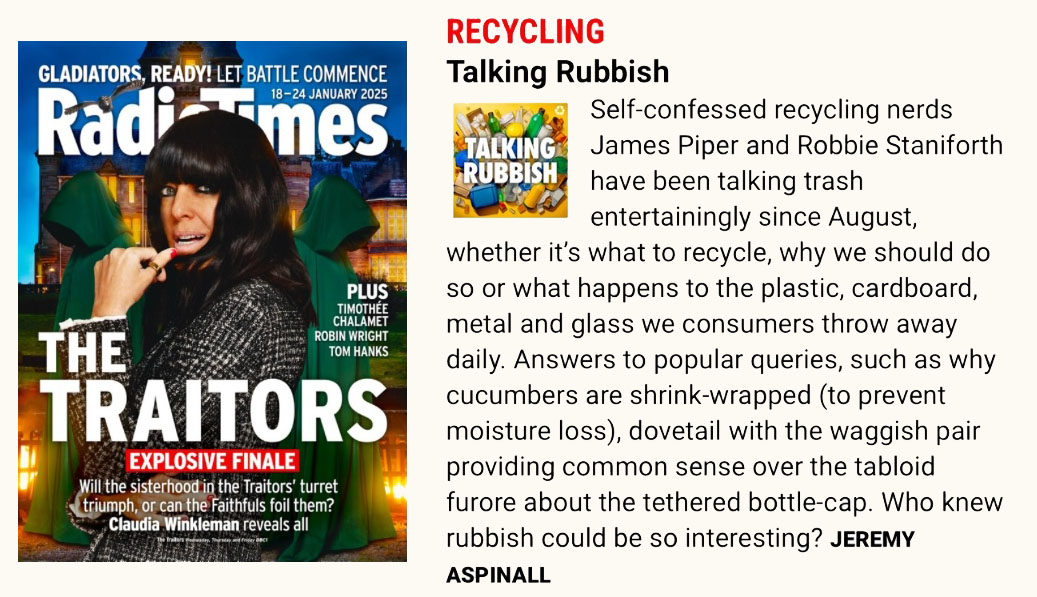
Join hosts James Piper and Robbie Staniforth as they delve into the world of recycling, hopefully having fun along the way. One thing is for sure, they will talk absolute rubbish from start to finish.
We are going to attempt a live recording of episode 100, on the 17th June at 7pm, get the link here...
Also, we would like to have an evening Talking Rubbish to celebrate the official release of our 100th episode. It will be in central Bristol on the evening of the 25th June, to let us know if you can make it, book your place on Eventbrite
Please take a moment to complete the Simpler Recycling tracker
We would love you to join our community on Discord
Special thanks to our sponsor, Ecosurety
To get exclusive videos and clips, follow us on Instagram, TikTok, Threads or Facebook; @rubbishpodcast or YouTube: @talkingrubbishpodcast
Or you can contact James and Robbie with questions or just general rubbish musings using the email address talkingrubbishpodcast@gmail.com or by texting them via WhatsApp on 07356 069 232
Relevant links and reports mentioned in the programme can be found on the Talking Rubbish Linktr.ee
Transcripts and episodes can be found on the Talking Rubbish website
Timestamps:
Should we ban plastic-free packaging? - 02:19
Additions and corrections - 29:19
Rubbish or Not: asbestos - 40:01
Rubbish News - 44:53
What do you do with "presents" from the cat? - 49:30
Residual Rubbish - 53:28
Music licence ID: 6WPY8Q4O2RPFIOTL
James Piper
Hello, welcome to Talking Rubbish, a weekly podcast delving deep into the world of recycling and discussing the truth behind snappy headlines and what we're cycling stories. In this episode, we will discuss whether the term plastic free should be banned. Is asbestos rubbish or not? And I have a question about how to recycle dead animals. I'm James Piper, author of the Rubbish Book, and I'm joined by Robbie Stanetfor. My bar from Rubbish Friend. Hi Robbie.
Robbie Staniforth
Hey James. Hello, how are you today? Hot, the truth be told. It's getting very warm in this booth.
James Piper
Very, very warm. Oh, in the booth. You mean not just I mean it is warm outside, but is it hotter in the booth than outside?
Robbie Staniforth
I think it's it's definitely transferring through to the recording studio here. Really?
James Piper
It's all about hot air you're speaking. All about smell.
Robbie Staniforth
It's about to get a lot hotter in here, sadly.
James Piper
My booth's nice and cool. I think we're sort of exposing. Are we 98 episodes in to people know we're in separate rooms? I'm not sure. Maybe that will change soon. Who knows? We'll we'll wait and see. Based on my intro, we're definitely dealing with the darker side of waste today, aren't we? We've got asbestos and dead animals. Yeah, not the most pleasant of topics. Yeah, I felt the need to get a bit more edgy for all those on social media who said I was too boring. I was like, this is it. I'm gonna. This is actually what happened to James Bond. Do you know this? No, what's it? Uh they filmed, I think would it have been the Living Daylights? I can't quite remember. There was a James Bond film that everyone said was really boring. So then the next James Bond film I did was license to kill, which is the only James Bond film that's a 15. And he's like quite drug fuelled, lots of sharks eating people. It's quite dramatic. And they just did this, you know, they got accused of being boring, and they went, We will create a super violent version of James Bond. Not sure it landed. So let's see how this episode lands.
Robbie Staniforth
So you're telling me when this post goes up on social media with you explaining or me explaining what to do with asbestos, you think people are gonna think that's really edgy, do you?
unknown
Yeah.
James Piper
This is just like license to kill.
SPEAKER_03
Trash talk.
James Piper
Our question today is should we ban the term plastic free? And this, I must admit, is a phrase I have disliked for quite some time. So I have thought about doing this trash talk, but um, it was actually an email from one of our influencers that floated it to the top. Um, I won't read the email because it'll spoil the punchline. But it is a but people do write in saying, look, plastic-free feels like it's misused. Could we do a bit of a deep dive into that? So that's what we're gonna do today.
Robbie Staniforth
I think the problem with this term plastic free is that quite often it doesn't actually mean plastic free. There is a type of plastic in the product that is invariably replacing a traditionally based plastic product. And so it's sort of a bit like a misonoma, and then that immediately makes one's blood boil because it's not technically accurate. I can see what they're trying to do, but the execution is slightly wrong, I sort of feel.
James Piper
Yeah, which i is why we have to start with trash talk, not talking about plastic free, we have to talk about bioplastic, which is actually something I really like, but it sort of l leads into the plastic free movement because lots of people, including brands, get confused between a bio-based plastic and a plastic that is truly plastic free. You get a lot of people saying, I used a plastic that was made from plants, therefore this is plastic free. What they were actually saying is this is fossil fuel free. And even that's not true because to grow the plants you have to use fossil fuel. But it's one step removed. So I I guess if you were kind of trying to market it, you could say, Look, this doesn't use a fossil fuel-based uh material to create the plastic. It doesn't use naphtha, it uses plants or seaweed or whatever it is. But there are very few that are truly plastic-free.
Robbie Staniforth
Okay, so what you're saying is that they should call it plastic that is not derived from a barrel of oil. That's ha that's what should be stamped on all of those products, is it?
James Piper
Subtitle, although a barrel of oil was used in the growth of this plant. But it's not as marketing friendly.
Robbie Staniforth
It's just not gonna get through a marketing team. It's not really got that pop. It's not got that snap we need.
James Piper
But it has created so much confusion because people believe that plastic-free is achievable in the main, and I think as we come into there are very few companies that could actually claim it. Let's discuss bioplastics and what they actually are. And even bioplastics is widely misunderstood. Bioplastic refers to the source of the plastic only. It has nothing to do with how you dispose of it. How you dispose of it is where we have terms like compostable or biodegradable, and as most influencers will know, we hate the term biodegradable. So really we only say compostable, which is a legally protected defined term in terms of how long something needs to break down, or bioplastic, which again is a largely protected term in terms of something that hasn't come from a fossil fuel-based material, petroleum-based material. But to be clear, some bioplastics do not degrade. BioPE, bioPET will not biodegrade. And equally there are fossil fuel-based plastics that do degrade. So you can't say, oh, because this plastic came from plants, it will degrade. That is not true. It has to be marked as compostable, but that is separate to the word bioplastics.
Robbie Staniforth
Okay, so already petroleum-based, that sounds like a better term, not petroleum-based. Is that a better version than plastic free? I don't I just think we should work in marketing, Robbie.
James Piper
We really missed a trick here. But yeah, they could be made of loads of things, sugarcane, corn, seaweeds, as we discussed before with like Nockplay and they're going to come up in this section. The problem with bioplastics is one of scale. So the market for bioplastics globally is forecast to grow. But those forecasts, if you look at studies, are like two and a half million tons in 2024 to nearly six million tons in 2029. Okay, so modest growth is almost double, or it's more than doubling, but compare that to 400 million tons of plastic coming onto the market that's petroleum-based. So bioplastics make up less than 1% of the market. And because fossil fuel plastic is forecast to grow faster than the bioplastic market, the percentage of our plastic that's bioplastic is actually going to get smaller over time.
Robbie Staniforth
And that's probably why these terms like plastic free have come up. Because it's a way of articulating that we want more bioplastics and that consumers like them, etc., and that there are certain applications where they can be used. So you can totally see why this plastic-free term came about. It's just that it's not quite accurate.
James Piper
Yeah, that's right. And it's a strong argument for having it because the market's so small. Why not let them have it? Why not let them have plastic-free? And it's sort of like, have you seen um is it vegan sausages? You can't call them sausages now. And oat milk, you can't call it milk. You know, there's all these things coming out of the EU, and lots of people say, you're just kicking the little guy. You know, you're you're taking these massive conglomerates of like dairy-based milk, and you're saying, um, you're saying, and you can't call your little oat company, niche oat company, oat milk. It's it does seem very unfair, and it's sort of a same with plastic free. It's like lots of people complained about it as a term when they had bioplastics, sort of spoiling where we're heading in this trash talk, but I think it's it's obvious where we're heading. Um lots of people got offended by people using this term because they're like bioplastics are plastics. And actually, this is such a small part of the market that I sort of wish people didn't care.
Robbie Staniforth
Yeah, but I think the problem is always that does it help or hinder not just the purchasing choice, so buying that particular product because it says plastic free, but the confusion it may then cause when it comes to disposing of it and discarding it. Because you're like, okay, this isn't plastic. Um what is it? And what am I supposed to do with it? And actually the instructions that need to be handed alongside the plastic-free label that can be any multitude of things and are actually quite complicated, and the kinds of things that we're finding ourselves discussing week after week, uh, and yet more confusion abones.
James Piper
So if we take an example, I looked at Knoppla, who have recently announced that they replaced 16 million single-use plastic units in 2025. Which is a huge quantity if you think about it. You know, this is a vast amount of material that they're replacing considering they're still sort of in that start-up mode. But the tonnage, if you turn that into tonnage, it's like 75 tons. I mean, we have such a long way to go when you consider we're talking about hundreds of millions of tons in the plastic market. And so I I love Knockplower and I what I love what they're doing. I think it's a really, really good product. But it is still niche and we need to keep growing it. And as Pierre said on episode 20, Pierre from Nockplower said, plastic has benefited from 150 years of investment all around the world. Trillions of dollars that have turned plastic from a petrochemical compound into the thing that we wrap around everything in our daily lives. So that's big bioplastic. So the summary of that is really plastic from plants. Which is probably the marketing term we should be using, actually. Oh yeah, that's much better. Plastic from plants. We did it. God, this is like watching a live design meeting, Robbie. Just not a very good one. I think marketing teams around the world will be impressed by what they determined. So let's move to plastic free, which is a term that doesn't really have an obvious start, unlike plastic for plants, which has all witnessed today. I bet it exists. I bet any money, it's actually really common. Someone messaged me the other day saying my buy less, buy best is eerily similar to similar to the tagline that the NHS supply chain uses, which is buy less, buy better, buy different. What do they mean?
Robbie Staniforth
I think that could apply though, because you're saying like buy different, as in don't just buy the standard product that's easy containing palm oil in the circumstance you used it, wasn't it? So maybe it's directly applicable.
James Piper
So when I go in for like an injection and they pull out a water gun and go, this is how we're getting it in, we're buying different. That's our policy. This is this is a good thing, isn't it? Anyway, we're completely off track. Sorry.
Robbie Staniforth
I'm sorry your blood bag is a crisp packet, but we decided to just buy different.
James Piper
Right, we're completely off track, Robin. Let's get back to plastic-free. So arguably it became popular from an environmental campaign group in Western Australia in 2011, and they were encouraging people to go plastic free for a month. And I think it's plastic free July. So to find out something is plastic free, I guess we first have to ask, what is plastic? And very helpfully, this is defined by the Single Use Plastic Directive, which was adopted in 2019 across the EU, I believe, the single use plastic directive. It's sort of the framework, isn't it, for the other stuff that's coming like EPR, PPWR. They all link back to the Single Use Plastic Directive, which is about banning single-use plastic products and making market restrictions, consumer reductions, marking, all those kind of things. But what it helpfully does is define plastic.
Robbie Staniforth
That's exactly right. And really the protected term or definition is a material consisting of a polymer to which additives or other substance may have been added and which can function as a main structural component of packaging. Under the single-use plastics directive, the legal definition is actually a lot broader than what most consumers think of a plastic definition as.
James Piper
And this keeps getting companies into trouble. So it got Ocean Saver into trouble last year. Do you remember this one? This was again the like big guys versus little guys story. People were very defensive of Ocean Saber because they put out ads that said plastic free. And the ASA received a complaint from Ecova. And that this was because the laundry capsules and dishwasher tablets contained PVOH. We've talked about PVOH before, it's a it is a type of plastic, it's the stuff you get wrapped around those tablets. And there are some studies that say because it just dissolves, it's not classed legally as a microplastic when it breaks down. So the argument is, well, if it's not classed as a microplastic when it breaks down, it can't be classed as a plastic. Before it breaks down. Yeah, exactly. That was their argument. Uh but they're but the ASA did actually side with ECOVA and said, look, you're not allowed to broadcast this ad again. And I remember everyone was so angry about this because they were like, Ocean Saver is so small and they're trying to do the right thing. ECOVRA are the bad guys that are owned by SC Johnson. But I'm gonna be honest, in this instance, I'm with the ASA. We have to protect these terms. And we it's a slippery slope. If they allow OceanSaver to say PVOH is plastic free, that means ECOVA can do it too, and everyone else. And so you've got to keep these terms protected. And there's loads more. I went through the ASA looking for plastic-free examples. I found Abnormal and Nutrition Drinks Company. They said plastic-free in their ads, but actually they had a plastic liner to stop moisture getting out, I think. Bambooe was a toothbrush company who said no plastic in their ads, but they did actually have bioplastic. They also got in trouble as their ads were saying 100% plant-based materials. The ASA helpfully pointing out that the battery probably didn't meet the 100% plant-based promise.
Robbie Staniforth
Yeah, that's ridiculous.
James Piper
Although I guess, you know, as a kid, you would have made a potato battery, wouldn't you? Absolutely. Would you do that? Or a lemon battery? A lemon, yeah, that's right. Yeah. I don't think it's going to power your toothbrush for very long. Really long-winded way of getting to this really, really important point, which is that plastic free is all about whether you have chemically altered a product. And there are not many plastics that have not been chemically altered. And again, back in episode 20, which was Pierre from Knoppla, he said through hundreds and hundreds of materials that were analyzed, Knopla was the first and only solution to have no chemical modification and therefore no plastic in it. Now, since then, Knopla have actually set up a group called the Natural Polymers Group, and that has gathered the companies who we believe don't chemically alter the packaging. The members of this group are Knoppla, Lolyware, Traceless, Plant C, Marina Tech, Zero Circle, and Sampler. Could be Exampler. We're not entirely sure. It's X A-M-P-L-A. I should have asked them this.
Robbie Staniforth
I'm pretty certain it's Zampler.
James Piper
Okay, so I reach Okay, great. I reached out to Zampler and got some detail from their CTO Mark, not on how to pronounce their name, just purely on their product. And Mark said some of the highest performing materials that we have are made in nature. So if we think about things like cotton, rubber, paper, and advances in processing technologies are enabling companies to take natural materials further and essentially create things that can replace single-use plastics. One of the main barriers for that to be commercially viable is cost. Traditionally, it's more expensive than fossil or bio-based plastics. It's difficult to be compatible with existing manufacturing processes. So we've talked before about how plastic uses extrusion in its manufacture, but natural polymers are already there. You've got to use them as a coating rather than an extruded product. And performance has been an issue, although I think that has been largely resolved, as can as has been proven by the likes of Knopla. Sabla have developed technology to process natural polymers to be able to deliver the barrier performance in packaging that's needed to protect against things like grease, water, heat sealing. And they don't, as I said at the start, they don't need to chemically modify to deliver that, which is amazing. And at a large enough scale, they can start being quite close in cost, if not complete cost parity with traditional plastic. So cost has started to go away, but at large scale, which is quite important. Zampler said as part of our manufacturing process, our materials are not chemically modified. And they explicitly are excluded from the definition of plastic according to the EU single-use plastics directive, which is what we've been talking about. They partnered with the National Physical Laboratory to validate that the materials were not chemically modified as part of the manufacturing process. But there isn't, and this was quite interesting. Mark was saying there isn't a recognised standard to test whether a material can be certified as plastic free. Even though these is it seven companies all produce a product that isn't chemically modified, they've all kind of done their own test to say we don't think this meets the definition of the single-use plastics directive because we're not chemically modifying them. There's actually no one who's officially created a standard around that. And they're looking to develop that, I think. I think that'll be partly what this natural polymers group does, because they're going to want a standard that people can comply with.
Robbie Staniforth
Well, it's very instructive that they've called themselves the natural polymers group rather than the plastics-free, plastics-free barrier coatings group. You know, they they had a choice about what to call themselves, and it's actually that unmodified, uh not chemically altered bit that they're sort of focusing in on and saying these are natural polymers rather than, you know, the term plastic-free. And and they are very close to this, aren't they? So they will know, as Zamplo have said, it's just hard to say what's plastic free because there just isn't a standardized test for it.
James Piper
One organization I think does really well on this is VegWare. I think they're really honest, which I ri which I like. You know, we like anything that's honest. And on their website, they have a page called Why Vegware Don't Say Plastic Free.
Robbie Staniforth
Okay, so you've been cheating on your homework here. You're just gonna roll off all of this. Or is that your homework? Maybe that is your homework, actually. I'm being unfair.
James Piper
But that's exactly what I do. My job is just go to websites, read, share it with you guys on a weekly basis. I don't know what else you expect from me, Robbie.
Robbie Staniforth
I mean, this is particularly answering the question that we're asking this week exactly.
James Piper
It's true, and I sort of wish I'd put it at the top. So, why vegweb don't say plastic free? And this is what they say. As demand for more sustainable items grows, so too does the inevitability that some of the claims associated with these products will be dubious. The easiest way to define plastic is made from polymers. This means the definition of plastic is wide-ranging. Not only does it include oil-based traditional plastic, but also plant-based compostable materials such as PLA. We've all seen increasing use of the term plastic-free in food service products such as cups and cartons. And then they go on to say that, you know, essentially with like an aqueous coating, you're mixing the plastic and essentially painting it on the cup. So it sort of feels like it's not there because it's in such small quantities, people feel like they don't have to acknowledge it's there. But we should recognise that even just a small bit of plastic to create the liner still stops your cup being plastic free. And they end with this is why we don't use the term plastic free for any product containing even a small amount of polymer in a water-based coating.
Robbie Staniforth
From their point of view, the easiest way to define plastic is made from polymers. And therefore, if it's got even a little bit of it, it's made from polymers. Ergo, not plastic free.
James Piper
And I think plastic-free, for me, where the confusion really stemmed in the UK was in 2018 because there was a trust mark created by Plastic Planet, who's an organization that want people to move away from plastic. And they created a trust mark which just had the words plastic free. And I'll make sure I put this on our social media and it's in it'll be in our stories so that you can see the logo. And Sean Sutherland from A Plastic Planet said, Our trust mark cuts through the confusion of symbols and labels and tells you just one thing. This packaging is plastic free and therefore guilt-free. Finally, shoppers can be part of the solution, not the problem. Now, this is where I get frustrated because when they announced it, they said the trust marker accredited packaging will include materials such as carton board, wood pulp, glass, metal, and certified compostable biomaterials. So they did not distinguish between this chemical altering. Now that is because they released the trust mark before the single-use plastics directive. And there were a couple of companies that took it up straight away, a couple of organizations. Certainly Iceland, the supermarket, were quite big on it at the start because they were trying to move everything away from plastic. Tea brand, Tea Pigs, had it on their packaging and two farmers' crisps.
Robbie Staniforth
Ah, that's definitely where I've seen it.
James Piper
It was actually quite interesting because I remember photographing our episode artwork for episode 19, which was our first compostable plastic. Episode and to do that, I took a photo of a pack of two farmers' crisps from a sandwich shop. And I had a look at my camera role last night and the plastic-free logo was there. But this morning on my walk in, I went into the same shop to find their two farmers' crisps, and that plastic-free logo has now been removed. Oh, okay. And this will be a common theme. So in 2018, a trust mark was created that said plastic free. Since then, the EU have said, no, no, you can't say things are plastic free unless they're not chemically altered. And so lots of companies have had to backtrack and remove the label because what they've got actually is plastic, even though early in their marketing they were saying it's plastic free.
Robbie Staniforth
Okay, so some of these advertising standards authority rulings have kind of trickled through industry, probably, and people are being a bit more cautious.
James Piper
The trouble with all this stuff is the legacy still exists. So I went on Two Farmers Crisps website just as an example. And I think these guys are good, by the way. They make compostable crisp packs. I'm not trying to slight them at all. I think they do a really good thing. But you can see what's happened. So their blog, they've got an older blog that says our crisp packets are 100% plastic free and compostable. And then when you Google AI it, Google AI is pulling from that blog and saying Two Farmers is the UK's first 100% plastic-free crisp brand. So even though they've removed the logo out in the wild and they don't talk about it anymore, that legacy still exists. The place I saw this the most was actually teabags, because I spent I went down this absolutely mad teabag rabbit hole last night. Because I Googled plastic free teabags. And then Google AI did like a summary of top plastic-free brands. And one of those top plastic-free brands was Clipper. And then in the description, it said known for their organic fair trade teas, their standard tea bags use plant-based bioplastics in brackets PLA and are 100% biodegradable in food waste bins. So they'd come up in this list of plastic free, but in that list, they're saying it's made of PLA. So it is not plastic free in the definition that we're talking about. So you go to their website, this is Clipper's website, and there's a heading, there's like an FAQ section. It says, Are our tea bags plastic free?
Robbie Staniforth
Okay, here we go.
James Piper
Exactly. They responded. So they were very different to vegware. They responded saying, at Clipper, we've always set out to do the right thing for both people and planet. In 2018, we were the world's first tea company to make all our heat sealed tea bags unbleached, non-GM, plant-based, and fully biodegradable. Clipper teabags are sealed with a non-GM biomaterial made from plant cellulose, known as PLA, also known as bioplastic. PLA is made from biomaterial, it's fully degradable and nothing like the damaging oil-based plastics that people are rightfully concerned about. If you want to make a choice that's better for the planet, then switch to a plant-based biodegradable teabag sealed with PLA. And PLAs are plastic.
unknown
I know.
James Piper
Nowhere in that does it say yes or no to the question, are our teabags plastic free? They give the longest answer. And it's sort of with logos and it's even longer than what I've just read out. I found that amazing. What a like the marketing team has clearly been tasked with, we're going to ask the question, are our teabags plastic free? And someone's gone, no, actually, they've got lots of plastic in them. It's called PLA. And under VEU, it's definitely plastic. Oh well, if we write like a really, really long answer that people have to scrape, we never actually answer the question. Do you think anyone's going to notice? Well, I did, Clipper. And I'm writing to you to tell you I noticed, and I really, really need you to answer the question that you set out in your heading.
Robbie Staniforth
But it to be charitable to them. No.
James Piper
That is not what this podcast is about. This podcast is about getting to the truth behind the snappy headlines. And if your snappy headline is a question, you need to answer the question.
Robbie Staniforth
No, that that's true. They shouldn't have posed it as a yes-no thing. They should have had the question as being something like, to what degree is there plastic in teabags?
James Piper
No, they should have been like Vegware and said, why we think our teabags contain plastics or why we don't say plastic-free. Or, you know, there's a big difference. This is actually like quite an interesting debate, isn't it? There's a big difference between Vegware who call out the issue and say this is a big issue, and a company that raises the question then never answers the question. But the answer they give is sort of makes you feel good about it. The answer they give makes you, as a layperson, think, well, they're definitely plastic free because look how long the answer is.
Robbie Staniforth
No, it's it's it's a good word soup, to be honest. Unbleached, plant-based, biodegradable, non-GM, biomaterial, not oil-based plastics. It's PLA. It's it's got it all in there, hasn't it?
James Piper
Clipper clipped that answer. Now just to be clear, I don't think Clipper ever used the trust mark, the plastic-free trust mark. This is just a criticism of their website and communications in terms of creating a question on your FAQs that you then don't answer. And the answer you give is it gives an illusion that you are answering it.
Robbie Staniforth
Yeah, and it's not really about the trademark itself. It's more free from plastic, no plastic inside. Uh it's those terms that we're thinking, hmm, should they really be used because they're not very accurate?
James Piper
To wrap this trash talk up or to attempt to wrap it up, I think one thing that is worth mentioning is I think large brands have learnt from the EU really defining what plastic is. It is actually smaller brands and startups coming into the market that are trying to claim plastic free when it doesn't really exist in the way they're imagining. And if they are truly plastic free, they should look at joining this natural polymers group because then that's a clear kind of point for everyone to gather and say we are the companies that aren't chemically altering our plastic. Everyone else who's just using PLA or a bio-based plastic has to recognise that a bio-based plastic is the same chemically as a petroleum-based plastic has not dissimilar impacts on the planet because you're having to use land and grow the plants. I I just think we have to be really careful with these terms, and particularly plastic-free. So I wouldn't, and just to answer the question of a trash talk, I'm not sure I would ban it, but I certainly would restrict it to a very, very specific use case, which is what the EU agrees with, people not chemically altering their plastic. Now it is a really good example of where brands were so keen to say something positive, as it's exampled by Clipper, that they decided to market themselves in a certain way, and they actually didn't understand what they were saying. And the EU has now come along, cleared it up, but in my view, potentially a little bit too late, because there's definitely a lot of confusion out there. You still see products from startups coming to markets all the time that say plastic free. I mean, how many times have we been to a material innovation conference, Robbie, plastered all over it is I'm plastic free, this is plastic free. And you just have one conversation, you realize, no, no, you're not in that group. You are chemically altering a plant to make plastic. It is plastic legally, and therefore you have to be really careful with your words. And ultimately, plastic free stopped being a scientific description and has become a bit of a marketing feeling. And so consumers hear it and imagine something natural, harmless, guilt-free. I mean, literally, Sean used those words, didn't she? It allows us to shop guilt-free. But legally, scientifically, and chemically, this is not what is being sold to us. Additions and corrections. Today I have some more deposit return scheme editions. Or just one actually. We did loads in episode 94, didn't we? The passion everyone has for deposit return schemes, it is it's big. People love talking about it, either positively or negatively.
Robbie Staniforth
And as the deadline comes up, they're only gonna be talking about it more.
James Piper
Yeah, like simpler recycling. No one talked about simpler recycling, and then suddenly it was like the BBC had a day on it, and everyone was talking about it for like a month. And that is definitely what's gonna happen here. So coming up to October 27, oh my goodness, we're gonna be we're gonna be swamped.
Robbie Staniforth
We're gonna have to earmark it in our diaries, I think.
James Piper
Anyway, we had an Insta message from someone who wants to remain anonymous. They make canned coffee, but they used plant-based milks.
Robbie Staniforth
Can't say plant-based milk, James.
James Piper
They use plant-based uh white drink, oat and cashew, from what I can see on their website. Now, in Ireland, where we were talking about uh DRS back in episode 91, they exclude dairy products from DRS. So they say if your product is dairy, you are not in DRS. That does not include plant-based white drinks. So that means they're in scope for DRS. So this is really important because they make canned coffee and they've chosen to use plant-based milks or white. I can't do it. I'm just gonna say plant-based milk. Everyone knows what I mean. But their competitors who make canned coffee, and this is like Starbucks and Costa, you know, there's canned coffees.
unknown
Yeah.
James Piper
They are excluded from DRS. I mean, surely over in Ireland, there must be a drinks company that's at least a little bit tempted to add a little bit of milk extract to their drink to then go, I'm excluded from DRS. Surely. There must be somebody who's thinking this is a good idea. This guy, for very obvious reasons, was quite angry because he's like, my direct competitors, the people who buy my drink, my direct competitors do not have to pay the fees that I have to pay and do not have to charge a deposit when they when they buy and sell their drinks. Now, the reason they exclude dairy, typically, from things like DRS, is because it makes everything a bit trickier in terms of cleaning and smells and the machines get a bit grim. But this guy was emailing saying, yeah, but our product's gonna smell as well. It's too it's gonna cause the same problems as dairy milk. So I I completely get the frustration. Now we actually don't have this in the UK because we do exclude most milk, but we do it in a different way. So in the UK, the way they've designed DRS is they've said it's just PET bottles and most of our milk comes in HTPE. Automatically the milk is not excluded. But they've done it by dictating the material type, which means that HIT in the UK, I believe, unless Robbie tells me otherwise, I believe that cans of coffee with milk, so the ones that you can buy that are Starbucks and Costa branded, will be in scope for DRS in the UK.
Robbie Staniforth
That's right. It'll all be in scope of DRS. There is no milk or milk-based products exemption. And remember, most of these plant-based alternatives are also in liquid carton board most often, and those aren't in DRS either. So what you'll find in the UK is that all actual milks and alternative milks will be out because of the material that they're generally sold in, and the ones that will be in, the coffees, whether it's milk or milk substitute, will all be in because they mostly come, I believe, in aluminium cans.
James Piper
And the other addition we have is related to the very, very hot weather we've had recently and the heat waves. Robbie, how's your room doing? Are you okay?
Robbie Staniforth
I've normalized to it actually, I must say. It's not getting any hotter with all this hot air I'm talking.
James Piper
Okay, very good. So this was about paperization and it continuing. And this was Lottie Link on Discord sharing a picture of the Garnier Umbra Solaire. Have I said that correctly?
Robbie Staniforth
Oh, yes. Yeah, I'm looking at this picture. Very interesting.
James Piper
So it's a plastic sun cream tube, you know, the kind you get where you squeeze the sun cream out, so it's like a flexible tube.
Robbie Staniforth
It's not plastic free, I can tell you that much.
James Piper
It's definitely not plastic free. At the top, it says the tube is integrated with 29% cardboard, which has reduced the plastic in the tube. Here's the problem: you've mixed plastic and cardboard and created something that is unrecyclable. So on the back, it says just put it in your household bin.
Robbie Staniforth
What? But those are like really similar to the toothpaste uh tubes that could be recycled if it was all plastic, isn't it?
James Piper
I think if you just had a plastic one, it would be recyclable, but because you've decided to reduce the plastic and mix some paper somehow into it. And I tried to get one of these because I want to understand how they've done it. It is it like a paper outer with a plastic inner, like a wine box, or I can't quite work out. I haven't managed to get one. I I went to the shops uh just before recording to see if I could find it, but I haven't been able to. So maybe I'll have to addition this addition with what it's actually made of. But certainly on the back of the products it said just household bin. Uh they shared with us that picture. Whereas the plastic counterparts say recyclable. And so when we go to my paperization rules, remember we came up with those a while back? We discussed uh having high recycle content, uh, light weighting, whether that would be a reason to move to paper. But one of the key ones was can it be recycled? And if you're moving from recyclable plastic to unrecyclable plastic paper mix, I just don't think that should be allowed. We'd like to take a moment to thank our sponsor, EcoSurety, who are on a mission to rid the world of unnecessary packaging. They help brands navigate the tricky world of extended producer responsibility, but that is not all. They also collaborate on some incredible recycling projects and consumer awareness campaigns for those tough to recycle materials. If you're an organization looking to make smarter packaging choices, check them out at ecosurety.com. And the best thing you can do to help our podcast grow is to tell your friends and family about it and to also leave us a review.
Robbie Staniforth
And if you leave us a review, you could be Robbie's review of the week. So this one comes in on Apple, a five-star review. Thank you very much to Boo and Green. Yeah, I'm going with that. Boo it's B-U-E. Bue? Bu and Bu and Green. That one's gone straight over my head if that's supposed to be something other than Blue.
James Piper
I don't want to I've done this before. Do you remember? I said there was um one that was like Heathy, and I said, Oh, surely they mean healthy. I can't remember what the Heathy and something, and healthy would have made sense. And then the guy emailed me going, Heathy's my surname. I'm gonna stop talking about review names. Because this could be Bue, like their name is Bue, and then they're green, Bew and Green. That would work. So if we now suggest this should be Blue, I guarantee I'm gonna get an email from Jenny Buzz. No, no, that's my name.
Robbie Staniforth
Okay, well, it's coming from Bue and Green. Superb pod, the informative and easy listening. V, presumably, very.
James Piper
It could be anything. Do not assume, Robbie, it could be. I'll get emails. I haven't got the time. It could be anything.
SPEAKER_00
I'm binging. Bing jing. That is very good.
James Piper
That is good. Yeah, we haven't. Have we had a binging? I don't think we have. I don't think we have a binging. It's great. Yeah. Thank you, Mr.
Robbie Staniforth
or Mrs. Bu. I'm binging this pod on holiday and loving it. It's so much more interesting than you would think. Loads of info about waste. What happens to it and how to reduce producing it in the first place by two knowledgeable and easy to listen to guys. Not preachy, just very interesting and easy listening. I will sort my waste and share knowledge better as a result of listening. Highly recommend. Thanks, guys. That's very nice.
James Piper
I really like easy to listen to guys. You know when you listen back to your own voice, you're like, I hate my voice. Then occasionally we get a message. I mean, I'm not sure this is what you means from easy to listen. But we did get a message from someone who says they listen to us on a plane because they get anxious on planes and they're very they're calmed by our voice. Not your laugh. Your laugh causes like immediate worry. Yeah, yeah, yeah. But um but our voices are very calming, and that's great.
Robbie Staniforth
So as soon as we put it on, it's like that's why me's eh. That's what they're hearing. Is that what we think?
James Piper
That's it. Super chilled. And you can follow us on social media at rubbishpodcast. You can email talkingrubbishpodcast at gmail.com, or you can WhatsApp us. Also join our Discord. It's the easiest way to engage with us and listeners of the show. And the link to all of those things is in the show notes. Do you think that's how I should do it? Just a reminder, we're on episode 98. I need to explain that now because that was so funny. Right. So guys, I have a camera, and this has happened a few times where if I form like an L shape with my fingers, the camera zooms in. So as I said, we're on episode 98. The camera just zoomed right into my face. Probably made that noise hilarious. I've managed to zoom it out, fortunately. But it is disconcerting every time that happens. It was like that dramatic zoom in. It was great. Okay, so we're on episode 98, which means we are only two episodes away from episode 100, which is just unbelievable. I can't believe we're there. And we have two events going on, so I just wanted to remind you guys. So we're going to try and, for various confusing reasons, record episode 100 before episode 99 is released, mainly due to Robbie's availability, I believe. So that's going to be on the 17th of June at 7 p.m. We are going live and there will be a live stream, and in the show notes to this episode, you will be able to find the link to that if you want to join us for that. And you don't need to go anywhere for that. That's just a live stream online. You can watch that from your own home. If you want to venture out to the house and see us, then on the day that episode is properly released, which is the 25th of June, the evening of the 25th of June, we're going to get together somewhere in central Bristol. So the link to both of those things is in the show notes. And we would love you to join our live stream and watch us record live. And then we would love you to celebrate episode 100 when that actually goes out as an episode. Rubbish or not? Rubbish or not today is asbestos. And this comes from a message from James on our website. So thank you very much, James. He did not reference it as a rubbish or not. You know, he had actually a story to tell us about asbestos, which I'm going to come on to. But it's pretty easy to turn it into a rubbish or not and probably sets us up for the story. So, Robbie, before we get into the detail, asbestos. Rubbish or not?
Robbie Staniforth
Can I possibly get this wrong? It is definitely not recyclable. Do not put it in your recycling at home. Now that does make me think, what should you actually do with it? Because whenever anyone mentions asbestos, all I ever hear is don't disturb it. Get professionals out. Don't touch it. Don't even look at it. I must say, I don't know exactly what one should be doing with it because it's very, very hazardous when you move it. So I presume specialist people need to be disposing of this stuff.
James Piper
Yeah, although sometimes you come across it in your everyday life. Oh, we had a new roof put on our house, and the reefers were not great. And a tile fell off quite early on after they'd finished. So anyway, got it fixed, got it repaired. Then I noticed another tile on the floor. I went to pick it up and I thought, that's asbestos. That is not, that's not come from my roof. And to this day, I still don't know how it got there. But there is this little tile, or there was this little tile of asbestos in my garden. And I had it checked actually because we were doing some more building works. We had some a person came over to do an asbestos survey and he said, Yep, you got some asbestos in your garden. Just randomly appeared. So uh double bagged it and took it to the local recycling centre. So there are times in your life where you will have to deal with asbestos yourself, and the best thing to do is to use gloves and masks and always make sure you double bag and then make sure you put the gloves and the mask in the bag as well. Um and you want to be sealing that up because this stuff can be extremely dangerous if disturbed. So it shouldn't go in your general bin, it shouldn't go in your recycling bin, it should go back to a recycling center where they will have an asbestos bin for it. Now, this is one of those that it's a hazardous substance, so you're not really allowed to transport it because you need to be a hazardous waste carrier to transport that sort of stuff. So the way they deal with that is, uh, and we talked about it a little bit on a previous episode, it's not considered hazardous till you arrive at the recycling center. So it's sort of you crossing the threshold of I'm in the recycling centre, but it then becomes hazardous as you hand it over. And so what most councils want you to do is ring the recycling center first to say, do you have space in your asbestos bin? Because if you arrive and then leave with it, that is bad. They don't want you to have to do that. The best thing to do, check your council website, but most council websites will say, ring us first, make sure we've got some space in the bin, make sure you've double bagged it, you've used gloves, mask. And this is assuming you found some asbestos somewhere, you know, that you wanted to deal with. This isn't like my house has lots of asbestos in. Don't deal with that yourself. Get a professional out for that. But if, like me, you've just found some in your garden, which is what happened to me, or maybe you've come across some in Elitpic or something like that, you can obviously report it to the council, definitely. But if you wanted to deal with it yourself, that is how you would manage it. So this leads us into Dunelm, which is the story that James has shared with us. And they lead our new feature called Nonsensical Corporate Behaviour of the Week. Because what they have done is identified that doorstops sold between 2019 and 2026 might contain asbestos. So these doorstops have sand in them, and in that sand there might be asbestos.
Robbie Staniforth
Oh, that's what the weight of the doorstop comes from. It's like filled with sand.
James Piper
And these doorstops are shaped like animals. Things like uh they what were they named? Like Hamish the toxic cow. No, that can't be right. Hamish the high. Cow. And on the recall part of their website, if you go to their website, there's a recall page. If you look at that, they say these door stops could contain asbestos. So here's the advice they give. If the product is undamaged, place it in a heavy duty plastic bag and double tape. If the product is damaged, gather the sand using wet cloths. Now, this is the advice normally use wet cloths to stop dust coming up. Wear gloves and a mask, double bag the sand in a heavy duty plastic bag, double tape, and seal it with the gloves, mask, and cloths inside. So far, so good.
Robbie Staniforth
Okay. That sounds similar to what you were saying earlier. Yep.
James Piper
Next point. Dispose of the sealed bag in your general household waste bin. Oh dear. Unbelievable. Absolutely unbelievable. So I've got their phone number. They've said, call us if you've got any questions about this. Well, I have lots of questions. And then you're about to hear from me. Rubbish news. So to bring me up, the EA has published a list of 117 high-risk illegal waste sites, 28 of them super sites with more than 20,000 tons. Oh no. The largest site is 281,000 tonnes of contaminated soil in Northwich. Now to put this in Bristolian, that is over 62 Clifton suspension bridges, including the stone towers.
Robbie Staniforth
Oh my word. Does that help? That's a lot of material. Yeah, I mean, it's a lot.
James Piper
Now, because a lot of these are active cases, the EA can't give much more information on this. But uh Philip Duffy, who's the chief executive of the EA, did say publishing this watch list is a deliberate act of transparency. Communities need to know that we're acting, and we want those committing these crimes to know that we're coming for them. Now, thank you, Philip, but we do need to do more than publish a list. And I'm gonna say that when we then prosecute these companies, or people, I think we should do a bit more than we are doing, because I have an example of how woeful all of this is. So there was an organization called DTM Grabhire, who was found to have illegally deposited thousands of tons of waste on a flood plain in South Devon. So it's nearly 4,000 tons of waste from memory. Their fine for dumping almost 4,000 tons of waste was £16,664. They paid £4.77 a ton in fines. Oh no. That's what, like a meal deal? A ton. So imagine that when you're buying your £4.50, £5 meal deal, you could, if you illegally dump something, get rid of a ton of waste for that price.
Robbie Staniforth
That is crazy. But surely it cost them more than £16,000 to clean up this whole thing.
James Piper
Well, it's funny you should say that, Robbie, because the cost of the cleanup was two and a half million pounds.
SPEAKER_03
What?
James Piper
That's an expensive meal deal. Now that is £716.33 per ton. Well, I really hope they learnt their lesson, DTM grab hire. You know. Absolutely not. We talked about fly tipping a lot, we've talked about illegal waste sites, but until the punishments match the crime and particularly the cost of cleanup, because bear in mind these guys have profited, right? They're they're dealing with waste, they're getting rid of it, they're definitely charging them a landfill tax. A lot of this is construction waste. So they're going to be charging a landfill tax of 100 and whatever it is a ton. And then they're getting fined, in this instance, £4.77.
Robbie Staniforth
Unfortunately, my rubbish news isn't much better. I didn't realise you were going to be doing that one. It's a story that came from The Independent, and uh it's following the recent bank holiday hot weather. It's a bit of a theme, um, us overheating here. The headline basically is Bournemouth Beach buried in rubbish after bank holiday heat wave crowds. So tens of thousands of people, every time there's these heat waves, uh, flock to beaches like Bournemouth's. Uh, this was actually the late May bank holiday. And so swimmers and sunbathers there. But despite there being over 300 bins on the seafront, so it's not like they don't think about this and try to provide some infrastructure. Even though they were there, they literally weren't enough. So these bins were overflowing. It's not that people hadn't used the bins, it's just that the council simply can't provide enough waste management for this peak time when there's tens of thousands of people there. And the list of things that were littered or fly tipped, depending on your definition, thousands of plastic cups and bottles, uh, thousands of beer cans, takeaway boxes, broken camping chairs, inflatable toys, discarded barbecues. And so the council had to deploy tractors. Fortunately, not diggers, James. They didn't have to dig up the rubbish, but they had to deploy tractors uh to clean up the beach. And so this was one of those things where it's just like, please, please, please, people, take your rubbish home with you. You found a way to get whatever it is to the beach. This logic runs that you can find the same way, probably, to take it off the beach and discard it somewhere more appropriate than just leaving it on, you know, a night uh a site of natural beauty. And if you don't know what to do with those things, why not write in for a rubbish or not? And we'll tell you a much better way to dispose of it than just leaving it on the beach.
James Piper
This was Lottie Link on Discord for the second time in one episode. This is how you get named twice. You do sun cream and dead animals. Lottie Link said, I hate to ask, so if you're sensitive, you might want to look away now, or in our influencer's case, skip ahead a bit. But now food waste is being taken out of our green bins, and which included meat and cooked food previously. They thought they would ask. My partner's cat is a prolific hunter, and he's on restricted outside hours now because of it, but sometimes still kills something and brings it home. And my partner puts the dead thing in the green garden bin, which I obviously hate as a sensitive sobbing about dead animal animal sort of person, but I want to check if that's actually okay. Because if it's not, then getting new, I think, food waste bins is a good time to change it.
Robbie Staniforth
I think first of all, surely it's you shouldn't be putting this in your garden waste, should you?
James Piper
It certainly stirred up a debate on Discord. I would say it's 50-50. I mean, look, where are we? So it's a dead animal, and you're putting a dead animal in your food waste if you eat meat. So what's the difference? And I can I get it, like I get that. And when I asked Ellie, she said, yeah, I think you could probably put um like a dead bird or something, your cat's brought in in the food waste bin. And so it does stir up debate, and I think people don't really understand the difference. Just to be clear, we're not talking about pets here, we're just talking about wild animals. Pets, if they die, obviously you're gonna maybe bury them in your garden or contact a vet, have a cremation, or whatever it is. So pets are different. This is wild animals. Now I was wondering if any council actually covered this on their website. So thank you to Northeast Derbyshire District Council, who actually said dead animals do not qualify as food waste.
Robbie Staniforth
Oh, well, there we go. There we have it.
James Piper
Even worse, they say if you do put it in your food waste and our operatives recognise it as a contaminated item, they will make you remove the contaminated item before they take the bin. So I can't imagine anything worse than getting a weak old squirrel out of your food waste bin. So, like the tea, I went down a very, well, I'm gonna say a live rabbit hole in this case, but um I went down a rabbit hole because if you dispose of dead animals, you have to make sure the disposal complies with the requirements of the animal byproducts regulations. Now, this came up a little bit on our aeroplane episode, which was episode 63, when we talked about the waste coming off a plane and the categories of risk that exist in waste. So without wishing to get into the detail on all this, there are three categories of risk in terms of animals and dead animals. There's high risk material, which is category two, and I think that's what this is, because this is not the highest risk category, which is where you get things like um, you know, you have a disease through your flock or something like that. That would be the highest risk category. It's also the stuff that is uh on the plane, we said that was the highest risk. But it's not low risk, which is the stuff we buy in the supermarket. So they've got like low, high, very high risk. And if you remember, we said don't compost dog poo, for example, because it might contain bacteria. Well, it's going to be similar with dead wild animals. There's a risk that they contain bacteria. So if you were to create compost out of it, that compost could be hazardous. So I actually think you are okay to put dead animals in the general bin, but you should check locally. So Northeast Lincolnshire said any dead animals, such as foxes, squirrels, etc., that are found in gardens can be placed in a black bag and placed in the normal general bin. Please ensure you always use gloves when picking up dead animals or birds. That's good advice. But yes, they can all go in your domestic bin. Uh Moira on Discord probably most closely aligns with my views. Definitely don't put it in the garden bin. We put any unfortunate mice that don't get away from the cat in time in the general waste as it will be incinerated, and I like to think of that as cremation. Residual rubbish. This is something that has happened to us this week that has made us feel like an emoji. I promised two episodes ago that I would infiltrate my local litter picking group, and I have now done so. Ah, very good. Yes, I went out for a two-hour litter pick with them on Sunday, and I'm now a proud owner of a very professional litter picker and like one of those hoops that go round the bag. Honestly, I'm I'm geared up for proper litter picking now. It was very productive. We had a park to clear, and you know, at the end of the two hours, this park's completely clear. It was really, really cool. And it was very hot during the heat wave, but we did fill about 12 big bags of rubbish just from one part. I tried to keep a log of all the stuff that's DRS-able in the two bags I filled. So I picked up 31 aluminium cans and 30 plastic bottles, so actually very similar. This was on top of five glass bottles, four tetracartons, and two buzzballs, Robbie. Boo. Only one vape, which I thought was quite good. I expected more in the park. One thing that was slightly frustrating is they don't recycle stuff. So I'm mixing into my bag, you know, things that I know could be recycled. And I did say to them, have you thought about pairing up and one of you doing recycling and one of you doing general? And they said that actually they didn't feel the bottles and cans would be high enough quality for recycling. Now, I think they are. I think they're pretty good. So I'm gonna try and make this change, but I think they probably need more volunteers. So I'm gonna try and get some more volunteers so people can pair up and one can do recycling, and that would be really good. On to the real question. So for influencers who have been listening, the reason I infiltrated this group, I say infiltrated, the reason I helped this group, volunteered with this group. Sounds really sinister. And the reason I was so happy in terms of my emoji is that back in episode 92, I mentioned a fly tip I had found, which had three fridge freezers, a bed, a TV, a desk, a chair, and 15 green rubbish bags. And someone had commented to say it was not a fly tip, it was actually a litter pick. And I did not believe it. I had to hear it from the horse's mouth. So the first question I, before I'd even said hello, I said, I just need to know, did you guys litter pick all of that? And uh Liz, who organises this session, said, Yeah, that was the result of a two-hour litter pick.
SPEAKER_03
Really?
James Piper
Let me just say it again. Three fridge freezers, a bed, a TV, a desk, a chair, and what I thought was 15 green rubbish bags, but she said actually it was more like 30. What? Was the result of a two-hour litter pick. And she did go on to say that the gentleman who lifts the fridges is 80.
Robbie Staniforth
What?
James Piper
Well, sir, spare your back because I have joined this group, and I am the proud owner of a sack truck. I'm not gonna lift fridges. I got a terrible back, but I can get my sack truck and we can lift those fridges together. Can you believe that? This I honestly thought it was a fly tip. I mean, it was neatly arranged, but it took up so much space on the pavement and was next to a bus stop. And they said, no, we just informed the council and they come and get it. And a group of, I think six of them in two hours collected that much stuff. They are absolute powerhouses, and I have huge amounts of respect for anyone who volunteers to do this stuff. And I'm looking forward to joining them again soon.
Robbie Staniforth
Good on them. Um and so mine this week is definitely a sweating emoji. We've mentioned it a few times. Because on that bank holiday Monday, I wasn't at Bournemouth Beach contributing to the mass fly tipping, you'll be glad to hear, and littering. Um, I was actually at home. And that meant that I was at home on a Monday when the bins got collected for a change. Now, don't want to go too much into how hot it was and the fact that that's probably uh climate change induced, and it's not all great news um having such hot maze. But I did realise that as an upstanding citizen who loves bin folk, you know, the people on their collection rounds, I did what anyone would do and ran out to ask if they wanted a drink of water. And of the three of them, two accepted. Uh so I ran back in, got them a pint of water each, and as they were glugging it down, we got chatting about, you know, the public holiday and things, because they were, you know, clearly very, very hot, like red in the face, absolutely sweating buckets. They had their PPE on, so like long trousers and things, and they they looked not really prepared for hot weather, if I'll be uh totally honest. Um, and we got chatting and I asked them, what happens? How come you work bank holidays? And they confirmed they always work bank holidays, but they get them off in lieu. And they were actually really chipper about this. I thought, oh, poor you, you don't get the bank holiday off. They were like, no, we go on holiday when there isn't traffic queues and take a long weekend somewhere else in the year. So I thought that was quite nice. Anyway, I asked them, you know, if you finish as early as possible, can you sort of get out this afternoon to enjoy some of the warm weather? And you know, they confirmed that once the round's finished, they could chip off, which I remember Ashley in episode 85, when we did that interview with the UK's number one bin man, said that once your round's done, you you're gone for the day. But they said they will not be finished early because on hot days they simply can't get through the round quick enough. They're just slow because they're hot and bothered and tired. And so that also confirms something else that Ashley said, which was that doing the bin round is best in spring or autumn when it's not too hot, not too cold, um, as Goldilocks would say, just right. And so, binfluencers, this summer, if it does continue this heat wave, do think about your bin crew suffering in the heat to get your recycling done. And if you can, why not pop out and have a quick chat and give them a drink? Because I'm sure they'll appreciate it.
James Piper
Very nice. That's a nice way to end. Thank you, Robbie. So, as always, thank you all for listening. Thank you for the reviews and engagement. We love getting the opportunity to do this podcast. Join our Discord, follow us on social media at rubbishpodcast. You can email talkingrubbishpodcast at gmail.com or you can WhatsApp us. Everything we have discussed today can also be found on our Linktree, and the details to all those things can be found in our show notes. There is nothing left for me to say other than see you next bind day. Hi. Bye.