111. When does a Deposit Return Scheme become a tax?


 Apple Podcasts
 Spotify
 YouTube
 Amazon Music
 Castbox
 Podcast Addict
 PocketCasts
 Key Takeaways
- Deposit Return Schemes (DRS) successfully drive high container return rates across Europe, typically achieving between 80% and 98% collection efficiency.
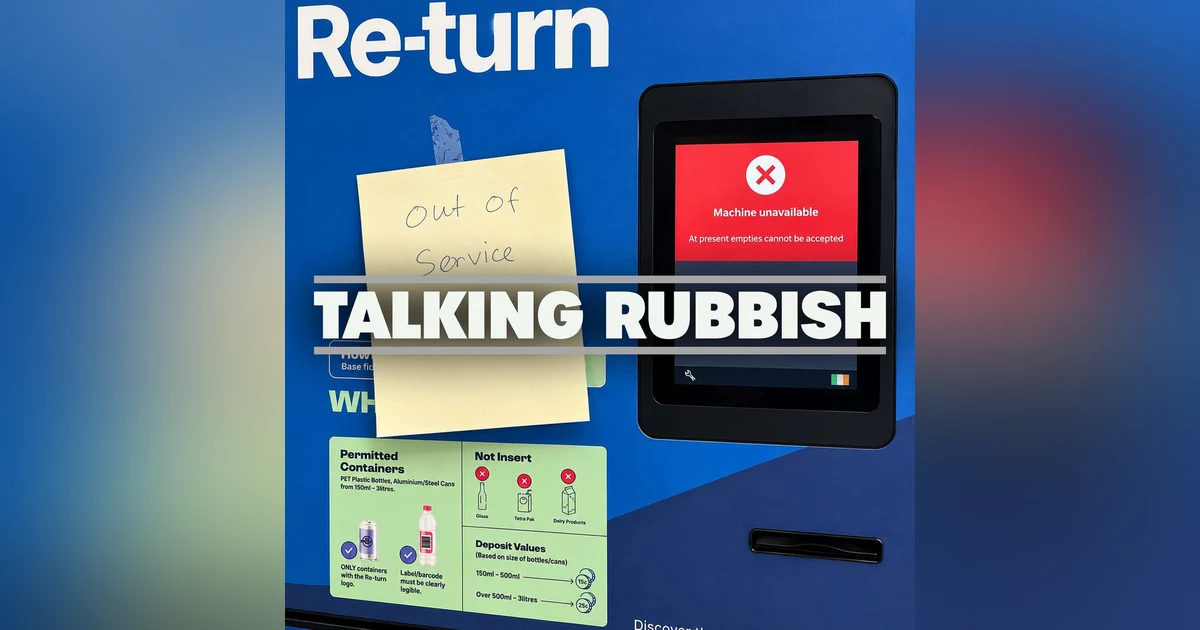
- James Piper's personal experience using Ireland's DRS highlighted common pitfalls, including full or broken reverse vending machines and difficulties for tourists trying to navigate the system.
- While a DRS can increase recycling rates, it often creates unintended consequences like a informal secondary economy where individuals rummage through public bins to collect and redeem bottles and cans.
- Infrastructure challenges, such as a lack of alternative return locations when a machine is full, can make returning containers frustrating and impractical for everyday consumers.
- The line between a refundable deposit and an effective tax blurs when consumers find it impossible or too inconvenient to claim their money back, forcing them to abandon their deposits.
Deposit return schemes can deliver impressive recycling rates. With that in mind, what can we learn from countries already using them? Following a trip to Ireland, James shares his experience of the country’s DRS, from the ease of spotting return points to the unexpected economy created by putting a value on bottles and cans. We look at what Ireland gets right, some of the unintended consequences, and what the UK could learn ahead of its own scheme launching in 2027.
Plus, are arcade tickets rubbish or not, why do we need a recycling label when everything will be recyclable, how will butter be packaged in our dream shop, and why are James and Robbie worried about being accused of being polyester?
Join hosts James Piper and Robbie Staniforth as they delve into the world of recycling, hopefully having fun along the way. One thing is for sure, they will talk absolute rubbish from start to finish.
To see James and Robbie live at London Packaging Week, get your free ticket here.
Please take a moment to complete the Simpler Recycling tracker
We would love you to join our community on Discord
Special thanks to our sponsor, Ecosurety
To get exclusive videos and clips, follow us on Instagram, TikTok, Threads or Facebook; @rubbishpodcast or YouTube: @talkingrubbishpodcast
Or you can contact James and Robbie with questions or just general rubbish musings using the email address talkingrubbishpodcast@gmail.com or by texting them via WhatsApp on 07356 069 232
Relevant links and reports mentioned in the programme can be found on the Talking Rubbish Linktr.ee
Transcripts and episodes can be found on the Talking Rubbish website
Music licence ID: 6WPY8Q4O2RPFIOTL
Frequently Asked Questions
What is a Deposit Return Scheme (DRS)?
A Deposit Return Scheme is a system where consumers pay a small upfront deposit when purchasing a drink in a bottle or can, which is then refunded when they return the empty container to a designated collection point for recycling.
When is the UK Deposit Return Scheme launching?
The UK is currently marching towards the launch of its Deposit Return Scheme, which is scheduled for October 2027.
What are some of the challenges associated with Deposit Return Schemes?
Common challenges include full or broken reverse vending machines, a lack of convenience for tourists, and unintended socio-economic impacts like individuals sorting through public waste bins to collect valuable containers.
At what point does a deposit become a tax?
A deposit can effectively feel like an unrecoverable tax if consumers are unable to return their containers due to broken or full machines, lack of local infrastructure, or time constraints, meaning they lose their upfront money.
James Piper
Hello, welcome to Talking Rubbish, a weekly podcast going deep into the word recycling and discussing the truth behind snappy headlines and one-decided stories. In this episode, we will discuss my experience with DRS in Island. Arcade Tickets rubbish on a question about why OPRL is needed if everything will be recyclable. And how will butter be packaged in a tree shop? I'm James Piper and I'm joined by Lobby Standard for my rubbish friend. Good morning, Robbie.
Robbie Staniforth
Morning, James. I hope you're well.
James Piper
He's gonna get in there. How are you today?
Robbie Staniforth
I'm good, thank you. Very well, thank you. Is that the new start? That's the new start. I hope you're well. You know, just the positive assumption that you're gonna be well.
James Piper
It's very good. I like it a lot. Next week, as this goes out, we're gonna be live on a doing a little show at London Packaging Week.
Robbie Staniforth
Yes. Gonna be great.
James Piper
Yeah, can't wait. So this is on the 17th of September at 10:30, and we're gonna be doing packaging promotions gone wrong. Oh gosh, I'm sure there's plenty of them out there. Can't wait. It's gonna be so good. I started doing the research, there's just some really funny examples and some horrific examples. But yes, where companies have used packaging to do a promo or a competition, they haven't quite thought it through. It's completely gone wrong. So we're gonna do that live and then it will go out uh probably a week later as an episode. But um if you want to see it first and you want to meet us, you want to see it live, then head on over to London Packaging Week. I'll put the details in the show notes. I thought it was worth us doing a bit of an update.
Robbie Staniforth
Yeah, no, we did promise when we did our last episode on DRS that it was vital we would keep people up to date as we march towards October 2027 and the launch of a deposit return scheme in the UK.
James Piper
And around that time I mentioned I was going to a wedding in Ireland. Oh, yes. Which was May, and I made loads of notes about DRS, and I thought one day we'll cover this. And I think today is that day as we align to some of the news in the UK. And I guess I was intrigued as to what we can learn from the Irish scheme that maybe we could take into the UK scheme. Okay, very good.
Robbie Staniforth
Well, I've got no experience with the Irish scheme whatsoever, so I'll be leaning on you heavily for your experiences.
James Piper
And we're getting ever closer to the UK scheme, October 27. People are starting to get nervous.
Robbie Staniforth
Yeah, it's sort of like nearly a year away, only just over a year.
James Piper
Yeah, and as a reminder, so uh the Irish scheme was launched in February 2024. So they have uh they've been running it for a couple of years. Everyone got very annoyed at me on social media last time we discussed this because we discussed it in episode 91. We talked about how uh how the UK may launch a scheme looking at Ireland and and some of the negativities, because when you first started DRS, you have quite a low return rate.
Robbie Staniforth
Yes, it takes a bit of time for the bottles and cans to come back.
James Piper
Everyone was saying, Why don't you look at countries that have had schemes going for 20 years? And I was like, Well, because the UK hasn't started yet. I sort of want to imagine what the first year of the UK is gonna look like, so I might as well look at the first year. So it's an important first point that we know that as deposit return schemes embed, they get better.
Robbie Staniforth
Yeah, they're not gonna be perfect from day one, and that's just totally normal. And it would be kind of ludicrous for the government and those involved in setting up the schemes to think that they're gonna suddenly magically get all of these containers back within a year, the recycling rate's immediately gonna jump to 95 plus percent in terms of what's collected. That just never really happens when they launch. So, just as a reminder, a deposit return scheme is quite simple. It's merely that you pay a deposit up front for any drink that you buy, and then you can redeem that deposit. Now, different schemes work in different ways. They have different types of containers included with a deposit, and some not in certain countries, and some use reverse vending machines to get the deposit back, others use purely manual return points. Lots of different ways you can do it, but effectively you're paying up front and you only get that money back if you bring it back to be recycled. And the logic being that this is a great way to get people recycling.
James Piper
And it and on this podcast, I've been pretty critical of them. Yes. I mean, I was gonna say not today, but I am obviously gonna give my observations on the Irish scheme, but I will give them as impartially as I can. Um but but ignoring all my criticisms, it is worth saying that they work. Countries with DRS in place will typically have a container return rate of something between 80 and 98%. And there are currently 22 countries across Europe with an active DRS. And if you take a country like uh Lithuania was a good example, in just 18 months, their recycling rate jumped from 34% to 92%.
Robbie Staniforth
Yeah, obviously they started with a very immature waste management infrastructure, so it's the perfect kind of place to say all we need to do is put in some infrastructure, make it simple for people, and they will actually engage in it. And it's a great news story.
James Piper
And that's one of the challenges, right? Because we're not at 32%. So the UK plastic bottle uh collection rate is something like 60% from households, and aluminium cans is about 80%. So there is an argument, as I've said many times, that you're kind of you're putting in a lot of cost, you know, billions of pounds, to collect something that already has a good collection rate. You've got the carbon of people then taking it back to a supermarket, you've got the issues of people who are unable to travel to the supermarket, what are they going to do? There's all sorts of things that come with deposit return schemes. And it is, in my opinion, when you've already got a return rate, a good return rate, it's a sledgehammer to crack a nut. Now, I'm not gonna say that's a bad thing on this episode. I'm gonna just talk about the Irish scheme and what I experienced. Okay. First up, how easy was it to use? I'm gonna be honest, usually I really struggle to engage with deposit return schemes as a tourist.
Robbie Staniforth
Really? You're the kind of guy who like loves to know all the information and download the apps and kind of get involved.
James Piper
100%. But they are, I think, well, first of all, they're rarely obvious if you're not used to them. If you don't live in the country, it's actually quite hard to engage with just because no one's advertising it on a day. You know, they advertised it a lot when they launched it, they embed it in the culture, and then they sort of forget, oh, tourists might come and we might need to tell them there's a deposit. So, yes, while there might be a reverse vending machine in your big supermarket or there might be a plus deposit on the price tag, if you don't speak that language, like in Denmark they call it PANT, I think. Yeah, I may not know what that is as a tourist. And spotting a reverse vending machine that's going to give me money back again, it may not be that obvious. So I do find it quite hard. So, like in terms of European cities I've visited that have an active DRS, the ones I've visited are Denmark, Croatia, Iceland, Germany, Norway, Sweden, and Malta. And I believe, as a tourist, I have only ever successfully returned one bottle, which was in Norway.
Robbie Staniforth
Okay, so it was that difficult. It sort of is a bit like buying a bus ticket in a foreign country. You're like, where's the where's the ticket booth? Um, who do I give the ticket to? How much is it? Whereas when they switch to like tap-on-tap-off of buses, you can go anywhere in the world. You just tap your card and it will charge you a pound or two pounds or whatever the local currency is. There's no real equivalent to that for deposit return schemes, no sort of universality about how to communicate around it and what you're supposed to do when you take it back and how it gets redeemed, etc.
James Piper
Yeah, and I wouldn't say it's necessarily difficult. It's just I've I struggle to engage with it. So Denmark is the exception to this rule because my dad lived in Denmark for a couple of years. And the culture, I I mean, I came back saying we need deposit return schemes, they're amazing. But the culture was you go into a shop, you buy 24 bottles of soft drink and glass. This is what we were experiencing. You buy it in glass in a tote box, you drink it, you put it back in the tote box, you take the tote box back to a supermarket, put your glass in the DRS machine and fill up your tote box again. So it's just a completely different uh purchasing um experience to the UK, where I'm buying a pack of 24 cans of coke in a carbo box. You know, I I can't reuse the carbo box to bring the cans back because I've ripped it to open it. It's just completely different. And so I think if UK supermarkets started moving to a place where everything was sold individually and you just sort of had these reusable totes that you were taking around the supermarket and that became your culture, it'd be really easy to engage with DRS. That just gives an insight into why I found like Denmark really easy, but I struggle as a tourist because you're actually not able to do that. Now, what I will do is donate those bottles and cans. So on a lot of the bins, they'll have points where you can leave the bottle and can so that someone else can collect it. So it's not like my deposits were going to waste. It's just I thought, can I really do I have the energy to try and negotiate this machine and I'm going to get a voucher for this supermarket though I don't actually need anything in because I'm leaving in an hour.
Robbie Staniforth
It's not particularly designed for tourism, isn't it? There'll there'll be hot spots where there is lots of tourism, it's important for them to sort of engage with deposit return schemes. But generally, the way that they're put in is for the lion's share of people who'll be engaging with it. And that's kind of behaviour change that will happen over the course of the first couple of years of the scheme of the residents of that country. And I'm sure Ireland is sort of just coming out the other side of that behaviour change.
James Piper
So I've successfully used one deposit return scheme, and unfortunately, Ireland did not increase that number. Okay. We will come on to that. The first thing I did in arrival was to head to a shop to stock up on supplies, and the shop we visited was called Fresh. And the return machine, first thing I noticed, it was just on the right as I walked through the door, and I thought, wow, okay, actually, that was really easy to spot. Very, very prominent, um, really usable. As I walked out of the shop, this guy walked past me with two enormous bin bags full of cans and bottles. Oh, great. And I sort of ran back in. I was like, I need to find out what this guy's doing. Ran back in, like confronted him. I think I probably scared him a bit. I was like, excuse me, I do a podcast. I said, What do you do with these cans? Where have they come from? And he said, Well, we have an office round the corner, and we all collect up our cans and bottles. Then once a week I bring them here and we uh get the money and then we donate that money to charity. Oh, that's pretty cool. So I just thought, well, this that's great. You know, this is really, really nice. Perfect, perfect way to start my DRS experience. Warms the cockles. Yeah, I guess the only negative, and I again I'm only saying this to bring balance to that, is that guy was probably using that machine for like half an hour now because he had a huge quantity of cans and bottles. Oh. And there's only one machine. Okay. There's an argument to say, well, if you then came in, you know, it would be better for him to have to have some form of commercial collection where they could come to the office, count them out, and and give them the money rather than using up a machine in the supermarket. But that is a small niggle in a very, very nice uh situation that I started with. The reason I thought that even more is because Fresh didn't have everything I wanted, and so we had to go down the road to a local Tesco, and the machine in Matt Tesco said, sorry, we've we're out of use. And I think it was full. I think once these machines get full, they're out of use. Obviously.
Robbie Staniforth
There's no more stories.
James Piper
So I don't think it was broken, I think it just hadn't been collected. And it is worth noting in the five days that we were there, the machine never accepted a bottle. So I went back to Matt Tesco every day to see if it would accept a bottle, because it was just next to my next to where we were staying, and that machine never accepted a return in the whole time we were there. Okay so it was not emptied. So obviously, if you're queuing up for half an hour in fresh, because this guy's got his massive, you know, hundreds of cans and bottles, if you're queuing up for ages, there's not an alternative down the road. The alternative down the road isn't accepting bottles and cans.
Robbie Staniforth
Yeah, sure. I mean, one hopes that that's kind of teething issues and isn't something that continues long term, but trying to get the timing right to empty these machines and also just have enough machines around the place so that you don't have large queues is definitely something that um Exchange for Change in the UK will be scratching their head. How do we get this exactly right? Because on the flip side, you don't want to invest loads and loads of money in these machines that just remain unused. So either way, you're you're either spending money that you don't need to on this really expensive system because you've got too many of them, or in the case you've described, people maybe disengage a bit because they're like, I can't actually get my deposit very easily.
James Piper
And one solution to this is, and I think this is a loophole. One solution to this is you say, Well, if your machine is full, you have to manually offer a takeback at your checkout. Um, because the way these work is you have either an RVM in a larger store, if you're in a smaller store and they can't afford a machine, they will offer manual takeback. But as far as I can tell, and there was a lot of complaints of this online, there is no requirement for you to do both. So you're either having a reverse vending machine or you're offering manual collection. If your reverse vending machine is broken, you then don't need to manually collect. So that can leave entire areas with no route for return. And again, this was a common complaint online and an observation online that perhaps that would lead to shops being disincentivised to empty their cans and bottles. Because actually, if they don't particularly want to engage with DRS, the easiest thing you can do is have a reverse vending machine, let it get full. Oh, God. And then say, oh okay, we don't have to engage with this anymore. Now, there is a reason you wouldn't do that because actually retailers get paid for collecting up cans and bottles.
Robbie Staniforth
Yeah, sure. And the the ill will of their customers, they don't want that, you know, they want them visiting the store. So ideally they want it to be as frictionless and seamless as possible.
James Piper
Of course. But it was an observation that was made online, so it's just worth sharing. So over the week we collected all of our bottles and cans, and why not? I mean, they're valuable now, so it was 15 cents for the smaller containers and 25 cents for the larger ones. And something people often praise DRS for is the way it makes packaging valuable. Suddenly everyone cares about recycling, right? Because they want to get their money back. But from my experience and my time in Dublin, it does not make everyone care. It it is not enough money for people to go, okay, I'm gonna go out of my way to claim that back. If you're spending, I don't know, one to two euros on a soft drink, actually that 15 cents very quickly just gets swallowed up into the cost price of the drink. But what it does do, and what I have observed, is it provides a source of income for people who then want to go and collect it out of the bin. So typically for me, what I saw, and again, I'm I'm only commenting on what I saw, was a lot of homeless people rooting through bins, taking out bottles and cans. And ultimately improving the collection rate of the scheme and the system. But I don't think it makes the majority go, oh, 15 cents, I'll take that back. What it does is it creates a whole new economy of people going through bins and taking out bottles and cans.
Robbie Staniforth
Sure. And this was always the slight fear all the way through the UK designing its scheme, this grey economy, so to speak, of people ideally cleaning up litter where it's been littered. Oh great, people are gonna pick that up. That seems like a service to society. But kind of rooting through existing bins to make sure that it's recycled can leave somewhat of a mess outside of that bin if they're not putting everything back into the bin, particularly if these cans and bottles are going in general waste bins.
James Piper
Absolutely. And litter is such a kid. I mean, I'm so I am excited for DRS for one reason. I have a park nearby near our house that every morning has hundreds of cans and bottles in it. If you're watching on video, I'll flash up a picture I took the other day, and you just think this is where we want DRS, right? Because it's ridiculous that people are just drinking cider and beer in a park, you know, you uh hundreds of cans in the morning. It's unbelievable. Um but as you say, there is an issue that if you're digging through bins, and and by the way, I mean like sophisticated digging through, I mean I saw people walking around with wheelbarrows, crates, massive bags, hundreds, thousands of bottles and cans being carried around. Because I would do a morning walk every day, you know, because just get my steps in. I would I would be up at like seven doing a morning walk, and I would just see everyone methodically going through each bin, picking out bottles and cans and uh carrying huge bags of them, which they're then going to return when the shops open. But as you have identified, this has led to Dublin asking questions about this scheme, specifically Dublin, specifically city centres, because a local counsellor said the bins that people are digging through are not meant to be dug through, and they're actually creating more litter, they're pulling out food, pulling out things that aren't DRS-able and just leaving them on the side. And that is happening more and more. And I saw that. Now I've got to say, I am just really uncomfortable with this digging through bin thing because the bins in Dublin are like a hole that's just big enough for your arm. So it's like um, how do I describe it? It's um, well, it's bin size, and then it's got like holes like you would get in like a um when um a glass uh bottle bank.
Robbie Staniforth
Oh, okay. Like a round hole, it's not like a letterbox aperture. No, round hole.
James Piper
And then people who are doing the collections are putting their arms in these bins. They're doing one of two things. They're either pulling the bin bag through, which is obviously causing a lot of litter because a bin bag full of rubbish is going through a tiny hole.
Robbie Staniforth
Squeeze it through, yeah.
James Piper
Or they're just putting their arms in. Now, these are bins that could have broken glass, syringes.
Robbie Staniforth
What could be in there? Yeah.
James Piper
I just I am so uncomfortable with this. And what I am uncomfortable about is the blase attitude that everyone takes where they're like, TRS is great, look at our return rates. And they ignore the risks and hazards that come from actually people not really caring any more than they did before. I mean, sure, sure, some people will. Some people will want to claim a deposit. Lots of people, from my experience, are just putting it in public bins, and then people are going and picking it out. I personally don't like this. You know, you've got deposit donation points on the bins, as I talked about earlier, which is where I tend to leave mine. But I didn't see those being used at all. So for whatever reason, the public aren't engaging with that, and there's not enough spots anywhere. I mean, if you were uh some of these bins had 20, 30, 40 bottles of cans in, from what I could see. Yeah, you know, the ring around it maybe has space for six or seven cans. So even if that was used in full, you'd still have people rooting through the bins because they'd think, well, there's not enough space on those donation points. Now, to solve all of this, councillors councillors in Dublin are talking about two things that completely destroy, in my opinion, these return rates. Now, I could be wrong, but they are talking about replacing the bins with big belly bins, which are the ones that don't have a whole you can't reach into them.
Robbie Staniforth
Oh wow. So the it's just inaccessible, that's it. It's gone. The deposit will never be redeemed. Yep. Wow.
James Piper
But of course, that adds risks because as I say, as you say, the c it will never be redeemed. The colloc collection rate will be lower. Because these, from what I can see, people who are picking it out in the morning are picking out thousands of bottles and cans that will just disappear from the system. The other option, and perhaps even worse, because I think it just creates a bit of an us and them attitude, which I just don't like, is they are talking about should we put in place a system where you can only claim deposits if you have a household registered address, if you have a collection, a household collection, you would basically be licensed to then also get deposits. And so it just completely removes the ability for a homeless person to make income from collecting up bottles and cans.
Robbie Staniforth
Wow, even if even at those donation points that they might choose to go and visit, they wouldn't be able to redeem them. That seems like a pretty drastic action to me.
James Piper
Yeah, and it's just it's actually going to affect the collection rate. It's it's you're you know, you're trying to close loopholes because you don't like the extra litter coming out of the bins or you don't like that homeless people are able to claim the deposits, whatever you're whatever reason you try and close these loopholes as counsellors, but then you defeat what DRS is for, which is to create something valuable to someone, it may not be you as the person consuming it, sure. To create value to someone that then increases return rates. So I mean relying on small groups of people to increase return rates is a byproduct of DRS. I'm pretty confident this happens worldwide. And I and my and I I don't think I don't think we should criticize that. Why shouldn't people in need have an opportunity to make money from things people have discarded? Like I don't there's no issue with that. But it it really does create a weird subculture. I mean, I saw two people get in a fight. Two two um, I believe they were homeless people get in a fight about who owned a particular bin. You know, a a fist fight over this bin is mine. Wow. I pick through this bin, not you. You know, it it creates this subculture that perhaps. Isn't that healthy? You know, I'm being quite careful here because again, I'm I'm not unhappy at all with the concept of people making money out of things people have discarded. I think that's a good thing. But it does make me wonder whether there's a completely different model here where you actually lean into that rather than just ignore it. Because it feels like what's happening right now is you just sort of ignore it. You just say, Oh, well, that's happening, let's not think about it. It's happening at six in the morning while I'm asleep. Um could you not have something like a big issue type model where people are properly paid to collect this material rather than having to rummage through bins to find it? I don't know what this would look like, but wouldn't it be amazing if like Coca-Cola and Pepsi could actually um you know provide a model where people could earn safely? Yeah, sure. Where people who didn't care about the deposits could put it in an open container rather than a closed container where we're trying to hide the bottle and can. I don't I don't know what that looks like, but I just feel like there's an opportunity.
Robbie Staniforth
Yeah, I think while we don't have necessarily all of the exact solutions for resolving it, it is important to sort of surface the fact that it's not all as rosy as one might think in terms of these schemes. There are unintended consequences, and this is one of those unintended consequences, albeit one that was quite foreseeable.
James Piper
So why then, Robbie, if I collected all my cans and bottles for a week, did I fail to return them? And it is because on the day of my flight, and we had like an hour between kind of cleaning up the flat and me getting on in a taxi to go to the flight, on the day of my flight, the machines within walking distance of the flat were all full.
Robbie Staniforth
Oh no. So both of the the Tesco one and the Fresh.
James Piper
Well, there were multiple Tesco's.
Robbie Staniforth
Oh, okay. There were other shops.
James Piper
Oh no. I think Fresh was closed. Oh, okay. Because it was a s I think it was Sunday, Fresh was closed. Okay. I was walking around with an enormous bag of bottles and cans, trying to return it, and there was no opportunity for me to return it. And uh in an hour. Now, obviously, if I'd had longer or I could drive somewhere, then it would have been different. So I physically could not make a return. So I just hung the bag off a donation point, and I would imagine very and actually I hung it off the bin where the two were having a fight. So I hope I didn't cause a fight. Now I think about it, I kind of forgot I didn't. Oh no. But I would imagine these were very quickly claimed. But as I say said earlier, my successful Taurus deposit returns remains at one.
Robbie Staniforth
Oh gosh, that's kind of foreseeable, I would say, also. The fact that really you've got a narrow window and the system either works or it doesn't. And in this modern world, we keep saying that convenience is key. You know, that's what the retailers and the grocers and the people selling these drinks would say. We've got to have convenience for everybody. Life's fast, you know, there's not much time in the day. It's got to be convenient, convenient, convenient. Well, the same has to be said for the world of recycling and rubbish. If you need that much convenience to buy things off the shelf and conveniently get your bottled drink that you're not having to refill and etc., etc., then the exact same convenience needs to be afforded through these deposit return schemes.
James Piper
I guess the question that I was asking myself is: at what point does a deposit stop being an incentive and start becoming a tax? If it's difficult for you to claim back or impossible for you to claim back, let's say you can't get back to a supermarket for whatever reason, and it becomes very difficult, you decide to just use your curbside instead. At what point has that become a tax for you? Because you can't engage with the system. And for me, that's sort of how I felt in Ireland. I you know, I could have spent a bit longer looking, I would have missed my flight, mind. The tourist time. I guess I could have started the day before returning it, but I just, you know, you shouldn't have to, right? And so the launch in the UK is going to be super interesting. There is lots we can talk about in the UK. There's some financial news that has come out recently. I think we're going to need to do a part two. So we're, I think we pause there on this is what I learnt in the Irish scheme. Let's do a part two, which is then how this is translating into the UK system. But I guess the learnings that I have, um, and some of these things are too late for exchange for change for a UK deposit return scheme, but the things I think I would be doing is having a very high deposit, you know, so that it became valuable to more people. So 25p, 30p. If you're going to do it, make it really valuable. And part of the reason I say that is because take Bristol as an example. So many of our public bins are big belly bins. Sure. So we're going to lose those containers if we're relying on this culture of people digging through bins to collect them. It's not going to happen. And this is true across the country. There's lots and lots of big belly bins, lots and lots of bins you can't go back into. And so we did we've got to make the deposit valuable enough. And obviously, we're talking about a 20p deposit in the UK because they decided that was the right amount, it was just enough that it would cause people uh to return, but not so much that it puts people off buying. I personally would have gone higher. Um there is a question mark as to whether you make it easier for people to collect them up. You know, so if you're going to rely on a culture of people going through bins, then I would create open spots for people to be able to claim the bottles and cans from, and I would look at how we could do that. I would make it a requirement to return manually if your reverse vending machine is broken. I think that would be that would be really positive. There's got to be a backup plan, surely. To wrap up this trash talk, deposit return schemes work. I really, you know, for all my frustrations of them, hopefully this has been less negative than usual. I know it's coming. I'm pretty chilled about it. And they do work, they do increase return rates. They can get huge numbers of bottles and cans back, and they can really have an impact on our litter. And I genuinely think when ours launches, the park near me is going to be a lot cleaner. So I'm looking forward to that. But putting a value on something changes behaviour in ways that perhaps people don't expect or don't realise until you see it. And it does create an incentive to return your own bottles. But actually, if you don't care about that, what it does is it creates an incentive for someone to claim your your empty bottles and cans, which means it turns bins into a source of income. And if you turn bins into a source of income, you have all sorts of weird things that happen, like fights over whose bin is whose. And remember, a deposit return scheme is not your being paid to recycle, it's that you're lending a system money, and we need to make sure it's super easy to get that money back. Oh no, we got the labels wrong. No, the labels. Uh no, we didn't. There were a few things I think would have tightened up a bit, made it a bit clearer. Okay. But before we do that, I just want to say thank you to Kyle on Discord for a very important addition about vape recycling. Because I said a store larger than 400 square meters would have to accept a vape without you making a purchase. So in the waste electrical regulations, you buy a toaster, you can return a toaster. And I said a store larger than 400 square meters would have to accept it. You can tell I haven't been in waste electricals for a long time because I forgot that it was actually 400 square meters of electrical sales space. Oh. Which actually discounts quite a lot of the supermarkets. Yeah, they don't sell that much electronics, yeah. Yeah, exactly. So curries, you would definitely be able to, because obviously they sell electronics across a huge space. But something like a supermarket where their electronics is just one aisle, they probably don't reach that 400 square meters. Having said that, you know, the Tesco I went into and the vape shop I went into said I could return them without making a purchase. So it is always worth asking. And the one you went to, yeah. And the three stores that didn't take my vape back, that refused to take the vape back, they were just refusing point blank. So whether I'd made a purchase or not, they were saying we don't offer recycling. So it's kind of a moot point, it's a really important point to get the legislation right. But in terms of my experience with the five stores, the ones that said they would take it back didn't require me to make a purchase. And the ones that wouldn't take it back would not have taken it back, even if I made a purchase. But yes, just to be clear on the legislation, I think that's a good addition. Thank you, Kyle. And just in terms of my wording on labelling, I felt there were two things that would have cleaned it up a bit. So I mentioned quite a few times that OPRL have two recycle labels that don't recycle and recycle. Yes. Of course, they have that is true, but they have subcategories. So like recycle, return to supermarkets. Oh, with an instruction. Yeah. So I made it, I felt as I was listening back to it, I thought, I've made that sound a little bit too simple. Okay, so this is a self-correction. It's a self-correction. Just I thought that would clean it up a bit. So you get some things like coffee cups where it's like take back to store.
Robbie Staniforth
Yeah.
James Piper
Uh flexibles where it's take back to supermarkets. But the overall label itself is still just recycle or don't recycle. Sure. And uh listening back to it again, a lot of his corrections come when I listen back and I go, God, I wish I'd said that. And in the old days of audio, Robbie, back when we were audio only, I'd just go in and record it. Record a little clip. Can't do it with video. I'd have to make you wear the same clothes and get you back here. Um so a lot of our conversation was about the EU requirements. Yeah. But it is worth noting that the UK will be bringing in its own legislation. So we said, oh, the UK will have to do this because the EU will make them do it, you know, like tethered bottle caps. Sure. It's actually a bit stronger than that because the UK have already said we will create a mandatory label legislation. And I believe they're going to align with the EU. Now we don't know, I suspect this is where I my comments in the episode are still true, that I don't know whether they will align on like, and your bins have to be the same, because that would be quite onerous for us. But um, but we will see. So the UK will come out with its own legislation and we will do a proper episode on that when we get more information.
Robbie Staniforth
Yeah, it's been a few years now with a black hole where their once-lived policy or there was a hope for policy on labels. We're hoping in the coming months that the government will make their intentions clear now that the EU have come out with theirs.
James Piper
We'd like to take a moment to thank our sponsor, EcoSurety, who are on a mission to rid the world of unnecessary packaging. They help brands navigate the tricky world of extended producer responsibility, but that is not all. They also collaborate on some incredible recycling projects and consumer awareness campaigns for those tough to recycle materials. If you're an organization looking to make smarter packaging choices, check them out at ecosurety.com. And the best thing you can do to help our podcast to grow is to tell your friends and family about it, or you can leave us a review. And if you leave us a review, you could be Robbie's review of the week. Now, before you get into it, this review. Oh yeah. Okay, so we moved hosts recently so that we could go onto video. The new host also has a button that says, Do you want to receive fan mail? And if you tick it, it comes up in our show notes. It puts a little thing saying contact us directly. So I just thought, oh, I'll just switch that on. So I switched it on. Within two minutes, I had a message from someone asking a question. And I was like, wow, this fan mail thing really worked. And then I got a review from it. So there's loads of ways of contacting us, you know, WhatsApp, email, all the usual ones. But also in the show notes, if you scroll to the bottom, it says get in contact with us. That's our fan mail, as they call it. Not that's not my words. That's their fan mail, and that's another way of contacting us. So thank you to the per I don't get the people's names, so thank you to the person who left this review. Um, it's amazing how people have found that feature without me even knowing about it. I'm getting so many messages. Thank you.
Robbie Staniforth
Great. So this is from an anonymous listener, viewer. Yep. I don't know who it is. Who sent it via fan mail. Two amazing years of education, expertise, and entertainment. Here's to many, many more. I'm learning so much each week and recycling more confidently. Big change. No more household wipes. Cheeky wipes are washable, reusable, and far more effective. Love your passion, knowledge, and delivery in brackets. Also Robbie's laugh. Thank you. Thank you, James and Robbie, for my favourite weekly hour and podcast. Clap, clap, clap, clap, clap, emoji.
James Piper
That's very sweet. It's a great review. And you can follow us on social media at rubbishpodcast. You can email talkingrubbishpodcast at gmail.com or you can WhatsApp us. Also join our Discord. It's the easiest way to engage with us and listeners of a show. And the link to all of those things is in the show notes. Rubbish or not. We're both just back from holiday. Separate holidays, as we feel we always have to clarify. Always declare, always declare. But we do, even though we get this out every week, we do occasionally still take a holiday. We manage to fit it in. And I was down in the Sussex coast. We stayed at Seal Bay. Oh, okay. Not being there, no.
Robbie Staniforth
Yeah, I've heard of it though, yeah.
James Piper
Very like campsite, caravanning, that sort of thing. And one of the things to entertain holiday makers was an arcade, you know, an old school British arcade where you could win tickets to exchange for prizes. And as I watched people feed these, you know, little pieces of cardboard into the ticket machine, I found myself thinking, what is gonna happen to these tickets? Very good question. What's gonna happen? And so, as I like to do, I find rubbish or not in my daily life, and ticket arcade tickets was a good one. Robbie, what do you reckon happens? Rubbish or not?
Robbie Staniforth
Well, I think it is recyclable. So it's uh or not. Now I can see you're holding them there. So I'm desperate to sort of just feel I've got a confession.
James Piper
One thing I definitely have to do is remember that I've got my rubbish or not wall. Remember Ron. And when I've had an idea to do something like arcade tickets, to make sure I leave my holiday with some tickets tickets. Oh no, because yesterday, when I was thinking, oh, we're gonna do arcade tickets, I thought I haven't got any. I had to drive to Hollywood Bowl down the road from my house. Yes, yeah, yeah. And I thought it would be really funny if I now win a jackpot and get like a thousand tickets that I have to bring back. Luckily, I did not win the jackpot, I just won some tickets. But yes, I've got 20 Hollywood Bowl tickets, not Seal Bay tickets.
Robbie Staniforth
Okay, and I'm sort of desperate to feel the tickets. These are actually bigger. These are bigger than the slightly tickets. Because sometimes they're less card and more paper-y than this, but I don't think they ever have like a really glossy coating. So I'm gonna stick with or not, this can go in cardboard recycling, sort of mixed coloured cardboard recycling. Okay, so when these go in the ticket machine, I'm I would say 100% certain that these must go off to get recycled, because it's gonna be a huge amount of waste for these companies to operate on something that feels like cardboard. So I'm gonna say, or not, they get recycled as cardboard rubbish. It does make me think surely they could have a reusable version of this, but maybe that's too much to ask.
James Piper
Well, I had it. That's why I picked it as rubbish or not, because I had that exact frustration. I was like, the trouble is when you get like, as I did yesterday, 20 of them come out of the machine and you make that tear, you can't now reuse them because you can't join them back together. Yeah, because it's a continuous strip for however many you win in that competition. Exactly. And also I think the use tickets, you know, they start getting bent, and so they won't then go back in the machine. So it's just it's just too risky. So I think these are super single-use items, you know, they're literally like for what, five seconds? Pull them out of one machine, put them in another machine, get them counted, it's complete waste. Now, there is a reusable option, but first of all, I wanted to try and see the impact of this. So I did a bit of digging. And when I was um when I was seven, I lived in America, so between like the ages of seven and nine. And going to Chuck E. Cheese, have you ever heard of Chuck E. Cheese?
Robbie Staniforth
I've heard of it, but I don't I've never been and I don't really know what it is.
James Piper
One of my favorite places to go as a seven-year-old. Okay. Amazing cheese pizza and a big arcade. Okay. Okay. And Chuck E. Cheese said in 2014 that they were dispensing six billion tickets across 577 outlets. Wow. Now these tickets weigh about 0.2 grams, so just Chuck E. Cheese alone was using 1200 tons of paper a year. Oh my god. Just in tickets. That is crazy. Unbelievable. So I actually think this is a big problem to solve. And luckily, people have started solving it. And Seal Bay was a really interesting example of this because Seal Bay had two entertainment areas. Okay. So they had the one where I got the tickets and this happened. And then they had like a newer entertainment area. I assume it was newer. Because this one, when you went to the first machine to kind of get your money, you bought a reloadable card. Ah. You know, like a credit card. Okay. You put your money onto that. And then as you were playing the games, your tickets got loaded onto the card. Okay. And Chuck E. Cheese has done the same. They've moved to reloadable cards. So they did that in 2020. So that 1200 tons now is a thing of the past. Oh, that's great. So maybe we'll see less of these arcade tickets in the future. Rubbish news. So my rubbish news today we probably should have covered back in July, but it has hit the headlines again following comments from the boss of the Port of Tyne. So this was uh back in July, a crane collapsed onto a ship. Did you see this? No, I didn't see the ship. Oh, really? Oh, well, we really should have covered this in July if you haven't seen it. So uh Port of Tyne, a crane basic. I think two boats collided. Okay. Caused a crane to fall over. The crane fell on another ship and it hit a container. I think it may have hit two containers on the ship. On the ship, okay. That contained plastic nurdles. Approximately a billion plastic nurdles. Oh no. The container broke, fell in and tipped, and the all the nurdles fell into the sea, into the North Sea. And just to explain what a plastic nurdle is, this is basically pre-production plastic. So this is what we talk about when we say, let's next not export waste, let's export you know, product ready to be turned into plastic. Well, these are like little kind of lentil-sized bits of plastic that have come out of pellets almost. Yeah, pellets, yeah. Just the size of a lentil, plastic, and they're on a shipping container. So this is the downside to my plan of only export pellets or formed goods, is that if there's an issue, they're really, really hard.
Robbie Staniforth
Yeah. If the lentil size, imagine trying to sieve that out of the sea.
James Piper
Yes. So this happened in July, and Matt Beaton, who's the CEO of the port last week, was criticizing basically what he was saying is they were critical of the fact that these are classed as non-toxic. Because they are non-toxic. The trouble with that is the port doesn't know they're on the boat. So when things are toxic, the port knows they're there. So if there's a spill, they act really fast.
Robbie Staniforth
Yeah.
James Piper
Because they didn't know there were nurdles on the boat, because they didn't know it was the nurdles that had tipped into the sea, it took them three days to put a boom out to stop the nurdles floating away. Oh wow. Which I it's just too slow. I mean, yeah. He said, Oh, we didn't know there were plastic.
Robbie Staniforth
Surely the first question is what's in it? Exactly. They've got transfer notes to know who owns that container. They can pick up the phone.
James Piper
My opinion is that non-toxic thing felt like a bit of an excuse, but yeah, I I wasn't there, I don't know. Yeah. Now, one idea he had, which I thought was really good, so worth us flagging on his podcast, is he felt that like there should be legislation or rules that plastic nurdles should um be put in stronger shipping containers. So they should always be in shipping containers that are I I assume stronger. He said better. I assume that means stronger. And also they shouldn't be placed on the edge of the boat. You put them in the middle, then if a crane falls, it's not gonna knock that one container into the ocean. I thought those were really good. I mean, yeah, why can't we just do that? Just say if you're carrying something that's gonna cause pollution if it falls into the ocean, actually have that in the middle. Um now, unfortunately, because of this spill, nurdles have begun washing up more than 30 miles away. And, you know, I suspect uh the people, the volunteers who are helping clean it up have said it's got better. They're collecting less and less of them every day. But they will keep turning up for years now. And there were some horrific pictures of, you know, birds eating them and all sorts of things. So these environmental designs, I mean, these are just quite avoidable things if you put in different rules around how to transport things like little bits of plastic, and it does nothing for people feeling plastic is bad if you have these situations. So we've got to resolve, we've got to make these things less likely to happen.
Robbie Staniforth
And my rubbish news this week comes from, and you must have seen this, James, the pictures from Reading Festival and Leeds Festival too, but particularly Reading.
James Piper
More than seen it. I mean, so many influencers have sent it to me who say thank you all. I have I I this needed to be covered because I was forwarded this video by, I don't know, 20 to 30 people.
Robbie Staniforth
Yeah, so I I basically it's live footage showing exactly what was left. We had a colleague also on the podcast, Gareth, who went to do the cleanup at Leeds Festival, which is kind of twinned with Reading. And he said, Yeah, it was hard to walk through and realize that there were even just unused things. It's not just about tents, there were things like kettles in a box unopened, perfectly good, that people had left. Now, his theory was that these are young people generally going to their first festival post-GCSE, post-A level. They don't really know what they need. They've never done it before. They don't really know what they should be taking and what's useful. And then suddenly they realize actually, I didn't need this thing. They possibly get themselves into a bit of a state upon exiting the festival, having been there for a few days, dare I say it. And they make some bad decisions ultimately. Likewise, the low cost of the tents mean that they just, if four of you chip in to have a tent between the four of you, you've probably only paid £25 each or something. And then therefore that just gets baked into the cost of the festival, which is obviously hundreds of pounds. Now that doesn't detract from the fact that it is awful, the the litter scenes. I had a look at a BBC News article on this one where I saw the news and Festival Republic, who organise it, they sort of aimed for no tents to be left. They offered a co-op voucher if you showed yourself taking one home, you know, leaving with one. However, it didn't work, clearly, because the footage shows that it just um wasn't acceptable.
James Piper
Now I suspect there is a bit of groupthink. If you see, you know, four people around you walk off leaving their tent, you think, oh, well, I'll just leave mine as well. And you almost need that, like you almost need to super incentivize like 20 people in one group to take their tent. You just say, look, we'll give you 100 quid if you pack up your tent. And it will cause everyone else to feel guilty. Yeah, agree. Rather than doing a small incentive for everyone, you need to create that group think of it's unacceptable for me to leave my tent, because actually I'm the only tent in this area that hasn't been taken.
Robbie Staniforth
Yeah, we need to like plant some like influencers like happily packing up their tent so everyone thinks, oh whoa, I want to be cool like those guys and package.
James Piper
That is a role for me and you next year. If dreading the leads want to give us free tickets, we will, with big smiles on our faces, pack up our tent. I love packing my tent. I never knew it could be this fun to pack up a tent. Uh I won't hold that breath. Rubbish question. This was a LinkedIn question from Hayden Thomas. So thank you very much, Hayden, about uh commenting on our labelling episode, episode 109. And he made a very good point, which was do we need a recycle slash don't recycle label if PPWR requires everything to be recyclable by 2030? So if PPWR is asking for everything to be recyclable, why do you need a label? Great question.
Robbie Staniforth
Yeah, it is a great question. That's obviously PPWR in Europe. So perhaps in Europe they don't need yes no, but in the UK, there is no law that says everything needs to be recyclable by 2030. So there does need to be an instruction, would be my direct answer, to let people know.
James Piper
I think um, yeah, it's a really good point about legislation. I think there's an emotional point to this as well. So rather than looking at the system as a whole, I was like, I'll just look at one packaging type. And it got me thinking about PET bottles because I believe 100% of councils collect them. I was trying to find one that didn't. I think it's 100%. It might be 99%. So if you're in a council that doesn't collect PET bottles, let me know. So in theory, that is a very recyclable product. It's uh if all councils collect it, it's recyclable under the definition of PPWR. Yet in the trash talk, we said only 60% are collected at the household. So it doesn't matter that PET bottles are recyclable, they are not being put in the recycling bin. And so it's just an observation that there is a difference between practically can something be recycled, like from a material perspective, from a scientific perspective, can it be legally defined as recyclable and a call to action that cons consumers have to take? And I was looking through APRL's consumer survey to get some detail. So they surveyed over 5,000 people in 2025, and 81% said they use recycling labels to decide if something can be recycled. So I guess the question would be how much lower would that 60% be if there was no call to action on the bottle? And remember, you know, recyclable is the property of the packaging, and the label is an instruction. I believe in a world where every piece of packaging is technically recyclable, you still need a call to action to tell people what to do with it. Greengrocer, this is the part of the show where we're deciding the ultimate packaging for some of our supermarket staples.
Robbie Staniforth
So carrying on the torturous theme that I've had of bread, of sandwiches, of honey, we're going to have butter.
James Piper
And we have to thank Jamie for this. Oh we love getting inspiration from Binfluencers. And Jamie commented on episode 108 on Spotify, um, saying that you commenced your um, I think you were saying, I can't believe it's taken us so long to get to this product. I think that's how you said it. And Jamie heard, I can't believe, and thought they're about to say it's not butter.
Robbie Staniforth
So I definitely missed a trick there. I also couldn't believe it wasn't butter, but now it is.
James Piper
So, Jamie, this green grocery is dedicated to you. Uh, butter is harder than it sounds. Uh, we've talked about butter butter. Well, if you leave it out of the fridge, it's particularly in the heat wave, yeah. Butter is harder than it sounds. Traditionally, butter wrappers are made from a combination of materials, so paper, plastic, aluminium, and that's because butter is fatty, and fat is really good at getting through paper. So you need to have things to block the fat getting out. There is another problem with butter wrappers in that you want to be able to fold it. So the machines that wrap butter, they are doing what's called a dead fold. So a fold where it just stays in place. Okay. And if you think about your butter wrapper, there's no tape, there's no it's folded in place.
Robbie Staniforth
That's very cool. I've never thought about that in my life. No tape, a dead fold. There you go. Amazing.
James Piper
And that's why you get bits of aluminium because it holds the fold. If you just had grease-proof paper, you can do it, but if if you have grease-free paper, it is more likely to be to rebound and kind of open up. Yeah, so you see things like grease-free paper in like an artisan farm shop because you sort of that's part of the experience, right? But in a mass-produced butter in the supermarket, you're less likely to see that because they don't want the wasted product of kind of it coming unfolded in transit.
Robbie Staniforth
But we're not we're not talking about margarine here, we are just talking about butter, yeah, not spreads.
James Piper
I might come onto spreads. Oh, do you want to come onto spreads now?
Robbie Staniforth
Go on then.
James Piper
Uh I was looking at Lurpak. So Lurpak spreads are in a polypropylene tub. Okay. Um, and they say that's very recyclable. And I agree with them. It's quite interesting with Lurpac. They have like a sustainable packaging bit of their website. Oh, really? Where they talk about the polypropylene tub. Then they talk about the little, you know, individual packs.
Robbie Staniforth
Yes.
James Piper
And they say, well, those are also polypropylene, so fully recyclable. And they're, no, no. What? They're too small. They're not going to make it through the recycling system. So one of our rules is no single serve butter. Okay. You know, same as we're saying no single serve ketchup. But I do think for spreadable, a polypropylene tub is good. Now the Lurpack Sustainable Packaging website is quite funny because at the top they've got a picture of the butter wrapper. Um, like big at the top of the website.
Robbie Staniforth
Okay, the aluminium deadfolded butter wrapper.
James Piper
They don't mention it anywhere. It just goes, it goes polypropylene tub for spreadable. Here's our little ones, which are also recyclable, and then there's no mention of the butter wrapper. So clearly, theirs has lots of multiple layers, is not recyclable. Oh no. And when we did this on rubbish or not, we said unrecyclable. You know, nobody wants it anyway. The butter residue. Sure, yeah. It's just not that, it's not something that is going to go through the recycling system and be valuable at the other end. Um, we covered uh when we did that episode back in episode 43, when we did it as our rubbish or not, we covered Audi, which did something interesting in 2024, because they introduced what they described as a recyclable paper-based butter wrap, uh, and they were doing it on their own label butters, and they said those were fully recyclable. And if you remember at the time, we couldn't understand what the barrier coating was. Yeah. And I still don't know. Oh, okay, fine. Um, and so I guess what I'm gonna say is for butter wrappers, what we want is something that is predominantly paper, can cope with fat, is gonna protect the butter and works on existing packaging machinery because we don't want to be replacing all the packaging machinery. I still don't think you want to put it in your recycling bin at the end. You still want to put it in the general bin.
Robbie Staniforth
So we're not advocating for glass or ceramic butter dishes stacked up in the dream shop.
James Piper
No, I just think the weight of them compared to a predominantly paper wrapper. Yeah, how many butter dishes do you need at home? So I haven't got like the chemistry. This is like the first one where I'm like, I want to do something like this, but I'm not sure what the barrier's gonna be. Okay. The difference is what I'm gonna say for Greengrocer is we are going to tell everyone what it's made from. Okay. This is my and I've made this frustration at the time. How do you have created something amazing and then gone, but we're not gonna tell anyone what's in it?
Robbie Staniforth
Yeah.
James Piper
And that's such a missed opportunity.
Robbie Staniforth
Or how they've done it or whatever.
James Piper
So the beauty of Greengrocer is that it will replicate these kind of technologies where it's like predominantly paper, the lowest amount of polymer possible uh to create the barrier, because the weight of alternatives, glass or ceramic or whatever, would be so heavy.
Robbie Staniforth
What will the note on it be? Please use to grease your tray for baking before discarding.
James Piper
Nice. That's what we would do. But we're not gonna claim plastic free, we're gonna tell everyone what the polymer coating is, and we're gonna encourage other butter manufacturers to use the same coating. Residual rubbish. So we decided to actually have two holidays last week. We did Seal Bay during the week, and then for a long weekend, we went over to France to visit some friends. We got the ferry over to France. Very good. Yeah, very good. Trying not to fly, it was great. I enjoyed the ferry. We took the car over, made everything simple.
Robbie Staniforth
Oh, yeah, I saw the bike rack on the back of the car.
James Piper
You took bicycles too. Yeah, yeah, it was loads of fun. And our friends we were staying with, um, they got married at a similar time to us. Um, so not us, uh, to me and Ellie. Me and Ellie got married in 2020 during COVID. Um, and they also got married in that time frame. And they had plastic cups for the kids. And I couldn't help but notice the plastic cups were their wedding cups. They obviously had leftovers. Oh, okay. So they were just using those constantly. It's great. And they were very excited to tell me that the date on the cups was wrong.
Robbie Staniforth
Okay.
James Piper
So the date on the cups had the 18th of July 2020, but because of COVID, they moved their wedding to the 24th of July 2021.
Robbie Staniforth
Ah, okay.
James Piper
And they had decided not to make new cups, to use the wrong ones on their wedding rather than make new ones. Very good. Which is amazing. And it got me thinking, God, there were 320,000 weddings delayed because of COVID. Oh, yeah. I wonder how many people actually changed their stationery and their gifts and their whatever to match the right. I bet it was a high proportion. So I was very pleased that my friends didn't do this, and it got me thinking, I wonder what the impact of postponed weddings was because of COVID.
Robbie Staniforth
In the world of waste, not just weddings, but sort of anything. If dates change, you've got a big problem having to reprint things.
James Piper
So my emoji was curious as to anyone, did it? So I wonder if any influencers. Well, you can do either way. Did you have your wedding moved because of COVID and kept your wrong stationery or wrong merch? Did you call it merch? Yeah, merch. All right. And likewise, did you move your wedding and actually reprinted, redid everything? Is anyone gonna confess that? Because I am fascinated. We won't name you, you can be anonymous. But I would love to know how many people actually made some changes.
Robbie Staniforth
So my residual rubbish this week came from something that I actually read about a new Gen Z term that's floating around. Right. Called polyester. So I was reading this, and obviously, because it's polyester, I was thinking it must be something about recycling. That just shows how un-Gen Z I am because it actually means to be fake or false, but it's specifically for people who are just being inauthentic online or they're doing sort of shots to camera things on Instagram that are just obviously fake, and that the the sort of the the diss, if you like, or the slang is to say that's polyester. And so and so I picked this one up this week, and I just thought, given that we talk so often about different types of plastic, it's actually come into the like nomenclature of Gen Z. Now, hopefully, they will start very quickly to think, once they've called someone polyester, whether it is recyclable polyester or not, I think that's maybe a little bit too much to ask. So I think uh my overriding emoji was probably uh one of those ideas, you know. I don't think I'm going to be trying to tear people down very often on social media. So I'm not sure I'm gonna be using the term polyester, but I'm gonna be on the lookout for anyone who calls me polyester, that's for sure.
James Piper
Very good. So now I get to do my scripted end to the podcast, which some would argue is quite fake. That's so polyester. Is this my polyester? Here we go. I'll try and make it not polyester. How do I as always? Thank you all for listening. Thank you for the reviews and engagement. We love getting the opportunity to do this podcast. I promise that's not fake. And join our Discord, follow us on social media at rubbishpodcast. You can email talkingrubbishpodcast at gmail.com, or you can WhatsApp us, and everything we have discussed today can also be found on our link tree, and the details to all those things can be found in the show notes. There is nothing left for me to say other than a very genuine See you next bin day. Bye. Bye.