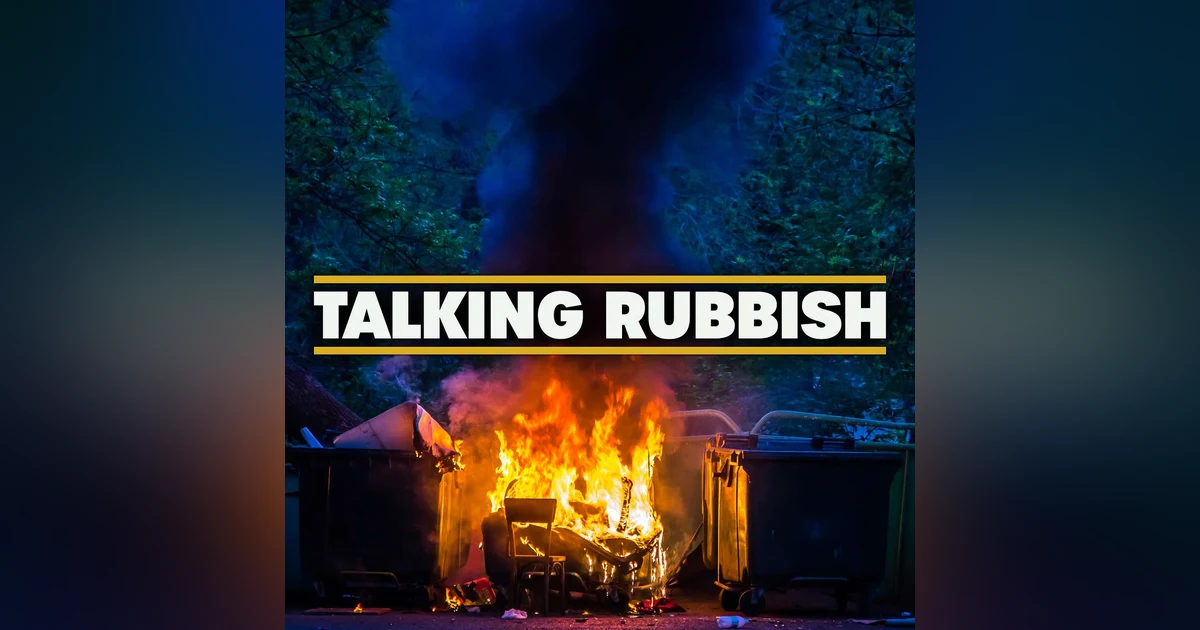
107. Why our bins keep catching fire


 Apple Podcasts
 Spotify
 YouTube
 Amazon Music
 Castbox
 Podcast Addict
 PocketCasts
 Key Takeaways
- Fires at waste and recycling facilities are increasing exponentially due to the rising amount of lithium-ion batteries, vapes, and gas canisters ending up in household bins.
- A staggering 48 million batteries and small electricals were thrown into residual waste bins in London alone in 2025, highlighting a severe behavioral challenge rather than just a lack of awareness.
- While public awareness of bin fires is relatively high, personal accountability remains low, with many people incorrectly assuming that safely managing sorting risks is entirely the responsibility of waste recyclers.
- Industry experts propose implementing a £5 deposit return scheme on vapes to successfully incentivize returns and combat the rising fire hazard.
Fires at waste and recycling sites are becoming increasingly common, with batteries, vapes and gas canisters ending up where they shouldn’t. In this episode, we look at why our bins now contain more energy than ever before, why awareness alone doesn’t seem to be solving the problem, and how these fires could make recycling increasingly expensive. Plus, we discuss a deposit return scheme we can actually get behind: a £5 deposit on vapes.
Plus, are pregnancy tests rubbish or not, will BuzzBallz be included in a deposit return scheme, how will honey be packaged in our dream shop, and is fly tipping really cheaper than littering?
Join hosts James Piper and Robbie Staniforth as they delve into the world of recycling, hopefully having fun along the way. One thing is for sure, they will talk absolute rubbish from start to finish.
Please take a moment to complete the Simpler Recycling tracker
We would love you to join our community on Discord
Special thanks to our sponsor, Ecosurety
To get exclusive videos and clips, follow us on Instagram, TikTok, Threads or Facebook; @rubbishpodcast or YouTube: @talkingrubbishpodcast
Or you can contact James and Robbie with questions or just general rubbish musings using the email address talkingrubbishpodcast@gmail.com or by texting them via WhatsApp on 07356 069 232
Relevant links and reports mentioned in the programme can be found on the Talking Rubbish Linktr.ee
Transcripts and episodes can be found on the Talking Rubbish website
Timestamps:
Why our bins keep catching fire - 00:55
Additions and corrections - 23:04
Rubbish or Not: pregnancy tests - 31:26
Rubbish News - 37:47
Are BuzzBallz in scope for deposit return schemes? - 44:43
Green Grocer: honey - 49:26
Residual Rubbish - 54:03
Music licence ID: 6WPY8Q4O2RPFIOTL
Frequently Asked Questions
Why are recycling bins and waste facilities catching fire more often?
Bins contain significantly more energy today than they did in the past due to the proliferation of lithium-ion batteries, vapes, and small electronics carelessly thrown into general rubbish.
Are vapes recyclable and why are they causing fires?
Vapes contain powerful lithium batteries that spark and ignite dry materials like cardboard when crushed inside waste trucks or recycling plants.
How can I safely dispose of batteries and vapes?
Batteries can be recycled at most major grocery retailers that legally provide battery collection bins, and vape retailers should offer dedicated take-back schemes.
What is a deposit return scheme for vapes?
A proposed deposit return scheme would add an extra fee, such as £5, to the purchase price of a vape, which consumers get back when they return the device for proper recycling.
James Piper
Hello, welcome to Talking Rubbish, your radio podcast that we deep into the world of recycling and discussing the truth behind snappy headlines and one-sided stories. In this episode, we will discuss the increase in recycling fires. Are pregnancy tests rubbish or not? I have a question about whether buzzboards are in scope for DRS. How will honey be packaged in our dream shop? I'm James Pofa and I'm joined by Robby Stanley. Hi Far from Rubbish Fred. Good morning, Robbie. Morning, James. How are you today? Yes, very good. Thank you. Happy two years.
Robbie Staniforth
Yeah, two years, yeah. Pass me by. Yeah, no, I I had to check because I was like, it must have been August sometime, and it was actually August the 1st. Yes, 2024, that we released our first episode. Yeah. No meals.
James Piper
No card. No flowers. I'm very sorry.
Robbie Staniforth
Me too.
SPEAKER_02
Trash tour.
James Piper
Today we want to discuss the increase in battery fires. Not just batteries, vapes, electronics, gas canisters, the fire starters.
Robbie Staniforth
Yeah, I mean, there's plenty of sources of ignition knocking around the world of waste.
James Piper
And prepare yourselves, guys, because you are going to hear today about a deposit return scheme I fully support. Ah, yes. I don't hate all deposit return schemes. There are some I would be very, very keen to see in place, particularly ones that are linked to fires. But we'll come on to that. A while ago, we did an episode on fire on battery fires. I think it was episode 73. Okay. And to set up, or the inspiration for that episode, I should say, was you and me going around a mirth in Avonmouth. That's right. And we were chatting to Stuart from Suez, who was telling us all about the fires. And it just so happens that that exact mirth that we toured that inspired episode 73 has itself now experienced a fire.
Robbie Staniforth
I know. It's so tragic, somewhere that you sort of know and have appreciated the difficult work that they do trying to get through uh organizing and sorting all of our household waste and some commercial waste too. Suddenly part of it was caught fire and they're now dealing with the consequences of the not just cleanup, but what do we do next? How do we get it operational and running again?
James Piper
Yeah, I just thought the irony of the site that we taught. Oh no. To have a discussion about fires that inspired our discussion about fires, now having a fire is so depressing. And it is far from the only one. In July 2026 alone, there was a fire at a waste transfer facility in Southwark, a fire in a landfill site in Fife, a recycling centre in Wimbledon, Northampton, Widness, Perth, the sewers and Avonmouth one that we've just talked about. And then August didn't start too well because on our anniversary, Robbie, August the 1st, there were two fires at a landfill site.
Robbie Staniforth
At two landfill sites. God, it's like it's really, this is serious stuff. You know, it's all well and good, sort of saying, look, it's just par for the course and we got to deal with it, that it's become commonplace. So it becomes sort of normalized, doesn't it? It's like, yeah, we're gonna have fires because of this. It's like, no, this is needs to be sorted out urgently and desperately, this issue.
James Piper
And it's the landfill ones. I mean, that they're not the worst, but they're the ones that concern me because one of the very few environmental benefits of a landfill, and when you have these people come on who say, don't incinerate, send it to landfill, that's because the environmental benefit of it is that you're locking away carbon. And you have a fire, it releases the carbon that you've locked away. So I've often, or we've often talked about fires at recycling sites, but not landfills. And where we've got things like heat waves, which are drying all of our all of our landfills out, all of our packaging out, whatever, whatever's out there is getting drier and drier, it makes those fires more likely. And you're just undoing the benefit that a landfill brings.
Robbie Staniforth
Yeah, certainly at this time of year, it feels like any source of ignition and it's just gonna go up because there's fuel absolutely everywhere.
James Piper
And that's why recycling is so likely to catch fire, because you've got dry cardboard and these things that are very ignitable, and you're putting with them a battery or an electronic or a vape or something that's just started a little fire, it very quickly can spread amongst the dry recycling. And uh typically, when you see CCTV of fires that have happened in recycling centres, that's what's happened. You've got a small ignition to start, but it rapidly spreads through the recycle it. Yeah. The fires that we talk about and we read about are just the incidents where the fire was big enough to write about it. I mean, we don't talk about the ones that were detected, but managed and stopped. And there are more than a hundred incidents a month in recyc across recycling. But again, we're only talking about maybe a dozen that actually made the headlines. Sure. There are lots that are controlled, managed, put out that just we never hear about.
Robbie Staniforth
It's really important to make that point though, that we're not just talking about ten or so big fires a month. We're talking about hundreds of chances that there could be something potentially catastrophic. And it's not just obviously about plant and equipment and decreasing the amount of recycling we can do, etc. It's about people who work in these plants.
James Piper
And from memory, it was essentially doubling it. It had gone from 700, I think, in 2023 up to 1300 in 2024. So it will be higher again. When they release new numbers, it will be higher again. You'll start getting into 2,000, 3,000, 4,000 instance, and it will just keep increasing because ultimately our bins have changed. You know, 20 years ago, our household bin contained what? Newspapers, food waste, tins, glass, very, very predictable bits of packaging. And today, our bin contains energy, a lot of energy. We're taking out the recyclables and putting them in the recycling bin. And what's left, if we don't manage batteries correctly, is just a bin full of things that could go up once they start being crushed. And I guess that's the exercise I wanted to do prepared for this. I just thought I'll walk around my house and think about how much my house has changed. And you walk around, you're like, come on, my toothbrush has quite a sophisticated battery in it. My watch has a battery, my razor, my biscuit tin now. Thanks, MNS. And even a lollipop, which we're going to come on to as part of my residual rubbish.
Robbie Staniforth
Oh gosh, okay. I'll talk about that.
James Piper
That's nicely themed, my residual rubbish, to this uh strash talk. And we know vapes are a significant problem, right? And I don't vape, so I don't have any in my house, but we know that's a significant problem. And according to UK Fire Training Limited, vapes accounted for 23% of incidents. And vape fires are increasing despite the ban on single use. And we've talked about it before, reusable vapes are just single use with another name. They've just put a USPC charge point on what was already there. I had a little look. The shop down the road from here, they were selling vapes. They have a big sign in their window going, vapes £3.50. And I'm thinking, is that a long-term reusable product? Is that the price I'm expecting to pay for something that's long-term and reusable?
Robbie Staniforth
Absolutely crazy, isn't it? That's like throwaway money. It's probably the same price as a can of beer in the shop or whatever that gets consumed within, you know, in my terms, hours, you know, I sit over it and really cherish it. Yeah.
James Piper
It's the same price as it was before. You know, it's the same price as disposable, isn't it? So people act in that way. And we can tell that by looking at the numbers, because while there has been a drop in vape sold, so it's gone from 8.2 million to six million, that is not a significant drop if you think, well, everything should be reusable. So if everything's reusable, you're expecting what, 8.2 down to, I don't know, a few hundred thousand because everyone's just reusing their vapes.
Robbie Staniforth
Yeah, there's only so many people who are vaping and therefore needing to buy a device. They've got their device, they don't need to buy another device. And also, it doesn't correlate in any way to the increase in fires. We haven't suddenly seen, oh great, it's dropped by what would that be, 25 or so percent. So therefore, fires have dropped by 25%, not in any way, shape, or form by looking at the data.
James Piper
We see this across the board where you ban something or you change something, and people just find a loophole. You know, we have gas canisters as well, and because we've got ROM behind me, which is our rubbish or not wall, I needed a gas canister because we did a rubbish or not on nitrous nitrous oxide canisters. I have a small confession. This is the one inaccuracy on ROM. Oh, really? It's not up there. It is up there. Oh, okay. Back here, I think. There we go. Oh, yeah. Oh, that's amazing. I knew where it was. Okay. Okay, that is a canister, right? That looks like a nitrous oxide canister. Yeah. That is actually a carbon dioxide canister. Because nitrous oxide canisters that are small, like the ones, I mean, for people on video, they're going to see this. So if you're not on video like the ones you find. You used to find littered everywhere. They've been backed, these small ones. So the only one I could get for Ron was a CO2. CO2 one. Okay. Because the big ones actually don't fit on this wall. Yeah, sure. It would have taken up a whole one of these segments, probably. When I went looking for one of these, I went to a dodgy part of town. Oh gosh. My neighbourhood. I'm gonna find a nitrous oxide canister. And I I looked for days, weeks, I couldn't find anything, but I found hundreds over the course of the week, hundreds and hundreds of the massive canisters. Oh, okay. You you ban disposable vapes, people go, that's fine. We'll just make reusable vapes exactly the same as disposable, same price, they'll look the same. Just put a USB-C charger on them. You ban nitrous oxide, people just buy bigger canisters. And because when you talk about reusable electronics, generally you're going to have more power with these nitrous nitrous oxide canisters being so big, they are now a real fire risk. So actually, the bands that you're putting in place create more risk of fire.
Robbie Staniforth
There's an old adage that a ban is only as good as the thing that is likely to replace it. So, in the instance of the incandescent light bulb, if people think back, it must be a couple of decades now since that was phased out and banned, there were readily available better versions of a bulb that saved more energy that would immediately replace the incandescent bulb. And there was lots of furor around. I like the orangey light, and it took a while to mimic that style of light. But the ban was good because of the product that replaced it. There was a huge oversight and lack of thought on what would replace these items. And actually, as you say, they're either just as bad and in some cases quite a lot worse.
James Piper
So whatever happens, nobody ban batteries. Because God knows what people come up with to replace the battery. So yeah, we've got gas canister bands, but the small ones, we end up with big ones. We've got disposable vape bands, but we end up with reusable ones, and we've got batteries. Those are the main fire starters for a recycling centre. And there was a really interesting news story that I saw yesterday, actually, from East London, which showed that there had been a 52% increase in fires between uh 24-25 and 25-26. So those financial years. 52% increase in fires, which they were attributing to batteries. And they had estimated that 48 million batteries and small electricals had been thrown in the residual bin in 2025. But 47% of Londoners surveyed said they were fully aware that throwing them in the bin causes fires in bin lorries or waste facilities. So a larger propor I feel a larger proportion of people are aware of the fires, but that is not reducing the fires. And this tells me this isn't just an awareness problem, it's a behaviour problem. I think I think we've got a, I mean, we we've all been there, right? If we're completely honest with ourselves, we've all been there where we've got a small battery and we're like, am I gonna take this back to a store or can I just throw it in the bin? Yeah. And you're not, and you're thinking, well, I'm not gonna cause a problem, am I?
Robbie Staniforth
Yeah, no, that's absolutely right. And I think, you know, before I understood the world of waste management, so casting my mind back to 16-year-old Robbie hovering over a bin with an AA battery, I would have definitely put it just straight into the bin. Like I I didn't, I I maybe knew to a degree that it shouldn't go there, but it would have been too much hassle to have taken it anywhere else. And and you sort of, as you say, it's not going to be me who causes the issue further down the pipe. No one's ever gonna know. And the reality is no one does ever know who was that person. It never gets tracked back to anyone. There's no personal accountability in taking that wrong action in the moment. Of course, since then, as soon as you do adapt your behavior and realize that's just totally unacceptable, and start putting it somewhere else, then that just becomes normalized in your own household. And likewise, when I've shared households with other people, being a student, etc., it's very quickly you sort of understand what is the rules of engagement. So, in terms of what you should be doing with those things, the batteries, the vapes, the gas canisters, it isn't as hard as I've got to take the store them all up and take them back to my local recycling facility. Yes, you can do that, but there are additional options for batteries and for vapes. For batteries, anyone who's selling a certain amount, most major grocery retailers have to legally have a battery bin. So it's not just I've got to wait for that time when I go to my local recycling facility. You can actually do it every time you go grocery shopping, you can deposit your batteries. And likewise with the vapes, whoever's selling them to you should have a scheme to take them back. So it's sort of similar. It may be a grocery, maybe um a smaller format store, but there are places to take these things. It isn't as difficult as waiting for your annual run to the tip. Um, there's plenty of ways to avoid this.
James Piper
One of the issues, I guess, is that people listening to this who have chosen to listen to a podcast about recycling are probably doing the right thing. Or you at least want to do the right thing. Yeah. You know, and I I think I don't get anything from BIMFluencers countering any of these views. So whenever we've done an episode about fires in the past, episode 73, where we talked in depth about this, I don't get anyone come back to me to say, well, that's a load of rubbish. However, what I do is cut some of our discussions up and put them up on social media.
Robbie Staniforth
Okay, to a much wider audience.
James Piper
A much wider audience, absolutely, yeah. Much wider audience who have not chosen to listen to a recycling podcast. They have had recycling thrust upon them by the algorithm. And back when we released episode 73, I put up a clip of us discussing battery fires. And if I just read you some of the comments to give you an idea of kind of what I think we're experiencing in the public, here is and obviously there'll be some trolling in this, there'll be some just Yeah, I I'm behind a keyboard, I'm anonymous, I can say what I want. But just to give you a flavor of the comments, every battery I've ever used has gone in the bin. Millions of batteries go in the bin each year. So what? I literally put all my batteries in the bin. And perhaps the most depressing for me was I keep telling my parents that batteries don't go in the bin, but they don't listen. Beyond these comments, there was a common theme, and I think we discussed it a little bit before in the podcast, but I'll bring it into this discussion as well, which was if a recycling plant can't withstand a battery, it deserves to burn down. That was a that was a general theme. This is the recycling plant's fault, not mine.
Robbie Staniforth
Fortify yourself against this risk is what they're saying.
James Piper
It's obvious this is going to be a risk. Why haven't you built around it? And I think it's just worth reflecting that the world is a very different place compared to when these MERFs were built, you know, 10 to 20 years ago. I had a look at lithium ion battery storage. So 10 years ago, the amount of capacity in lithium ion batteries in the world was about 79 gigawatts, I think. Gigawatt hours, I think is the official way of saying it. Um, this is a website I found, I'll put it in our link tree. Again, I don't know how accurate it is, but it gives us the theme. 10 years ago, 79 gigawatt hours, and in 2024, that was 1,260 gigawatt hours. Wow, yes, it's pretty exponential. Yeah, I mean, it's more than a 10 times increase. Well, more way more than a 10 times, almost a 20 times increase across those 10 years, and it's forecast to 4x again as a minimum, because you'll talk about electric vehicles, you'll talk about scooters, bikes, everything that's got these batteries in. I mean, it would be way more than 4x in the next 10 years. And that and that's the important thing. We have more power in our homes than we have ever had before. And that means that we have more power in our bins than we have ever had before. As I say to people who were commenting on our socials, batteries, gas canisters, vapes, when they get crushed, they might start a fire. Not all of them, very few of them as a percentage. Very, very few of them will start a fire. And so millions of batteries will go through our system without starting a fire. However, if the numbers increase and there is a 0.01% chance of a battery catching fire, if the numbers are increasing, well, the risk increases. Sure, yeah, it's as simple as that. It's just a maths thing. It's nothing, you know, there's no there's nothing clever here. It's just you put more batteries on the market and occasionally a battery causes a fire. Well, you've just increased the risk of a fire. And that's why we're seeing more and more of them. And every one of those fires costs money. Every one of those fires takes out UK recycling. And uh my argument back to these people who were saying it should, it's the responsibility of the recycler, not me. My response was, but how would you filter for that? So the only way of doing it, and we de we definitely discussed this on the podcast before, so apologies for the repetition. The only way of doing it is to screen people's bins. Yeah. And to say, well, I'm not putting that on the truck. Yeah, bin soupers. Yeah. And so what's gonna happen? They're gonna have some X-ray scanner on your wheelie bin. They're gonna say, you put a battery in that wheelie bin, I'm not tipping it into this truck. You now need to dig through your bin to take the battery out before I'll take this bin. That's the only way of stopping battery fires on trucks and in recycling centers. So actually, all these people saying, well, it's the problem with the recycler, not me, they will make it your problem.
Robbie Staniforth
Yeah, absolutely. They're not gonna set up, and they do have some, but they're not gonna set up full screening at the front and go digging into it themselves. It's just way too expensive. This is a push the problem back upstream in terms of, you know, mitigate it or avoid it altogether. And, you know, people are very resistant. These same types of people who uh think it's the problem of the waste managers are very resistant to anyone looking in their bin and saying they can't do what they've already done, sort of thing, and unpick uh the battery going into the bin. The technology is pretty good and pretty readily available, so it's a kind of be careful what you wish for. I personally think it's probably an eventuality at some point in the next five to ten years that there will be more screening of what goes into the recycling and the general waste truck, even, because this is getting to be such a huge problem. Insurance going up massively for all of these sites, because the insurers and the underwriters are just sitting there saying, it's happening more often. What mitigations have you got? No matter what mitigations you've got, it's still more likely to happen it compared to 10 years ago. Therefore, your premiums are having to go up.
James Piper
And the average insurance claim is about £50,000 now, and that is increasing, and we are then seeing more and more claims each year. And you are right that uh, you know, recycling will become uninsurable, in my opinion. Or we'll all end up paying a lot more to manage our waste. So councils will see their costs increase exponentially to cover the insurance, or recycling plants become untenable and close. Which which leads us nicely into a DRS I can get on board with. Aha. Here's the good news. Well, not good news if you smoke a vape, but back in June, the EESA put together a proposal and they said we should have deposits on vapes. And Biffer said that deposit should be five pounds. They felt that was the level that would encourage people to bring them back. And I could not agree more. Yeah, sell a vape for £3.50 shop down the road, add a fiver onto it. It's £8.50 now. They get their fiver back when they bring it back. I £100. If you like the my all the problems I had with deposit schemes on drinks are around how necessary is it when you've got curbside recycling. If bottles were exploding in our bins, I'd be saying, get them back to store. However, and I'd be fully supportive of the DRS scheme because you've got something else in the mix.
Robbie Staniforth
Yeah, and this is something that's been floating around for a long time. And my worry is it isn't just about the waste management industry coming together to say we need to prevent it and we need to manage it, and that's why we need a deposit return scheme. It's actually for much broader advocacy groups to say, you know. Whether it be around littering and the environment, or whether it be uh around health and children starting to um to vape when they never would have smoked, and all of those studies um around that behaviour to actually gather behind the idea of this DRS thing, because it is absolutely not just about these fires. Of course, that's very, very important part of it, but it's simply around the fact that they need to be managed and collected at much higher volumes than what they currently are for lots of different reasons.
James Piper
Absolutely. So just to wrap this trash talk up, 20 years ago our bins were full of rubbish, and today they're full of batteries, lithium cells, gas canisters, electronics. Our homes have changed. And the products that we buy have changed, and the way we buy them has changed. And unfortunately, the way people throw things away has not changed. It has not kept up with our product mix changing so much. And if we don't change that, these fires, they won't become less common, they will become normal. Additionals and corrections. Tony left us a review a few a few weeks ago. I think he was called, was he called West of View? And he said at the end, I've done some calcs on dental-related products, which I'm gonna send you over email. And we made a comment quite a while back, actually, I think it was back in November 25. We made a comment saying that with recycling, you want to keep it all intact, and we would advise not cutting up toothpaste tubes. Ah, okay. To get out the last bit of toothpaste. Well, Tony did some calcs and discovered if you don't apply what he referred to as the cut and scoop method, then you miss 8% of the toothpaste.
Robbie Staniforth
Wow.
James Piper
That's a lot. Okay. It's an awful lot. Now, this is what we like to see, Tony. This is the kind of pedantry that's going to win us a British Podcast Award. So thank you so much. Now, generally, I am against cutting packaging. As I say, recyclers want things in predictable shape. Yeah, they do, yeah. And we want to keep the collectors, the waste collectors, safe from sharp packaging. You know, we discussed before the Guinness can, we've got one up here with the nitrogen widget, which is there in the middle. Um, don't cut the can open to get the nitrogen widget because you've just created a hazard for the collectors. And so we don't want to do that. However, Tony has convinced me because eight percent is a lot of product. So if Tony managed to scoop out eight percent after cutting his toothpaste tube, I think I'm gonna allow people to cut their toothpaste tube.
Robbie Staniforth
I just think it is it really eight percent? I can't I'm struggling to believe because I've got my current toothpaste tube probably was finished, finished about three weeks ago. And I'm still going, pushing really hard with the tiniest bit of peace um uh toothpaste coming out each time. And I suppose it depends how fastidious you are with sort of pushing it right to the end and stuff. I think 8% is a bit high.
James Piper
Okay.
Robbie Staniforth
I think there might be something left in your code. Can I challenge you to cut open your toothpaste tube when you get home? No, we don't recommend it.
James Piper
No, I'm about to recommend it. Can I challenge you to cut up your toothpaste tube when you get home and see how much product you get, weigh it before and after, and then compare it to the product that was in there, and then bring that to additions and corrections next week. I'll I'll addition a correction. Great, that's perfect. Because the way Tony did it was he weighed his tube, cut it, scooped out what he could, and weighed it again. Okay. And decided that was 8% of the product. Anyway, I am going to revise our advice because Binfluencers, you guys like the detail, and I feel like we can change this slightly. So you I will allow, and I think it won't affect recycling, cutting off the very end. So the you know, like the crimpy bit at the end.
Robbie Staniforth
Oh, the crimp bit at the end.
James Piper
I think if you cut that bit off and then get in and scoop. Yeah. I think if you cut it in half, no, you have now made it too small, too difficult. Yeah. Okay. But uh I think I will I will change that. One rule I'm not changing is don't roll them up. They need to be big for reset. Don't roll them up. Keep them toothpaste shape, but you can cut the crimpy end off to get the whatever percentage it is. Look forward to Robbie telling us next week. And yesterday, as this episode goes out, uh PPWR started. Oh, yes. Of course. Yeah. But uh one thing that is interesting, and I spotted, is days before it went live, so just last week, as this goes out, there was a softening of the rules from the European Commission. Oh, okay. I didn't spot this. So they issued guidance asking authorities to prioritize warning and corrective action and saying that recalls and market withdrawal should be reserved for persistent non-compliance. Wow. Okay. This is so irritating because the this is the risk of trying to introduce something bold and not phasing it in. You know, so we talked before about with flexible plastic, and lots of people have commented, by the way, on our flexible plastic episode to say phasing is the answer. Yeah, sure. 50 local authorities, 100 local authorities, 150 local authorities do that every year. You build capacity. The European Commission are switching everything on at once. And because it's so bold, the brands then become convinced that you're not going to launch it on time because they're like, well, this is so big, it's going to get cancelled. And so they don't prepare properly because they're convinced it's going to get cancelled. And then just before the deadline, they're going, Well, we're not ready. And so the European Commission says, Well, we can't afford to not have all these products on the market, so we'll just remove some of the more heavy-handed kind of restrictions, and we'll make it a bit more voluntary. And then the brands will prove to be right. And so it's exactly the same thing that's happened with flexible plastic. No one believes the deadline, they don't prepare, they say we didn't prepare, they say, okay, we'll move the deadline, or we'll soften the deadline, or whatever it is. And it is so frustrating because it is the brands that have invested huge sums of money getting ready who are now out of pocket, sure. And the ones who are unprepared benefit. And I just in the world of recycling and sustainability, you get to a point where it's like, I just don't believe anything that's being said. And that is the conversation that's going to be happening in brand boardrooms. And they say, Yeah, we got this thing coming in. But it's not going to be as bad as it currently is written, or it's not going to be as bad as they say, so let's not completely prepare. We'd like to take a moment to thank our sponsor. EcoSurity, who are on a mission to rid the world of unnecessary packaging. They help brands navigate the tricky world of extended producer responsibility, but that is not. Or they also collaborate on some incredible recycling projects and consumer awareness campaigns for those tough to recycle materials. If you're an organization looking to make smarter packaging choices, check them out at ecosurity.com. I continue to be relieved that they have not changed that. You know, there was this threat of changing it, and I was like, oh god, I can't learn a new one. Yeah, I mean, it's quite nice that it stayed the same. Anyway, if you want to help our podcast to grow, then the best thing you can do is tell your friends and family about it, or you can leave us a review. And if you leave us a review, you could be Robbie's review of the week.
Robbie Staniforth
And this one comes in from Kevin via WhatsApp.
James Piper
Thank you, Kevin. People taking up the mantle, a WhatsApp review.
Robbie Staniforth
A WhatsApp review, yeah. As requested.
James Piper
I mean, just remember, guys, before Robbie gets into us, just remember I need more reviews. You don't have to just be on Apple. You can WhatsApp, you can email, you can Spotify comment. I will find it.
Robbie Staniforth
I'm getting to the point where if someone says something nice about the podcast on LinkedIn, I'm gonna just clip it and go, that's a review, isn't it, James? I actually have one.
James Piper
Oh god, what was it? I can't actually remember, but there was one the other day I turned to Ellie and went, is this a review? Can I use it? And she said yes. And I forgot. I haven't I need to find it because I can't remember what medium it came in on.
Robbie Staniforth
Write us a formal review so we don't have to go into these grey areas. So this one's from Kevin on WhatsApp. Talking rubbish has become my fixture of the week, not just a one-off listen. Most industry content and commentary either oversimplifies or buries us in jargon. Talking rubbish manages neither. Sharp on the systems, packaging, loopholes, EPR systems, landfill economics, but conversational enough that I actually look forward to the discussion rather than queuing it up out of obligation and feeling I have to. Months in and still learning something worth repeating in a meeting or on a train home, much to my passengers' amusement, I suspect. Thank you, guys, from someone whose job is to already know this stuff, but treats every day as a learning day.
James Piper
You can follow us on social media at rubbishpodcast, you can email talkingrubbishpodcast at gmail.com, or you can WhatsApp us. Also join our Discord. It's the easiest way to engage with us and listeners of a show. And the link to all those things is in the show notes. So just to share my workings, about 700,000 babies are born in the UK each year. And I ended up on a Reddit thread titled, How many pregnancy tests did you take? Which the top comment was 30 in the first few weeks. I was insane and do not recommend. And then there were loads of comments of people going, I was exactly the same. I also did 20 to 30. And I thought, oh my goodness. And then someone else had commented with the mean girls reference saying the limit does not exist. So I was like, okay, Reddit is not helpful based on Reddit's calcs. We're using billions of the days. And in the UK, that would be about 4.2 million, which felt about right. Um, the one I have, which is like a clear blue one, the one here. Okay. Uh, weighs 24 grams. So I work that out to be about 100 tons of pregnancy tests entering the waste stream each year. Robbie, 100 tons of pregnancy tests, rubbish or not.
Robbie Staniforth
Well, it's funny this one. I'm so glad that you've bought one to add to the rubbish or not wall. Uh, because when I closed my eyes and thought about what a pregnancy test looks like, having seen this segment come up, I was picturing a COVID test. I suddenly realized. No, mate, I've got COVID. I suddenly realized I had absolutely no idea about pregnancy tests. Um I mean, they're not designed for you. They're not designed for me, for sure. I've only had to interact with one once. Yes. I've got one daughter and no other uh false alarms, so to speak. So therefore, I don't know anything about these devices. However, I understand having seen the one that you've brought in, it's got a battery, it's hard plastic, it looks to me like it's an electronic device of some sort. And so, therefore, very similarly to other small mixed waste electricals, that's how you would dispose of it. So I just don't think we can call it rubbish because it's not going in the general don't put these in the general waste bin, whatever you do. Um, dispose of them with your small household electronics. Now, some local authorities, including Bristol, will take those from the curbside. So you can actually dispose of this kind of thing and recycle it at the curbside, whereas mm most local authorities don't have waste, small waste electricals collected from home. So you're going to have to go and take them back to uh either a retailer who's got um waste electronics take back or to a household recycling facility.
James Piper
Perfect. That's a great answer. I completely agree. One reason I picked this is because it fits neatly into fires, because it's a small electronic device with a battery.
Robbie Staniforth
Has it got a little button cell in there? It's that little button cell, yeah.
James Piper
Okay, fine.
unknown
Yeah.
James Piper
It's not a lithium ion battery, it's just going to be a button cell battery, but it's still an electronic item that we have to deal with carefully. Uh, clear blue on their website say before disposing of the test, remove the battery from the test stick, insert a coin into the slot on the back of the test stick, break open the plastic, remove the battery and dispose of it according to the appropriate recycling scheme, dispose of the rest of the test sticks according to the appropriate recycling scheme for electrical equipment, and do not dispose of electrical equipment in fire.
Robbie Staniforth
Wow.
James Piper
They made it sound horrendous, and it is horrendous. There is no easy way to get the battery out.
Robbie Staniforth
Yeah, why is that? Why do they have it like sort of they don't want people meddling with the battery or something?
James Piper
But then they're saying single-use locked-in item, isn't it?
Robbie Staniforth
When you're finished with it, they're saying to take it out. So make it easy to take it out. It doesn't make sense, the design.
James Piper
And it is, I mean, obviously, it's worth saying they're not all electrical. And I would argue the this is an area that has moved very much into the electrical. Because when you look at a lot of the kind of They used to be like COVID tests. When you look at the ones that are more like COVID tests, um, a lot of the reviews are like, I was getting false negatives. I think a false positive is very unusual, but false negatives or the line was too difficult to read, or whatever. Okay. So lots of people have transitioned to these kind of ones where it just says pregnant or not pregnant on the screen because they just feel more confident with it and comfortable with it. And I'm not, you know, I don't think that's necessarily a problem.
Robbie Staniforth
Maybe people were using 30 of the previous, more sort of analogue one, and then now they're using one or maybe two of the electronic ones.
James Piper
Interesting carbon assessment. When I tried to look at non-electronic versions, um a company called Ovum came up quite a lot. Okay. Uh now they make kind of a lot of them are plastic paper mix, and they partner with MVOW, who we know well. Oh, yes. Who do chemical recycling, um, and they will provide you a prepaid envelope to send it the used test back to mval for some chemical recycling, which is quite cool. And there are increasingly paper-based options coming onto the market which appear to avoid the mixed materials. So uh one I found was Hoopsy, that was 99% paper and appears to be coming to the market next month. So in September 2026. Oh, very cool. There we go. So one reason I picked this was uh the fire risk, Robbie. Uh, there is a second reason because Ellie and I had you our second baby. Oh my gosh, really? Oh, that's amazing. Congratulations. Thank you. I thought I'd announce it to you as we record this and to the podcast world. Oh. Which has put me under immense pressure because uh I'm rubbish at telling people. Ah, okay. And uh this is going out, you know, in a few days after we've recorded this. So I now have a frantic, you know, texting session.
Robbie Staniforth
Put yourself under pressure before they hear it through the podcast.
James Piper
People hear it through the podcast, and I haven't told them I'm gonna be in a lot of trouble. Yeah. But yes. Eli and I, baby number two. Oh, congratulations. Thanks very much. Rubbish news. Over the many, many episodes of Talking Rubbish we've done, you definitely noticed some consistent themes. And a fine for littering is definitely one of our consistent themes. Yeah. And last week someone called Anna reported in The Guardian her experience of littering. She was outside London Waterloo station and the bin was full. Next to the bin was a plastic bag. So this is very similar to your person in Tesco who had a the cardboard situation. Plastic bag at the base of the litter bin containing rubbish, and she had a coffee cup and she put her coffee cup in the bag that was there. An enforcement officer watched her do this and issued her a 500 pound fine. Wow. And this happened in Lambeth Council, that's where Waterloo is, which is the which is when the Daily Mail did a FOI, they found it was the second most fine issuing council. Okay. Does that make sense? Yeah, yeah, sure. What's the better English for that? The council that issued the second highest number of fines after Manchester City. Uh they had over 7,000 fines, Lamberth Council, so they are on it. These enforcement officers are paying for themselves. And I suspect there's lots of tourists around Waterloo. It's probably quite easy pickings for people who want to issue a fine.
SPEAKER_02
Yeah.
James Piper
I just thought this was insane. 500 pounds for a coffee cup when you're actually trying to put it in the rubbish. Now, I do get annoyed that the public do have a tendency when a litter bin is full to try and balance their litter on top of it or rather than going, oh, there's another litter bin down, I'll just hold on to it for five minutes longer. What I thought might be interesting is to think back to DTM Grabhire, who were prosecuted for dumping 3,490 tons of waste, if you remember. And this was the one where we talked about it being the price of a meal deal per tonne.
SPEAKER_02
Yeah.
James Piper
My question to you, Robbie, is if Anna had managed to get her coffee cup into the fly tip rather than the bin. So if Anna had said, I'm not going to try and throw this in the bin, I'm going to give it to DTM Grabpire, they can put it into their fly tip, and I will pay my share of the prosecution based on weight. Instead of 500 pounds, what would Anna have paid?
Robbie Staniforth
It's going to be a lot of decimal places or something, isn't it? It's going to be like 5p.
James Piper
5p? Yeah. You are right that it's got a five. Um, but it is more decimal places. So it is 0.05 pence. Oh my god. So she would have paid, I think, if my mouse is right, a billion times less if she'd been part of a fly tip compared to actually trying to throw something away at a train station in you know, next to the bin.
Robbie Staniforth
I mean, it totally highlights the disproportionates between organized waste criminals and just someone trying to do the right thing, albeit slightly ill-judged. Uh, it's just not fair.
James Piper
A lot of the conversation on Discord was this encourages councils not to empty bins. You know, because if there's a cost to emptying a bin, to drive around emptying it. If you can make money by not emptying it, because you can start prosecuting it. Driving from a distance. It's very scary, isn't it? It's the wrong motivation. Now, I'm not suggesting councils do that, but it's a good point that it will discourage councils from emptying bins.
Robbie Staniforth
So, my rubbish news this week comes in from a very fun story from southern Italy. Um, and it's all to do with digging through the rubbish. Um, so do you remember we talked a long while ago about the guy who lost his cryptocurrency in Wales and he just couldn't convince them to open up the landfill site and let him go find his potentially millions and millions of pounds worth of cryptocurrency? Well, someone in southern Italy, unnamed person for obvious reasons, bought a winning lottery ticket, disposed of it in their household waste, and did manage to convince the council and local waste managers to tip all of that weekend's rubbish, all of that week's rubbish, somewhere else so that, and then paid for them to sift through it, and they did find the winning lottery ticket. It's unbelievable. So this guy um uh uh effectively realized only because one of his family members pointed out to him, aren't those the numbers you always usually choose? And he was sort of like, Oh yeah, they are, patted down his pockets and was like, Oh no, the ticket's gone into the rubbish.
James Piper
Do you know why he threw it away? I saw this story. Oh, did you? Okay. Yeah. He threw it away because when he went to the shop to get the lottery ticket checked, the shop till came up saying unpayable. Unpayable. And he thought that meant it's not a winning ticket. Yeah, I read that and I didn't understand it. What it meant was this is too much money for you to pay out of the till. So he just completely misunderstood what unpayable, which I would as well. He said, Oh, no, there's no money, it's not payable. Yeah. I can completely understand why you threw it away. But unfortunately, it was the opposite. It was that it was too much.
Robbie Staniforth
So much money, you're not gonna get it from this country. So it's like a million euros. Yes, it was a million euros. I read that and I just couldn't quite understand what they meant by unpayable. So, yes, that caused him to get rid of it. Um, he then uh very kindly, the waste management company said, yes, we'll tip it in a separate location, provided you sign this contract and agree to pay for our services to route through it. And the luckiest thing was that it was a Sunday when this all happened. So they hadn't that it wasn't working the plant or whatever. So they were doing it on a day when It hadn't already gone off and been processed. If it had been in the middle of the week, this rubbish would have been gone, sorted, processed into much bigger piles, potentially landfilled or burnt already. So he was so, so lucky. And I cannot imagine what it must have been like to be handed over this ticket by these brilliant waste pickers who, a team of a couple of people, literally manually sifted through this stuff for him. Found numerous lottery tickets, by the way. So they found some. Oh no, it's not that one, it's not the right numbers, and then eventually got his winning numbers.
James Piper
Of course, loads of people will have thrown away lottery tickets. Oh my goodness. Yeah, what a tool, what a task. Amazing story. Rubbish question. So this came up because of buzzballs. We had all this conversation about buzzballs on LinkedIn. Loads and loads of conversation about buzzballs on LinkedIn. And a consistent question kept coming up, which was me saying obviously they might be quite tricky for DRS because they're the wrong shape and they're just tricky because they're hard to recycle. Which is it? Yep. And everyone kept commenting, well, they're not going to be included in DRS, they're mixed material. And I thought, they definitely are, but I now need to find out. Because we've discussed before the biggies. Yeah. And the fact that they will be included in DRS because they're just completely PET. Yeah. We haven't discussed the small tennis ball-shaped ones.
Robbie Staniforth
Okay, fine. So our other conversation was that yes, they're included in DRS, they just won't go in a conventional reverse vending. They won't fit in the reverse vending. So you'll just have to manually there's there will be provision for manually taking stuff back to shops and getting your deposit.
James Piper
Yeah, these will fit in reverse vending machines, but it just depends on whether they're in scope or not. Do you think mixed material, plastic, aluminium mix will be in DRS? I don't think so. I think it's too difficult. It is. Is it it is in DRS? Wow, okay. Yeah, I confirmed with Martin, who's been working on this, that they are going to include buzz balls in UK DRS.
Robbie Staniforth
Well, that's brilliant. I mean Well Isn't it brilliant? Well, it is aluminium and PET, and both of those materials are included in DRS. It is brilliant because I'd hate the loophole.
James Piper
Yeah. If they said it's not in DRS and you wanted to get out of DRS, then you could just make the plastic aluminium mixed can, which we hate. Suddenly we'd see it everywhere. So don't so I don't like the loophole. But what they said, what um Exchange for Change said is if you've got mixed materials, you need to come to us to ask what's included in DRS. So there was a question mark. Okay. The reason I don't like this is because everyone I speak to who's positive about DRS, everyone who thinks I'm wrong, says, but James, we're gonna get this amazing clean stream of material. Ah. And I'm now gonna turn around and say, Are you? Because it's gonna be full of buzzballs that are not a clean stream material that need extra processing and now need sorting, probably manual sorting from your material. You're not this is not good. This is not good at all.
Robbie Staniforth
No, but James, it's not gonna cost that much more for a reverse vending machine to guillotine off the top of a buzzball. There's now gonna be like a guillotine inside these already ridiculously expensive RVMs.
James Piper
This is a disaster. This is a disaster. But so I thought I'd have a quick look at Ireland, because obviously Ireland have introduced a DRS. Yes. If you go to Tesco's Ireland website or any retailer in Ireland, the drinks all have plus deposit next to them. So they have the price, plus deposit in the listing. So Buzzballs does not have that in Ireland. Oh, really? I do not think Buzzballs has a deposit in Ireland. I don't think they're included in DRS. And certainly when I went over to Dublin, I saw lots of Buzzballs littered.
Robbie Staniforth
Okay.
James Piper
And I kept thinking, why aren't people picking them up for deposits? And I just don't think it will go through a reverse vending machine.
Robbie Staniforth
Okay, so if you're listening in Ireland, definitely write in and let us confirm one way or another whether.
James Piper
So I so I wrote to do you remember we had that guy who was complaining that he'd put his coffee in a can because he was using plant-based milk. Oh, yes, yeah. His was including DRS, but his competitors weren't. Yeah. So I wrote to him and said, Have you ever considered a plastic aluminium mix? Because it appears that buzzballs aren't included. And he said, No, no, they're definitely included. And I showed him the websites and he went, Oh my goodness, I didn't know this. So I actually don't think this is common knowledge. And I think it is a big loophole because if you wanted to avoid DRS in Ireland, if there is a cost and you're putting a cost to a customer, I guess in theory, you could start using this very unrecyclable material. This is why it's really important it's included in DRS in the UK. Sure. So you don't just create a a wave of unrecyclable material on the market. But it does counter everyone's view that DRS is going to create a really clean stream of packaging. I just don't believe that.
Robbie Staniforth
But I feel like if it wasn't included in the DRS, say in in the UK, and it was included in EPR, obviously, which by default it would be if it wasn't in the DRS, you could then use the recyclability assessment methodology to make this format red and penalize it very highly because it is exactly what we don't want.
James Piper
Greengracer. So we're creating a dream shop.
Robbie Staniforth
So this week I just sent you on WhatsApp the simple emoji of the honeypot. It did put me in mind of the traditional uh ceramic, I suppose, honey pot that Winnie the Pooh used to uh wander around with um eating it with his hands or whatever. There's so many different formats out there of honey, aren't they, in terms of packaging? It's one of those things where you've got really premium versions and then very low-cost versions, and therefore they're all slightly differently packaged. So I wondered what we should put into our dream shop.
James Piper
Yes. Well, I narrowed it down. I mean, it's a choice between glass and PET, isn't it? You've got the PET kind of squeezy bottle or the glass jar with the metal lid. And I think in both instances, what you're trying to do with honey is prevent oxidation. Because honey is amazing. You know, it always comes up on those lists of foods that never go off. Yeah. And uh they found it in Egyptian tombs, honey, including. I think Tutankhamun's tomb had honey in it that was still edible, 3,000-year-old honey. And as long as it hasn't been exposed to the air, honey is amazing because it's got a really high sugar content. It's quite acidic. It's uh pH 4, I think. It's quite acidic. Oh, okay. Um, bees actually, when they're making honey, they pass on an enzyme that releases hydrogen peroxide, which create which is an antibacterial, um, it creates an antibacterial effect. And it has very low moisture. So these four things combine to make honey actually quite difficult to go off. It can go off, um, but it is hard. And I've never I've never had honey go off. No. But it it definitely can if it's like exposed to the air, or like if you were boiling a kettle, you create a quite high humidity that would land on the honey and could cause microbes to grow. It's not growing necessarily on the honey, it's growing on the ground. On the top layer moisture that you've added to the jar or to the plastic. But we are trying to keep it sealed as best we can between eating it.
Robbie Staniforth
Because that's for the crystallization, that that issue that you have of No, crystallization just happens over time.
James Piper
That's just natural.
Robbie Staniforth
That's nothing to do with air getting in or yep, okay, fine.
James Piper
No, like if you put it in the fridge, honey, you're gonna get crystallisation much faster.
Robbie Staniforth
Okay.
James Piper
Um, so that's not really anything to do with going off. Going off is gonna look like going off, it's gonna have mold on it.
Robbie Staniforth
Yeah, sure.
James Piper
Um the biggest risk to honey is the double dip. And I was gonna talk about this before when we talked about beans, but we ran out of time. Okay. Um Bold Bean did a really interesting post, which was people are complaining our beans are going off too fast. And they couldn't quite understand it because they were like, they should last a long time in the fridge. What people were doing was eating out of the jar, and they were putting the spoon in, eating it, and then putting the spoon back in with their germs from there.
Robbie Staniforth
That better have been a personal jar of the fine.
James Piper
But with honey, you're basically having the same thing, right? You might have a knife that's had butter on or it's hip or toast or whatever, and then you're going back into the honey jar. Yeah. That's where you're gonna get contamination from.
Robbie Staniforth
You must, must, must use a clean spoon.
James Piper
So, we're keeping it in a dark cupboard at home, both PET or glass work. If we were just talking about carbon impact of like the creation of the packaging and transport, I'm gonna pick PET. Same as our previous weeks tend to go towards plastic. But I did wonder whether sticky honey would be difficult for recyclers to wash out. Oh, yeah. Now, this is a conversation we've had on Discord. Wash should be fine. Yeah, we've had this conversation on Discord a few times, and we think it's all right. And actually, someone on Discord said what they do is they use glass and then they rinse it out with boiling water at the end. Yeah.
Robbie Staniforth
And then they use that to sweeten their coffee. Delicious. Put a bit of lemon in it and just drink it straight down.
James Piper
So I'm not gonna go for plastic, I'm gonna go for glass. Now, I'm doing this on the basis that what we're selling is And we can't put it in a pouch, you're sure of that. Which is good because we said don't do a pouch. It's gonna get too sticky in a pouch. Yeah. But I think as long as you've got local honey, you negate some of the transport issues of glass. Because even though it's heavy, we're not transporting it very far. And I think the jar is really useful at the end of its life. So my life with this honey is gonna be I'm gonna eat the honey out of the glass jar, I'm gonna rinse it out and use it to sweeten my coffee, clean the jar out, and I'm gonna use it to store something else. Okay. And it's that use of the jar that I think tips glass over the edge. Residual rubbish. This is something that has happened to us this week that has made us feel like an emoji. My one is not necessarily this week, although the experience will be, but I actually bought this product a while ago. Have you come across the Amos Lollipop, Robbie?
Robbie Staniforth
Absolutely not. No. No. And I think fortunately not, by the looks of it.
James Piper
I've got one here. The tagline is listen to music through your mouth. And I have been saving this one. I'm just opening it. I've been saving this one for um the fire episode, because it's another completely pointless bit of electronics. I'm just opening it up here. Okay, we can hear the rest of it. So it comes in a cardboard box. We have a plastic bag with um earplugs in. Earplugs. Foam earplugs, apparently to make the effect better. Okay. We've got a foil wrap, and within that foil wrap is a lollipop. So this is for sensory deprivation, is it? Luckily, I've got headphones in right now. So this is sold by co-op. Yeah. £6.99, £7.
Robbie Staniforth
Yeah.
James Piper
You press this button to turn it on, apparently that creates a red light. Let's see what happens.
Robbie Staniforth
Long press the button to turn on. Put the earplugs in and bite on the candy. Single click button to pause or play. I've got a What are you listening to? Can you tell? I don't think you're gonna know this song, but I certainly don't. What's the song? El Futuro by Fanta Nelida.
James Piper
Guys, I'm not actually lying for this segment. I have no music. It's bone conduction, so I should be able to hear music. Oh my gosh. Ah. You got it, have you? If you squeeze the lollipop between your teeth, you can hear the music. You can't hear it if you just put the lollipop in your mouth, but if you squeeze it between your teeth. That hits the bone now. This is gonna be how you get feelings. How do I stop it? Okay, so this single-click the button to pause. Yeah, I've just paused it. Apparently it lasts an hour. So this is ridiculous. This is a lollipop. I can't believe this is legal. This is a lollipop that has a CR2032 battery in it, a massive red LED to tell you it's on, although I can't see that, but apparently it is in there. And a speaker with everything welded together. I mean, what more do we need to say other than we should not be buying lollipops that can train electronics that play music very badly if you squeeze them between your teeth? Stop selling it, Cup, if you haven't already. And why you thought it was a good idea to sell it in the first place, I have no idea.
Robbie Staniforth
And my residual rubbish this week. I'm gonna eat this lollipop now, I hope that's okay.
James Piper
I won't turn the music on.
Robbie Staniforth
My residual rubbish this week comes from ants. And not as in uncles and ants. Actually, the little critters that get into the ants.
unknown
Sorry.
Robbie Staniforth
I'm gonna stop eating the lollipop for the next few minutes while you while we wrap up. Sorry. Anyway, ants are getting into my house. It's so dry, there's so few food sources around there that um I've got a problem with ants. What the heck does this have to do with talking rubbish, Robbie? You say that ants are going for the food waste. Yeah. So I don't know. I think we talked about it on one of the episodes. I can't remember, it was a long time ago now, but actually I've got a food waste caddy in the house that um has air gaps in it. You know, it's not just a solid plastic food caddy, which is great because it smells less, it lets moisture get out of the food, and it makes the whole thing less kind of sticky when you're getting rid of the I use those um compostable bags um before putting it out. However, it does mean it's quite penetrable for the average ant. So I'm literally disposing of my food waste.
James Piper
I'm sorry, but that is a sentence I never thought I'd hear on talking rubbish. It's quite penetrable for the average ant. Very an average ant. It's a bit smaller.
Robbie Staniforth
Well, by the looks of how many get in there, it's penetrable for every single darn ant in the garden or um one mile radius. Anyway, so what it means is um I was frustrated, angry, I would say, initially, you know, trying to get rid of these ants in the most humane way possible. But it's actually now smug face because what I'm doing is I'm disposing of my food waste on a daily basis, and that means I can just pop it into the big larger bin outside uh in the evening because they generally come in overnight while there's no activity in the kitchen and stuff. And so that has resolved the ant problem, is just getting rid of my food waste more regularly. It takes me an extra minute per day, but it's actually much better than the other options of throwing down ant powder and trying to seal things up and wipe surfaces all the time, and etc. So I got rid of my ants. I'm happy.
James Piper
Well done. As always, thank you all for listening. Thank you for the reviews and engagement. We love getting the opportunity to do this podcast each week. Join our Discord, follow us on social media at rubbishpodcast. You can email talkingrubbishpodcast at gmail.com or you can WhatsApp us. Everything we have discussed today can be found in our link tree, and the details to all those things can be found in the show notes. There is nothing left for me to say. Other than see you next bind day. Bye.
Robbie Staniforth
Bye.