91. Is the Government driving up plastic use?


Have you ever wondered how UK regulations are influencing plastic use? In our latest episode, we dive deep into the complexities of recycling legislation and its unexpected consequences. Join hosts James Piper and Robby Staniforth as they explore the implications of Extended Producer Responsibility (EPR) and discuss the future of materials like glass and plastic in our circular economy. Don't miss this enlightening conversation that sheds light on the truth behind the headlines. Tune in now!

 Apple Podcasts
 Spotify
 YouTube
 Amazon Music
 Castbox
 Podcast Addict
 PocketCasts
 In recent years, the Government has been rolling out four major policies set to reshape the waste industry. But could these well-intentioned reforms have an unintended side effect, driving a shift towards more plastic? In this episode, we explore how Extended Producer Responsibility and the future Deposit Return Scheme could change the packaging choices brands make, and what that might mean for the products on our supermarket shelves. Plus, are plant pots rubbish or not, what percentage of household batteries are actually recycled, and why is James considering taking up smoking to insulate his house?
Join hosts James Piper and Robbie Staniforth as they delve into the world of recycling, hopefully having fun along the way. One thing is for sure, they will talk absolute rubbish from start to finish.
Please take a moment to complete the Simpler Recycling tracker
We would love you to join our community on Discord
Special thanks to our sponsor, Ecosurety
To get exclusive videos and clips, follow us on Instagram, TikTok, Threads or Facebook; @rubbishpodcast or YouTube: @talkingrubbishpodcast
Or you can contact James and Robbie with questions or just general rubbish musings using the email address talkingrubbishpodcast@gmail.com or by texting them via WhatsApp on 07356 069 232
Relevant links and reports mentioned in the programme can be found on the Talking Rubbish Linktr.ee
Transcripts and episodes can be found on the Talking Rubbish website
Timestamps:
Is the Government driving up plastic use? - 02:15
Additions and corrections - 32:47
Rubbish or Not: plant pots - 39:19
Rubbish News - 45:06
What percentage of household batteries are recycled? - 48:21
Residual Rubbish - 52:51
Music licence ID: 6WPY8Q4O2RPFIOTL
James Piper: Hello. Welcome to Talking Rubbish, our weekly podcast delving deep into the world of recycling and discussing the truth behind snappy headlines and one sided storeys. In this episode we will discuss why UK regulations are increasing plastic use. Are plant pots rubbish or not? And I have a question about what the actual household battery recycling rate is. I'm James Piper, author of the Rubbish Book, and I'm joined by Robby Staniforth, my far from rubbish friend. Good morning, Robbie.
Robbie Staniforth: Hey, James, how are you today? Yeah, very good. Excited to be definitely at home base when we're talking about today's topic, for sure, EPR regulations.
James Piper: I had a comment just this morning actually from Sabra on our Instagram. Sabra was our interview for episode 55. She commented on our post about petrol and whether expensive petrol was driving people to electric cars and said, you're going to need to rename Talking Rubbish to talking climate slash environment sustainability. That's it. We're getting back into our legislative wheelhouse. We're going to talk about plastic straight
Robbie Staniforth: back to home base. Recycling of plastic.
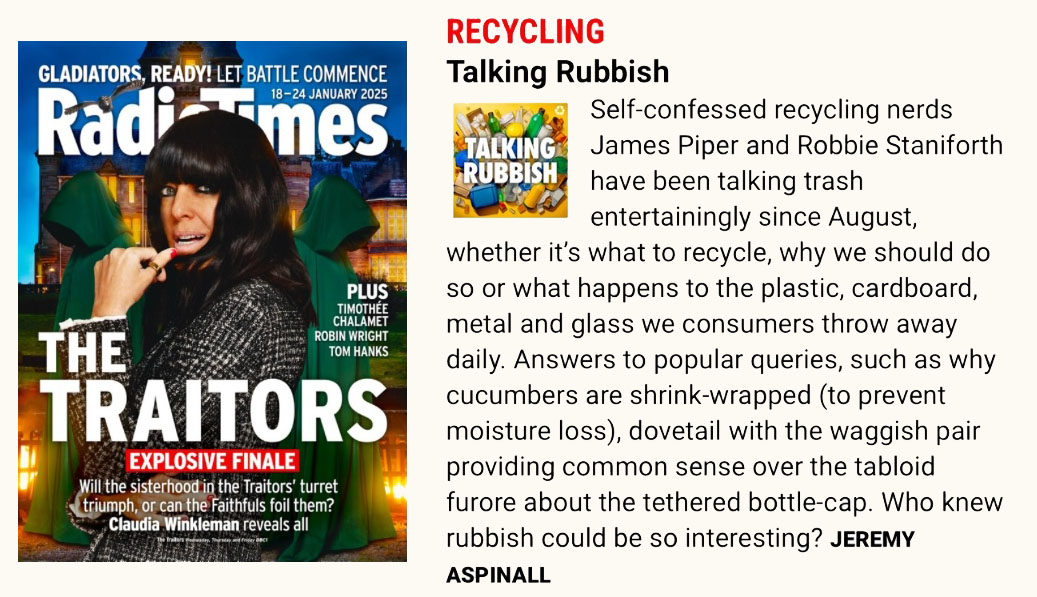
James Piper: Absolutely. And as we've mentioned a few times, Talking Rubbish Recycled content has launched and we have been really lucky with some of our press coverage. So thank you to the Radio Times who've covered it, but also to the Mirror, the expressima star, which I believe is all the same owner because we got a review across them in one day and that really boosted our listenership. So thank you so much to Kay, who wrote such a lovely review and it was just amazing to read how she was feeling about the podcast. She genuinely listens to us, so she will hear this. She's been an influencer for a long time and has helped us out by writing such a lovely review.
Robbie Staniforth: Yeah, it was genuinely very cool. Usually I don't like appearing in the Mirror, but on this occasion it was great.
James Piper: And recycled content's an amazing. It's only been out for us as we're recording this for a few weeks and we're up at like almost 2000 downloads a week now, which puts recycled content almost in the top 1% of podcasts.
Robbie Staniforth: Ah, great.
James Piper: It has a more frequent release than Talking Rubbish, so it's quite hard to compare the two. But it's nice to know that both our podcasts are kind of on par with each other. Trash talk. The question we want to ask today is about government legislation and whether it is driving an increase in plastic. Sort of feels counterproductive, doesn't it? You would expect government legislation, particularly in this climate, to say we don't want to drive plastic use, we want to drive other materials. But I think it is fair to say that we are either deliberately or accidentally experiencing a rapid rise in the use of plastic because of legislation.
Robbie Staniforth: And if you speak to most people about why this whole new governance system and focus on recycling has happened over this last five years in the uk, it's mostly because of the Blue Planet, which was a documentary which raised the issue of plastics. Many of the reasons, cultural reasons cited for having better waste and recycling legislation are how do we recycle plastic and drive us maybe to use less plastic? And it looks like there is potentially perverse consequences happening.
James Piper: This stems from the Environment act, which was launched in 2021 and really that introduced four pieces of legislation the Plastic Packaging Tax, epr, Extended Producer Responsibility, Simpler Recyc recycling and drs, which is deposit return schemes. We've done a few episodes on each of them. We haven't talked too much about plastic packaging tax, but it does come up quite a lot. But certainly if you head to our website where we categorise our episode, the legislation category currently has 14 episodes assigned to it and this will be the 15th Legislation Heavy episode. And there's this growing claim, particularly from the glass industry, that UK packaging legislation is actually pushing producers towards plastic. And British glass have just submitted a report to DEFRA which they say shows evidence that the current EPR fee design is creating strong financial incentives for packaging producers to switch away from glass and towards plastic packaging. This trend risks increasing the use of other materials while simultaneously weakening a demand for glass, a material that is widely recycled and integral to the UK's circular economy. Today, we're going to test whether that is true and what impact that will have on our choices in packaging in the future. When we go and do our weekly shop, what are we likely to see on the shelves? We're going to focus on the two pieces of legislation that have the highest cost attributed to them, so are most likely to drive material use. And also they're very brand focused. So that's extended produce responsibility and deposit return schemes.
Robbie Staniforth: Yeah. And in terms of a reminder of those legislations, EPR is the one where you have big fees based on the household packaging that we all dispose of. And the reason that there's these big fees for producers of that type of packaging is because they're now covering the local authority costs to collect and sort all of that material that previously was funded by just general taxes, central taxation and local taxes. So it's a huge shift and suddenly there's big fees involved. There The DRS deposit return scheme is basically not quite here yet actually. But lots of the setup costs are starting to be born getting ready for October 2027 when that gets launched. And effectively that's a system where you pay a deposit upfront for the container and then you get the deposit back when you return it empty for recycling. And this operates in many other countries. However, it's the first time really, it's going to be implemented into an economy that already has a very well established recycling system. So all of those costs of reverse vending machines in supermarkets to take your containers back, all of those types of things are included in the cost of this system. So it is going to be pretty darn expensive.
James Piper: At the heart of this problem is a very, very simple issue, that EPR is designed to charge fees by weight and plastic is much lighter than glass.
Robbie Staniforth: The government did try to account for this when they were setting their fees for epr. They had these metrics that were volume based and the term bulk density was thrown around to show how many containers you would have in an average tonne. And obviously far fewer for glass than you would have for the much lighter plastic. But effectively what many corners of industry are saying is they didn't do a good enough job on accounting for any type of bulk density. And ultimately, if you've got lighter formats, they claim that you're going to pay less.
James Piper: And I was trying to think, I was like, how are we going to cover this in our podcast? I need to think of a product that is sold in three of the main materials, so plastic, glass and metal. So, Robbie, let's talk beans.
Robbie Staniforth: Beans. Okay.
James Piper: As long time influencers will know, I'm a big fan of beans. I'm actually wearing my baked bean socks today. Really? I'll show them to you after the recording. One of the reasons I'm sure people wish we were on video, because I could just show off my bean socks. They're not foot gloves, they are socks. And I was trying to work out what the costs were basically which one was being driven by epr, trying to identify a food that came in all three major packaging types. And it occurred to me that in my recycling bin was a Heinz baked bean tin and a glass Bold Bean jar. We just have to have a moment of recognition for Bold Bean because they are one of my favourite new brands. I absolutely love them. I actually declared to Ellie this week that on days where we weren't doing a recipe box, we should only eat beans. Not sure how thrilled she is.
Robbie Staniforth: Why are you so into Them. I've never even heard of this. What was it? Bold beans.
James Piper: Bold bean. Okay. They're amazing. So there will be influencers listening now going, yes, I. He is absolutely right. I'm fully converted and there'll be people who haven't heard of them. They're basically expensive beans, about three pound fifty a jar, but their beans are in stock and so when you cook with them you're just like, oh my goodness, I did like a sausage. What did they call it? It was like a risotto. So sausage beanotto they called it, which was just like beans.
Robbie Staniforth: No, rice.
James Piper: Sausage and. No, no, the beans are the rice. Okay, so good.
Robbie Staniforth: Anyway, that sounds right up my alley, actually. Okay, so I've got to look out for bold bean. It's not plural. Bold bean.
James Piper: And actually they' chance they're in Asda, so they're now in all the supermarkets, I think they're certainly in the major ones and definitely Waitrose and Yeah, so. And they do all sorts of different beans and they're just amazing. I think they're great. Anyway, all I needed to do was pop out to get a plastic snap pot of beans and I had the trilogy. Now, Robbie, it'd be helpful to give us the starting point. So what are the fees, the EPR fees for those three materials?
Robbie Staniforth: Yeah. So plastics base fee for EPR is 423 pounds per tonne. So that's what we'd apply to the snap pot. Whereas the glass for the bold bean jar is only one 92 pounds per tonne. And the actual, the tin in the middle, the classic tinne baked beans would be £259 per tonne. So that's in the middle. So plastic on paper is the most expensive per tonne, £423. Then it's steel, £259. Then it's glass, £192.
James Piper: I was trying to work out how to rationalise these numbers, so I decided that I would work out the cost per bean. But that was a ridiculously low number, as in I'd have to be saying so many zeros. So what I'm actually going to provide you is the cost per a thousand beans.
Robbie Staniforth: You've invented a brand new metric, the cost per thousand beans.
James Piper: Exactly.
Robbie Staniforth: Cost per kilo bean.
James Piper: Cost per killer bean. That's it.
Robbie Staniforth: And tell me, did you actually count out a thousand beans? Surely not.
James Piper: I'd rather not answer the question whether I counted the beans in each of the pieces of packaging. Accuracy is key, Robbie. Accuracy is key. So based on the official killer bean metric, a steel can or is 5 pence per 1,000 beans. A glass jar is 13 pence per 1,000 beans. So nearly three times.
Robbie Staniforth: Wow.
James Piper: And plastic is 3 pence per 1,000 bean.
Robbie Staniforth: Oh, my word.
James Piper: So plastic is the cheapest way of delivering beans to us. And when you compare three packaging types with a consistent product, not necessarily a consistent brand, because I couldn't find any Heinz glass beans, plastic was the cheapest under epr.
Robbie Staniforth: Wow, that's crazy. And imagine if they move from the snap pot somehow to a pouch which is even lighter than the snap pot. It'd probably get even cheaper.
James Piper: Yeah, you'd be down at like. Well, like one penny, I would imagine. You know, it's gonna be a third of the weight, isn't it? This isn't a perfect science. Cause the EPR has penalties, right? We've talked about this many times. The recyclability assessment methodology. We have episodes on this. Basically, they're rating our packaging as red, amber and green. And they are applying penalties to packaging that is red if it's deemed to be unrecyclable. And they are giving rewards to green if it is deemed to be recyclable. And soon that penalty is going to be two times fees. So if you've got something that's unrecyclable that you're putting on the market, you will have two times the fees. That's okay. But if you think about it, if the snap pot is red, that brings its three pence up to six pence. It's still half the price of the glass jar at 13 pence. Robby, would you mind walking us through the recyclability assessment methodology for a snap pot? Because this was a. It was a polypropylene pot, the one I bought yesterday. Where do we think it's going to sit on the recyclability assessment methodology?
Robbie Staniforth: Yeah, I think the likelihood of it actually being red is pretty darn low. Because generally rigid PP items are quite easy to recycle. The only thing that would modify its rating from green down to maybe amber is if it had some sort of barrier coating that made it less recyclable. A certain percentage of a barrier coating to help it with that food contact application of the polypropylene and make sure none of the plastic migrated into the food or vice versa. It's definitely not red. I'm pretty certain of that. But maybe it's amber. So it's unlikely to be that six pence per bean, as the metric goes in a couple of years time because it is quite recyclable.
James Piper: Yes. The number we've given the three pence is actually assuming it's amber, isn't it? So that's going to be 3 pence. The glass 13 pence is based on amber. So that will come down slightly, but it won't come down enough to get close to that plastic price. To summarise all of those numbers, plastic is the cheapest, then metal, then glass. And the penalties are not enough to then bring balance to that because base fee difference is so large that the penalty doesn't close the gap. And this is British glass's point. The starting point is the starting price is so different that penalties don't actually make it more expensive to use something unrecyclable. So something red compared with recyclable when you're going across different materials that have very different weights. Now to be fair to the government, the costs do follow the traffic light percentages because they've released the percentages of how much of each material is recyclable versus not. And the costs do follow that. So the packaging type with the lowest amount of recyclable packaging or green packaging, which is fibre based composites, so things like cartons has the highest pound per tonne rate of 461 pound per tonne. Gonna have to do a whole separate episode on cartons very shortly I think to, to cover off some of these points. But cartons have the highest pound per tonne rate and the lowest amount of packaging classed as recyclable. And the one with the highest amount of packaging class recyclable, which is glass, which has 91% of glass is green, has the lowest pound per tonne rate at 192 pounds per tonne. So to be fair to the government, they've gone if lots of a packaging is recyclable it should have a lower fee and if lots of packaging is unrecyclable it should have a higher base fee. But the weight difference is just, you're talking like a factor of 5 or 10 depending on the product type. So a multiplier of 2 is not going to make a huge difference.
Robbie Staniforth: Yeah, I think the average person who looks at it would go oh yeah, that looks about right in terms of the ranking. But obviously we need to get into the economics of it versus the weight and that's the issue.
James Piper: So we've done. That's a bit about epr, that's a non drink packaging type. We talked about beans. Right. The other packaging type that we could do that cuts across all three glass, metal and plastic is a beverage container. But then you're getting complicated because you've got two pieces of legislation. So we've got EPR for glass bottles because they are not included in the deposit return system. And we've got deposit return system costs for plastic and metal because they are in the DRS system. I think it's worth us pretending we are a drinks company, Robbie. We're a startup drinks company. You and I were having a meeting to discuss what drink are we gonna put on the market, what packaging are we gonna put on the market? And let's go through the different costs.
Robbie Staniforth: Oh, it's gonna be a rubbish drink. This.
James Piper: Oh, this is merch. This is merch, I love it. Rubbish drink.
Robbie Staniforth: So the first thing to say is the biggest difference between these two bits of legislation is we've just talked about tonnage and the effects of having light plastic, heavy glass for extended producer responsibility. When it comes to deposit return schemes, they do a price per container fee. So the whole system cost is based on how many units are going around a system, rather than the tonnage weight. And the reason for that, obviously, is that the deposit that you pay in the first place and then get back is just attached to each individual container. So it totally makes sense for that system to be run based on how many units are going around the system rather than how heavy is it. And this is the first difficulty, I suppose, we're going to have as starting our new drinks brand in trying to work out which format to use, because you're not going to be able to compare apples with apples very easily. But DRS is focused on beverage containers from 150mil, so quite small, really, all the way up to three litres. But there's only these two materials, as we say, metal, which is aluminium or steel. We don't have many steel beverage containers in the UK anymore, so it's pretty much aluminium cans and then PET plastic bottles. There's a number of costs that need to be covered through the system. So there's obviously the collection infrastructure I mentioned at top, the reverse vending machines, very expensive bits of kit, if you ask me. There's the logistics and transport, and that probably is where the weight comes into it. You know, heavier lorries take more power to move them. Then there's the counting centres that are vital for making sure there's no fraud in the system and how many containers have been returned. And then there's finally the scheme administration costs. We talked a few weeks ago about Exchange for Change being the deposit management organisation who's going to administer all of this. They're going to incur a lot of costs just managing the system.
James Piper: There's two ways for those fees to be covered, right? You can have producer fees, so if you're a brand putting stuff on the market, you pay a fee into the system to cover those costs. But also unredeemed deposits. Unredeemed deposits are actually quite a big bit of the system. The best way to do this, because obviously DRS hasn't gone live, so we don't entirely know how it's going to play out. But we can have a look at Ireland, who launched a DDRs in, in 2024. So they're like the most recent to introduce Drs and they're just ahead of us. And so that would give us a view on what might happen in England and in the uk. In Ireland they have a per product fee of roughly now they do things in euros, so I'm just transferring it over. But roughly 2 pence for a PET bottle and 1 pence for an aluminium can. So the different materials have different fees and that's because of their market values. And that will happen over here, I suspect cans are more valuable, so they have a lower fee and it's roughly 2 pence for a beauty bottle, 1 pence for a can.
Robbie Staniforth: So just because it's price per container doesn't mean every single container is going to have exactly the same cost.
James Piper: No, you're right. Depending on material. Yeah. Every consistent material will have the same cost, but yes, different, I think. And they haven't announced how they're going to do this in England and Scotland and Wales and Northern Ireland. But I, I think they are going to have different fees for different materials. We'll find out soon and we'll report back when we hear that. I think in Ireland they have, and I'm not. I dug into some of the reporting to try and find out about this, but they seem to suggest the retailers also have a fee of about 2 pence per container that they collect. I need to dig into that a bit more because that hasn't really been discussed in the UK model, but it seems to be what they're doing in Ireland now. It is well documented on this podcast that I am not the biggest fan of chucking DRS into a well run curbside system. I think it's a really expensive way to, of improving an already good recycling rate. I would much rather we implemented DRS on things that had like 10, 15% recycling rates that you could drastically improve. It'd be significantly more value for money. But we are where we are. It's happening, it's fine. But to prove this point, all you have to do is look at the accounts for return, which is the IRIS system. In their 2024 accounts, they proudly say that DRS is achieving a 66% return rate. Okay, now, that means 34% of beverage containers are not going through the DRS system. This is the second half of the year that they took into account. So this is like the best number now, that's 66%. Well, in England, Valpak estimates that our pet bottle recycling rate is 70% and we have a consumer aluminium packaging recycling rate of 87%. So that's my biggest concern, that we're putting in huge costs for something that actually, at the moment in Ireland, is performing worse than our existing recycling rates. Now, obviously, these things bed in and they get better over time. And there are parts of Europe showing 95, 99% recycling rates. So I'm very ready to be proved wrong. But to take that leap from 70 to 99 takes, in my view, a disproportionate amount of cost money that could be spent on education and helping people actually recycle their bottles from home. I genuinely am excited to see how DRS comes into the UK and see what the results are. The thing to focus on when you look through their accounts, though, is they received 47.4 million euros in what I assume is producer fees, because that was their income and 66.7 million of unclaimed deposits.
Robbie Staniforth: Really?
James Piper: So they got more money from unclaimed deposits than they did from producer fees. And the collection and recycling costs were 46 and a half million, which led to a surplus of 67.9 million. Now, this means that after admin fees and the cost of running it all and everything, unclaimed deposits could have funded the entire system. Okay, so they actually didn't need to charge producers 2P and 1P. They didn't need to. They could have charged them nothing and the system would have been paid for. And I'm a bit uncertain as to whether that includes kind of the setup costs as well, like the reverse vending machines. And actually, the costs will come down over time, I guess. We'll see. And if I was British glass, that would be my fear, that I'm over here paying huge bills in EPR that are fixed and that are there and you can't do anything about them. And over here in drs, actually, people aren't engaging with it enough. And the unclaimed deposits could fund the entire thing so producers don't have to pay anything. That's the. That's the fear. Right? So if DRS comes in, we have to be getting up to those 90, 95% return rates so that producers pay their fair pay, so it balances against epr.
Robbie Staniforth: And the last thing you want is to set up a system that actually is economically beneficial to have a low recycling rate. It's the most sort of perverse idea I can possibly think of. Please don't claim your deposit and recycle this thing, because then it makes the whole system cheaper for producers. It's really crazy.
James Piper: It happens all the time in recycling. I mean, it is my biggest criticism of the TerraCycle model that you. The more success you have, the less commercially viable that product is. And that is not a good way of setting up any recycling system. We need to be driving for success. Now, what this means Overall is, for EPR, a glass bottle will range somewhere between 5p and 10p, depending on the weight of it. And for our newly incorporated drinks company, it would be cheapest for us to put an aluminium can on the market at 1p per unit, within DRS plastic, 2p per unit, and finally, glass at, let's say, 5p per unit. Now, I actually think that order does reflect what I consider to be the most sustainable option. So if I was. I'm going to put my hot take. Yeah. I'm gonna definitively say what I would do if I was a drinks company, if I was putting a drink on the market, I think I would start with an aluminium can.
Robbie Staniforth: Okay, I think we can agree on that.
James Piper: Yeah. It has a higher carbon footprint than plastic, but it is far easier to recycle and extract. And it comes out of the incinerator bottom ash. Right. So even if it didn't get recycled or it didn't go in the right place, there's a potential for it to get recycled, which just doesn't exist with plastic. So I think I would start with an aluminium can, then I would pick plastic for its low carbon footprint. And technically, plastic is the best material in terms of carbon footprint, all those things. But I think if I was putting a drink on the market, I would start with a can. I would then pick plastic. And I don't mean to annoy the glass industry here, because I do think they've got it really rough at the moment. But if you're choosing between aluminium and glass, which are pretty similar in terms of their Environmental claims. They both melt at high temperatures, they both claim to be infinitely recyclable. You know, they both. Okay, aluminium has a plastic liner, so it's got a slight downside there. But ultimately, if you're choosing between the two, I think aluminium's weight and the lightweight ness of it beats glass every time. Now, where glass will smash, it is in a reuse system. And in a reuse system, EPR charges only apply the first time round. So glass could very quickly be the cheapest in epr if we took back our old glass bottles, washed them, refilled them and put them around again.
Robbie Staniforth: Yeah. And I mean, that could be the same for your glass jar of beans as for the beer bottle too, couldn't it? You know, just going round a system suddenly makes it a more sustainable option.
James Piper: Having said that, it's really hard to do. There's a company called Again who had an amazing business model, so their business to collect up bottles from pubs and to wash them and then to offer them back to the market. And typically they would be offering them back to the market cheaper than virgin glass bottles. And it was a brilliant business model. I met the guy running it. I've had lots of discussions with them about how to make reuse work and they've gone into administration. You know, they couldn't make it work because, and to be honest, I'm not entirely sure why, they've just sort of disappeared. But I think it's a scale issue. I think something was going wrong in the scale of it. Either not enough glass was coming from the pubs or not enough people were willing to buy the glass at the other end. In my opinion, that's the future business model for glass. Now, British Glass very kindly shared with me a redacted version of this report they've submitted to DEFRA. Within that report, their analysis found that 43% of brands and retailers were considering switching from glass due to the cost of epr.
Robbie Staniforth: Wow, that's pretty damning, isn't it?
James Piper: Yeah, and it's really big because, I mean, glass is a big industry in the uk, manufacturing glass, melting glass. If people start switching from glass to other materials because of legislation that the government is bringing in, and the costs that the government are bringing in actually has a big impact on UK industry. You know, a lot of the plastic that's coming in is being imported and we're losing UK industry here with these costs and that's what they're trying to protect. The categories that were most at risk of switching were beer and cider bottles. Non alcoholic beverages, wine bottles and personal care products and beverage bottles have been severely impacted. Something we haven't. We sort of mentioned, but haven't really discussed is that DRS doesn't come in till October 2027. So some of these costs, as I said, haven't even been defined yet, like producer fees. And yet epr, the costs are already in. So the glass industry is paying now these fees. Plastic and aluminium cans. Plastic bottles and aluminium cans are not paying their fees till 2027. So that delay also has a big impact. And this is happening right now. Brands have to report data on what they're placing on the market and glass, aluminium and steel are in a continuous decline while plastic increases. Goo were reported in the Guardian considering a move from their iconic, and I'm sure you would agree, Robbie, very useful glass ramekins towards more of a plastic product. We are seeing Reef drink, that nostalgic orange drink is now in Tetra Pack. Radnor Hills has invested five million pounds to double their Tetrapac line. Rattler Cider, one of my personal favourites from my days at Extra University, can now be found in cans as well as glass bottles. And I think we mentioned them on the podcast before, but we Aisle Dairy stopped its milk operation and focused instead on ice cream. And they said EPR was an idiotic piece of legislation dreamt up by the Conservatives when they were in power, that is implemented by a Labour government. There is no allowance for the fact that glass is ten times heavier than plastic, no allowance for the toxic impact of microplastics in the environment, no allowance for the fact that glass is inert and ultimately returns to being sand. And there is no differentiation between bottles or packaging designed for single use versus reuse. Now, we don't agree with that last point because there is a differentiation. If it's reused, it will be cheaper. So they are wrong in their statement, but anger that they must, they have felt and shared, I think is important to share on this podcast. Another thing that was in the British Glass Report that I thought was worth calling out was this. They called it a death spiral and it's a bit miserable because if you think about it, particularly for the glass industry and epr, high fees cause producers to reduce the use of glass packaging. We're seeing that, right? People switch to plastic or tetra. The total system cost, however, is broadly unchanged. Because your council is still collecting glass, they still have to collect glass. Whether they're collecting 50 bottles or 10 bottles, they're still collecting glass. And so the fixed costs associated with the collection are still there, but there's less glass that's placed on the market. So the costs are then divided across a much smaller tonnage, which means it costs way more. So that 13p that we were talking about with Bulbean could go up to 20, 30, 40p. As the amount of glass on the market starts decreasing, that cycle keeps happening. It will get worse and worse and worse and there's no real way to get out of Death Spiral, as they're calling it, starts. It's difficult to see how it ends.
Robbie Staniforth: And that is fairly straightforward logic that is quite hard to refute. Now, whether the brands are actually switching or not, sort of time will tell a little bit. But that logic of less glass, same costs, means the existing glass gets more expensive, is absolutely spot on and very hard to refute.
James Piper: To wrap up this trash talk, I think it's a really difficult position. We haven't really talked too much because we've got loads of episodes on it and we'll come back to it again and again around the environmental impact of these different materials. There is a strong argument to say that a push to plastic is not actually a bad thing from a carbon perspective, from a lightweighting perspective. But the environmental impact of plastic is significant and the ramping up of plastic is significant. And I think material switching is quite a scary thing when we think about where we're heading as a nation, where the world is heading in this drive towards more and more plastic. And there is this very big question mark as to whether our government should be promoting that or not at the moment. The legislation rewards lightweighting, sometimes blindly, I think ignoring that wider environmental impact, the penalties for putting something unrecyclable on the market vs recyclable are not big enough. And that needs to change over time. We need to start getting into this point where if you're putting something unrecyclable on the market, it just is not financially viable to do that. This is creating real tension in the market between what is easiest to recycle, what is lowest carbon, what is cheapest to put on the market, and when cost, carbon and recyclability don't align, the market will not hesitate. Brands will not hesitate. They will pick the cheapest, especially at these times of uncertainty and cost of living and all those things. People are looking for the cheapest product and brands have to follow that. And right now that's plastic. Additions and corrections. Welcome to Bags of the Week, a recurring section where we will discuss plastic bags. My aunt texts me, hi, Cat. To say she was Upset with Co Op as her local shop had moved away from biodegradable bags to standard plastic ones.
Robbie Staniforth: Oh no, those useful caddy liners.
James Piper: I couldn't understand it because obviously I've still got the caddy liners in my co op and I haven't heard this from anyone else and she felt everyone would be getting in contact. But that suggested to me that it was quite localised to her rather than something we were all experiencing because obviously we've been very positive about the caddy liners and the co op carry bags that could be used as caddy liners. I think what's happening here is the Co op is quite different to a normal retailer. There's Co Op as the main brand which has around two and a half thousand stores and then there's co op societies which I think make up over 3,000 stores. And my aunt is based in Cheltenham and her store is part of the Central England Co Op Society. So I reached out to Ian Talking Rubbish's carrier bag correspondent who also happens to be the man who did all the work for Co op or support. Did all the work their team, I'm sure, but did a huge amount of this, bringing bio bags to Co op and he confirmed that the societies have a lot of things that they have to align with. They have to sign up to consistency around that main co op so that people experience the same thing. But carrier bags is not one of the things that they have to align on. And this appears to be why my aunt and I are having very different experiences when we shop. And just while we're on the co op, they bought the brand Summerfield in 2009. You remember Summerfield?
Robbie Staniforth: Yes, vaguely though, yes.
James Piper: And Summerfield was phased out as a brand between 2009 and 2011. I say this to explain my surprise when Mintinit on Discord shared a picture of a half buried Summerfield bag that they had found on a litter pick, which you could still read environmentally friendly, 100% biodegradable on the side of it.
Robbie Staniforth: Oh my word. And it's been at least 15 years.
James Piper: It must be 15. Yeah.
Robbie Staniforth: That's terrible.
James Piper: I know. So whenever we get these kind of pro plaster people who say, oh, a carrier bag will break down in a couple of months in a normal condition, it's like, no, it won't. Look at this one. It's been around for 15 years and there's a few weird oprl things for us to look into, Robbie, that I am putting in our. What should we call it? Our labelling Car park whilst I do some diggings. I'm just putting them here so that we can park them and then we will bring them up in the future when we've solved them. Someone wrote in and I could not find the email or message, so I'm really sorry to whoever wrote in about this. It was about spices like Schwartz and own brands.
Robbie Staniforth: Oh, yeah. Know them well? Yep.
James Piper: Branded ones have the OPRL label that says do not recycle the cap. And unbranded ones seem to have leave the cap on when you recycle.
Robbie Staniforth: Oh, gosh. And it's the same sort of plastic cap with similar material cap on a glass jar.
James Piper: Same size. Very odd. So we need to find out why branded and unbranded have completely different rules on spices. And Weetabix has featured a big part of my life, as I'm sure it does for most people with young children. They just seem to eat Weetabix all the time. And I noted that the paper wrap that wraps all the Weetabix is marked with do not recycle. And I'm just trying to work out what that's made of. It's. It's paper and it is very shiny on the inside. I assume for weed a bit to work, they need to keep moisture out, so there's something. There's some barrier going on there stopping it being recycled. But it does feel like paper, so I'm quite keen to find out what that is made of.
Robbie Staniforth: Are you putting it in your general waste bin as advised, James, or are you still recycling it as paper?
James Piper: No, no, I. I always follow the aprl.
Robbie Staniforth: Always.
James Piper: And then I just complain to them if it's wrong so that we can get outdated. I never know. You never know what that thing is made of. So you should always follow the oprl. And don't forget, we have a simpler recycling tracker where you can tell us what your council is collecting and what colour your bins are. The link for this is in the episode Show Notes. So far, we have had most responses coming from Shropshire and Dorset. I wonder what that means. Does that mean they're good councils or bad? I suspect bad. If they're residents are like, we must fill in this tracker. We'd like to take a moment to thank our sponsor, EcoSecurity, who are on a mission to rid the world of unnecessary packaging. They help brands navigate the tricky world of extended producer responsibility. But that is not all. They also collaborate on some incredible recycling projects and consumer awareness campaigns for those tough to recycle materials. If you're an organisation looking to make smarter packaging choices. Cheque them out@ecosurity.com and the best thing you can do to help our podcast to grow is tell your friends and family about it. Or you could leave us a review and if you do that, you could be Robby's Review of the week.
Robbie Staniforth: And this one is a five star that comes in from Apple, but it's actually a talking rubbish recycle content review. You're only going to be hearing this if you listen to the main podcast, the yellow one, but the review was actually about the green one, which is our clipped up past podcast with little nuggets of information. And it starts with. And the answer is going to be fairly obvious to this question now. Does Robbie read out these reviews too? Yes, I very much do. This one comes in from UK Psych, so thanks very much. When my son was deciding which university to go, Bristol was one of the options he'd never visited and asked what it was like, I quickly replied, oh, it's a brilliant city. They've got a good bin system. The moral of the storey. This podcast can seriously intrude on your daily thinking in a great way. I've listened to the main podcast from the start and have learned loads. This podcast feed, obviously the recycled content one is a great way to find the key recommendations and I'm working my way back through them. And if you're wondering, he's now in Bristol.
James Piper: That's great, isn't it?
Robbie Staniforth: Is there a Bristol tourism board that we can apply to? Surely we can get some funding or something?
James Piper: And you can follow us on social media at Rubbish Podcast. You can email talkingrubbishpodcastmail.com or you can WhatsApp us also join our discord. It's the easiest way to engage with us and listeners of the show and the link to all of those things is in the show notes. Rubbish or not. Today's rubbish or not is plant pots, specifically plastic plant pots. We have lots of people asking about these, including Andrea on WhatsApp and John in the bin box. So thank you very much to both of you. Plant pots have traditionally been made out of black plastic. This is partly to stop light getting into the roots of the plants, which can be quite damaging. And it also means they can be made of recycled plastic as it disguises the mix of colours. So plant pots are a great use for our recycled plastic. However, times have changed and a lot of plant pots now are made with greys, browns and detectable plastics so that they don't get lost. In the system. But, Robby, are they rubbish or not?
Robbie Staniforth: I think this is one that's recently changed, because if you had have asked me this question a year or two ago, maybe, as we started the podcast, I would have said no, you probably need to take it back to a garden centre to get it recycled. But I think this is now part of simpler recycling and provided that it's not undetectable, black PET or polypropylene plant pot, I reckon these should be recycled at the curbside.
James Piper: You're absolutely right. Yeah. DEFRA have confirmed that this falls into the category of pots, tubs and trays. So plant pots are within that category.
Robbie Staniforth: The clue's in the name.
James Piper: The clue is in the name. And simpler recycling basically means that councils have to collect pots, tubs and trays and they have to collect ones that are made of PET and polypropylene. So as long as your plant pots are made of that, and as you say, Robbie, as long as they're non black, because carbon black doesn't have to be collected at the curbside. If your council accepts pots, tubs and trays, which they should do, they have to collect plant pots. So if your council says, we accept pots, tubs and trays, and by the way, Bristol, this is true of you. You say you collect pots, tubs and trays, but you do say no to plant pots. Well, unfortunately, this is wrong. I love that this is now legally wrong rather than just morally wrong. Before simply recycling me, we're like, this is wrong, but in like a, oh, we wish they did better. Now it's like, this is wrong. Legally, I can send a letter.
Robbie Staniforth: This doesn't just feel wrong, there is a law that makes it wrong.
James Piper: So do always cheque locally, because as we know, not all councils are following simpler recycling yet. But assuming your council does collect pot subs and trays, they should take plant pots and you should ask them to update their websites, because quite a few, including Bristol, have not yet done this. There is another option, particularly if you have black plastic pots or your council, as I say, isn't quite there, and that's to return them from whence they came. A lot of nurseries will take them back and in 2024, B&Q launched plant pot recycling in over 100 stores. Now, the worry is, I guess these schemes might get switched off as simpler recycling beds in, because why would they invest in them if councils should legally be taking this material?
Robbie Staniforth: Yeah, no, I think that's definitely a possibility, but while they are there, we should try and use them it's also one of those things where you think, surely they don't need to be recycled, do they? If they go back to a garden centre, they can just go back to wherever the plants are repotted. Like, it doesn't feel like a single use item. Even those very flimsy plastic ones.
James Piper: Yeah. I bet the nurseries do reuse them. B and Q confirmed that they're made into new plant pots and a specific plant pot. So I think they are recycled, which is why you can take the black ones back, because the whole issue with black is that it can't be sorted. But if you're putting them in a dedicated plant pot bin, they don't need to be sorted. They're all plant pots and B and Q make them into the blacksmith planter pot, which I had a look at, and it is black, so it will not be affected by the fact that you're recycling a black plant pot.
Robbie Staniforth: Okay. And that's not a single use plant pot. That's like a sort of thick product type one.
James Piper: Yeah, from what I can see. I think so. It's quite big. Yeah. It looks like a. A. Yeah, Like a rigid plastic plant pot, but not one of those. Yeah, Flimsier ones. As with all things, when stores do take back, not all stores know about it. And this is a continual issue that you launch something nationally and then you go in and say, can I recycle this thing? And they say, what are you talking about? And that can be very disheartening. And we had DJ Blagg on Discord who commented that his partner tried to recycle plastic plant pots, A, B and Q, and was quite. I think he was saying I had to kind of gently nudge towards recycling rather than just putting them in the general bin. So he really wanted it to be a success. And unfortunately his partner was met with a member of staff who did not know about the scheme, was very rude about their partner's attempts to recycle it, and falsely claims that plant pots and trays were recyclable in the curbside collection. So this was a few months ago, before simpler recycling. At the time, Luton Council, which was where this B and Q was, was only accepting plastic bottles in its recyc. Eventually, his partner was pointed towards the garden section where she was allowed to leave the plastic items, but left upset and questioned the whole process. He went in a couple of months later, presumably to the same B and Q, and had a completely different experience. Asked the first staff member he saw and was pointed towards a named person in the garden section, who cheerily accepted the items and confirmed the plant trays are included. So this is just a call out to all brands and retailers. You know, if you're doing a system where you're collecting stuff back, make sure your staff are educated on it, because it can really put people off. And we don't just want to encourage the Green and keen. We'd like to get everyone involved in these schemes. Rubbish news. I spotted an absolutely bizarre storey. James Christie was clearing out his aunt's house and discovered the loft was insulated with of unused cigarettes.
Robbie Staniforth: What?
James Piper: Tens of thousands of unused cigarettes. This house was built over 60 years ago in County Antrim and it was built near a cigarette factory, which I think was called JTI Gallaher, which has since closed down. And James, who found this, actually had seen this in other houses in the area. So what they think was happening is filters and tips from the cigarette factory were falling on the floor. They then couldn't be used, so were set aside as rubbish. Someone in the factory will have said, hey, what are you doing with these? I can use them, I'll insulate houses with them. And presumably someone did it once and everyone thought, oh, this is a great idea. It's actually going to be pretty good insulation. It's a lot of basically the same material, isn't it, in the filters and tips.
Robbie Staniforth: Foamy.
James Piper: Put enough of them down stuff.
Robbie Staniforth: Yeah.
James Piper: So I'm just going to stress that this would not meet the current regulations for insulation. The fire service felt it was a complete hazard. I'm not sure the house could be sold legally because it wouldn't get a certificate to say that it met current standards. But you have to admire that historic ingenuity and reusing of waste. I loved it as a storey, but, yes, I'm not encouraging anyone to pick up their cigarette ends from the floor and then go, oh, I can use this to insulate the house.
Robbie Staniforth: Very resourceful, if a little old hat now, I think. So I've got more recycling news from South Africa, folks, after having done one a couple of weeks ago. And it's good news that the paper recycling rate has continued to increase across the country. So this is a dive into paper recycling. In 2024, it was at 60%. It's crept up up to 63.3% in 2025. And reading through the news about this, it was thanks to the tireless efforts of paper mills, a nationwide network of collectors, obviously dedicated small recycling businesses, and the tirelessly hardworking waste reclaimers who are generally on foot Collecting paper and card from businesses, people's homes, et cetera. And that meant that 1.2 million tonnes of paper was kept out of landfills and brought back into recycling loop, turned into things like same as what it would be in the rest of the world, packaging and tissues, etc. And there was a quote from the Paper Manufacturing association of South Africa, which I thought was interesting because they were actually promoting putting out paper and card in many areas for the informal collectors to collect them, because it actually creates the best quality and if it's put with other recycling, it gets wet isn't as good quality. So over in South Africa, these waste reclaimers are delivering what PAMSA say are the best quality paper and card, and that's leading to a much higher recycling rate.
James Piper: Rubbish question. A rubbish question today was a comment on Spotify from Emily. Thank you very much, Emily. She was commenting on episode 73, which was our battery fires episode, to ask whether we knew what percentage of double A and AAA batteries are recycled. I have to broaden this to household because I don't have the specifics on AA and aaa. So we're gonna have to include all household batteries. But we can have a rough estimate that and double A's and AAA's are going to be the majority of them, right?
Robbie Staniforth: Yeah, that's right, yeah. And when we look at it, you can see that the household, the smallish household type batteries, has a declared recycling target of 45% in the UK. But the latest full data from 2024 was that it was just frustratingly below that rate at 44.93. So this generally is a result of the fact that that small producers of batteries that report how many they sell don't actually have to do any recycling because they're below the kind of threshold. And that's what that 0.07 percentage gap is in the recycling rate. But the tonnage placed on the market was nearly 42,000 tonnes. And that must mean that, you know, 19,000 tonnes needs to be and could get recycled.
James Piper: And this is where we come to a huge issue in batteries recycling that very few people talk about. We have talked about it on the podcast before, but not in great detail. So it's just worth highlighting here. There are three types of batteries that are reported. Lead acid, which is basically your kind of standard internal combustion engine car, that's going to be a lead acid battery. Nickel, cadmium, which are your rechargeable batteries, and then other, which is where the household batteries sit. And so when you look at how many batteries are sold, unsurprisingly, 96% sit in that other category.
Robbie Staniforth: Yeah, it's a huge catch all, isn't it? For, like, the battery in your mobile phone, the battery in your laptop, these lithium ion ones that you see, even some of the newer rechargeable batteries that are lithium will go in there. But of course, these aa, alkaline and zinc ones that the question from Emily came from, those will also be in there too. So it's no surprise that 96% of the portable batteries, small batteries, are in that other category.
James Piper: However, when we look at the latest recycling data, 65% were lead acid. So a waste stream that makes up just 3% of the sales, makes up 65% of the recycling.
Robbie Staniforth: And that just has to be an accounting error. There's a mismatch between how companies are reporting them being sold and how recyclers are reporting them being recycled. Effectively, when they're going onto the market, they're being defined as non sort of standard household portable batteries. They're being classed as industrial ones. But then when they're getting recycled, and to be fair to the recyclist, it's just a small battery, so they think it's a household battery. And also they know that if they define it as a small household battery, they can sell the evidence it has an extra value, whereas it wouldn't if it was an industrial one.
James Piper: I have long been an advocate for a specific recycling rate for each chemistry type. So lead acid has its own recycling. Nickel cadmium has its own recycling rate and other has its own recycling rate. But that would mean the UK was not hitting its target of 45%. But the truth is, if we just look at the other category in isolation, the recycling rate would not be 45%, it would be 14%. Wow.
Robbie Staniforth: Yeah, and that sounds about right, to be fair. So these people who are trolling you on social media, saying, saying, I'm just going to throw mine in the normal bin anyway, clearly they're more prevalent than you think. If only 14% are finding their way, generally through supermarkets into those collection containers and getting recycled.
James Piper: So to answer Emily's question, if you were to read a news storey on this or search it in Google, I suspect it would say that we achieve a recycling rate of 45% for batteries. I think the truth behind the snappy headline is that we actually only recycle 14% of household batteries. Residual rubbish. This is something that has happened to us this week, that has made us feel like an emoji this week. I am Very angry. I've been positive through the podcast, but I'm angry right now in this section because at the weekend we bought a greetings card. The wrapper around the greetings card looked like plastic and it said on it, made with Nativia bio based film. And below the words made with Nativia bio based film, it said compostable, biodegradable and recyclable. Ignoring the enemy of this podcast, biodegradable, which is completely meaningless. And if you ever see biodegradable, it just means nothing. Don't believe it. I was taken aback by the fact that it said compostable and recyclable. There are not many plastics that can be both. Recyclers do not want compostable plastic because it weakens over time and so will affect the final product. Recyclers don't want it. They want normal plastic. Anyone who claims compostable and recyclable instantly me causes me to want to research it a bit more. So I had a look at Nativia and I found their brochure and their brochure said, this is industrially compostable home compostable. Although I'm not sure I believe it because it wasn't certified home compostable. It just said home compostable, but we can try it. And then at the bottom of the brochure it said, nativia films are not recyclable through traditional conventional plastic streams, even though on the plastic it had said compostable and recyclable. In their own brochure it said they are not recyc Recyclable through plastic streams. So why does it say on the packet recyclable? Well, I found another website. You ready for this, Robby? You're about to feel as angry as I was. I found on another website, Nativia can be mechanically and chemically recycled, but not with other plastics because it has a lower melting temperature. So they are saying, hey, scientifically this thing can be recycled. I mean, everything can be recycled if you're just looking at the science. But oh, don't put it in your plastic stream because it can't be recycled with plastic. So this is the old technically recyclable, but actually you should not be marking this as recyclable in any way, shape or form because you don't actually mean it. It can't be recycled with other plastics. And so in my opinion, they should drop the biodegradable, which is completely meaningless. They should definitely drop the recyclable, which is just so misleading, it's unreal. And just have the word compostable. And even then they need to get certified for home compostable or they need to just say industrially compostable. I will be reaching out to Nativia to let them know my views and I look forward to updating if I get any improvements in this.
Robbie Staniforth: So mine this week was a real mixture of emotions. So shock, surprise, relief and then joy. Ultimately, can I surprise you by saying that I'm still talking about my house move many weeks later?
James Piper: There's not one part of me that's surprised by that, by the way. That's the Robin.
Robbie Staniforth: It's all you've been talking about over this last week. So it's a few weeks since the big house move. I realised I've actually just lost my USB receiver for my wireless mouse. Been looking everywhere for it and, like, the device isn't broken, I'm just missing this vital part. So I'm thinking this is doomed to the electrical recycling bin because I can't connect it to my laptop anymore. So eventually I owned up to one of the IT team at Eco Surety and I said very quietly, in hushed tones, I've lost the receiver bit. Do you know if we can get, like, a replacement for my mouse? And to the rescue he came, because he replied, no, mate, sadly not. But you do know you can connect it without the receiver because it's got Bluetooth on it. So I was like, oh, my God, I've been worrying about this for a few weeks, having lost it and not being able to use this mouse and not wanting to throw it out straight away. So I was shocked, surprised, definitely relieved and joyful that he immediately showed me how to connect it via Bluetooth. And away I was going, using my mouse again. And so I just wanted to call out these experts, my IT guy, but also people in consumer and business electronics who really can play a huge part with a simple bit of advice to someone that keeps these consumer electronics being used. I had no idea until he told me that it could be connected via Bluetooth. It was pretty obvious after he told me when he turned it over and showed me the various different functions. But this, this tiny little fact keeps electrical items out the bin ultimately. And a slight addendum to the storey, because just last night I found the USB receiver.
James Piper: Classic.
Robbie Staniforth: So anyway, the whole thing has been reunited. Storm in a teacup. But there's a top tip for you out there. Don't be discouraged if you think your electrical items are defunct. There might be another way around.
James Piper: As always, thank you all for listening. Thank you for the reviews and engagement. We love getting the opportunity to do this podcast. Join our Discord Follow us on social Media Obbish podcast. You can email talkingrubbishpodcastmail.com or you can WhatsApp us. Everything we have discussed today can be found in our link tree. The details to all those things can be found in our show notes. There is nothing left for me to say other than See you next bin day. Bye bye. It.