2. Why coffee pods aren't that bad
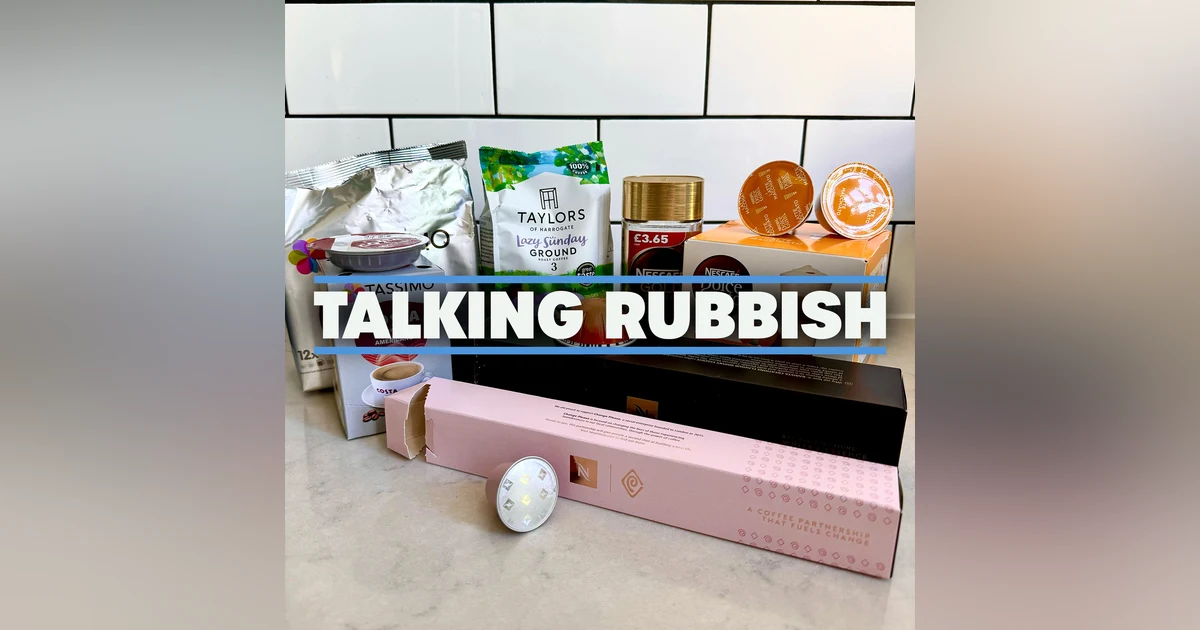

Discover why coffee pods may not be that bad for the environment after all and how they can get recycled. Plus, how are cardboard and paper sorted, can aerosol cans be recycled and do you need to take tape off wrapping paper?

 Apple Podcasts
 Spotify
 YouTube
 Amazon Music
 Castbox
 Podcast Addict
 PocketCasts
 Hello, welcome to Talking Rubbish, a weekly podcast delving deep into the world of recycling and discussing the truth behind snappy headlines and one-sided stories. I'm James Piper, author of the Rubbish Book, and I'm joined by Robbie Stanaforth, my far from rubbish friend. Hello. Hey Robbie. Hello. Hello. This is so exciting. We've had a great reaction to the trailer. People loved it. They were telling me, did you really have to drag Robbie out at six in the morning to record a trailer? And I did. No lies here. That is what happened. Episode one has been out for I'm just looking at my watch, like maybe an hour. Has anybody listened, yeah? Yeah, loads of people have listened, which is crazy. It's so early in the morning. So we're super grateful to everyone who's listened. I'm just so delighted that people are listening. We've actually already had a message from someone saying they really enjoyed it, which is just really kind and really nice. So thank you so much for everyone who's listening, and hopefully we can continue to make these episodes really good. So, Robbie, when we were listening back to episode one, and we I've listened to it more times than I would like to admit, we did we said it would be quite important just to give updates to the things we said. You felt that was quite important.
SPEAKER_01Yeah, sure. I think it's one of those like asterisk bits because when we're talking through uh rubbish and recycling processes, there's not always exactly the perfect language to explain exactly the issue. You know, we have to be a little bit reductive on here, and I think that's one of the great advantages of doing these kind of easier to access uh podcasts. But certainly when it comes to uh a couple of the issues, I think it's worth us just sort of recapping.
SPEAKER_00Yeah, great. So the things you pulled me up on, or the one thing you pulled me up on was the national guidance piece, where I'd basically said that when we say something on this podcast and we say it's national guidance, uh, we would say that trumps council messaging. And I stand by that, I would defend it. I think if uh Recycle Now or the government are saying, hey, this is best practice, then we should be doing that. But I just wanted to make it really clear that it will probably be very few and far between where we say something and we say, okay, that we think is national guidance. That won't happen very often. So obviously, with lids where there's been a physical change and they've been attached to the bottle, there's an argument to say that is now national guidance, and it won't happen very often that we say that. So there's a difference between us saying, yes, do this everyone, and check with your council locally. Obviously, there's a big difference on that.
SPEAKER_01Yeah, for sure. I think the uh councils, you know, there are some very good local authorities out there who keep their recycling guidance up to date all the time. It gives you the really best advice of what you can do in your local area. Unfortunately, that isn't the same across the whole of the UK. Uh, and there are lots of areas where what we're trying to do is be quite universal in the advice and the guidance that we're giving and the research that we go and look and find.
SPEAKER_00For this to work, for this podcast to work, really, we want to keep updating our guidance, updating the things. So if you're listening to us and you're thinking, no, what they're saying is loads of rubbish, then write in. Because I mean, we are trying to only talk rubbish, but if you think, hey, actually, I've got something to add to that conversation, write in, and we're gonna keep building. Every episode is gonna build on the last, so that together we all build a complete picture of recycling.
SPEAKER_01Sure, agreed.
SPEAKER_00Great. So, well, I mean, so far, Robbie, we have had. Are you ready for this? I'm gonna I'm gonna give you a long list. We have had listeners from Spain, the US, Australia, France, Portugal, Mongolia, Ghana, Denmark, Uganda, Germany, Turkey, Bulgaria, and Austria firmly justifying their position as the number one recycling nation. I'm sure Austria heard on episode one, that's what we were saying. But we are truly talking rubbish internationally, and that's so exciting.
SPEAKER_01Wow, that's amazing. Yeah, I think we're gonna have to try our best now to expand out from what happens, not just locally, in local authorities in the UK or in the UK itself, but maybe internationally by the sounds of it.
SPEAKER_00Absolutely. And uh, can I just ask if anyone has a friend from Finland? I would really like you to get them to listen in, because I'd really like to talk to a Finn about a bin.
SPEAKER_01And that's this week's pun, is it? Thanks, James. Uh pause for laughter. Uh yeah, I suppose I'd like uh curbside sorting tales from a lady in Wales. Maybe I'm not shooting shooting far enough in Wales, am I? What about talk to a serb about sorting at the curb? Irony is I don't think they have curbside sorting in Serbia. They're probably like it then.
SPEAKER_00Fantastic. So the first part of our podcast, same as last week, is the rubbish process. And just to introduce what this is, we wanted to take some time each week to explain how recycling actually works, working through the collection, sorting, and actual recycling of materials. Last week we went through the different collection methods, and today we'd like to start going through sorting. We're going to take this material by material, so we're going to start with how is cardboard sorted?
SPEAKER_01Yeah, and I think we talked about this um a little bit last week when we were talking about the collection, and and we were saying that cardboard and paper needs to be kept away from liquid. And that was something that I remember reading in your book, James. And I know that the moisture affects the weight. So if you have really moist cardboard that's coming over a way bridge, it makes the whole thing uh heavier, and therefore, in the recycling statistics, if you like, it makes it seem like more cardboard was recycled than is actually the case because it's full of water, therefore heavier as it goes across the across the Weighbridge. And that really does upset the statistics and the balance between how much cardboard is like sold and how much cardboard then ends up getting recycled. What I don't understand, and I'm hoping you're going to talk us through, is why in the recycling process or other areas is it important, or is it just the that Weybridge thing and that it gets really heavy and harder to handle?
SPEAKER_00Well, so when we talk about uh carbo being wet and and and having moisture in it, I think we should just first of all, Robbie, a couple of times there you said Weighbridge, so it'd be nice just to explain what that is, because we haven't actually talked about that before. So when a recycler picks up waste, the first thing they're going to do is drive to their uh facility, to their MERF, or to the recycling centre, and they have to weigh the material coming in. So the trucks literally stop on a big set of scales that are suitable for trucks. They sit on a big set of scales, they know what the weight of the truck is, and they can just take that off, and then that gives them the weight of the material that's on the truck. So that's the weigh bridge coming in, and obviously, recyclers are kind of weighing each part of the process because they're trying to work out how much they've recycled, and that's where moisture can have an impact because obviously moisture can make things heavier. Interestingly, I was looking at the DS Smith website uh a couple of days ago, and they were saying that if cardboard is mixed with other materials, then 20% of it could be unusable. But if you separate it out of curbside collection, this can fall to 1%. So this is the difference when we talk about sorting and separating versus collecting something mixed. So I guess your question, sorry, I've done a couple of definitions there and kind of gone off piste, as is likely with this podcast, we should say. Your question was can wet cardboard be recycled? And the answer is yes. The Murph is looking for cardboard and paper that acts like cardboard and paper. That's worth saying. When we send cardboard and paper to a Murph, they're going to use lots of things to sort it, which we'll talk about in a second. And most of those things are looking for cardboard and paper. So they're looking for paper that's flat, cardboard that's flat, cardboard that's brown, paper that's white. That's kind of what everyone's looking for. And so if it's got moisture, it will affect the colour. If it's got moisture, it's likely to brick up together, to compact together and be much harder for those MIRFs and recyclers to find. It can quickly lose integrity. You know, paper and cardboard are made of little fibres, and if they get water, then they're going to break down. Those fibers will get smaller and it'll be harder for the recyclers to identify them. It can also affect machinery. If you imagine kind of just wringing some paper under a tap and then trying to put it into a machine that's expecting a flat, dry bit of paper, it's going to make a huge difference. So it can affect the machinery. So what we say as consumers and what we try to do as residents is use lids on bins. So where we have a paper and cardboard bin, trying to use lids if possible, um, putting cardboard and paper bin as close out to the collection as possible. So if your collection's happening at you know eight in the morning, you might put it out at 7.30am rather than the night before if it's forecast to rain. So trying to put it out as close to collection. And even if it does get wet, still recycle it because that's still going to be the best thing. At the end of the day, the recycling process, which we'll talk about next week for cardboard, does use a lot of water. So it's not going to drastically affect uh the recycling, but it might drastically affect the sorting.
SPEAKER_01Yeah, and then what once it gets to that sorting station, if you like, it there's lots of different things that I believe they can do to kind of either separate it if it needs to be, including uh like optical sorting, and they can actually sort of look for paper uh using a camera and then blowing it away from the rest of the waste stream with like jets of literally jets of air where paper gets blown away from other waste streams. Um they can also vibrate it out of the waste stream, and so they can also use things like trommels, which is kind of like a giant washing machine, uh drum. I don't think they're wet, are they? They're actually it's a dry process, is that right?
SPEAKER_00Yeah, the troml's looking to sort out fines and contaminants, basically. So where we've got maybe dirt or uh bits of metal or small things, we talked about small things last week. Trommels are a classic reason why they might get lost in the process. It is basically a giant washing machine, you know, just a big drum that's got holes in it, and they push all the recycler into it, and then um the small bits will fall out of it. So it's not, I don't know how much it's used within the recycling industry, but it certainly can be part of the process to remove those contaminants.
SPEAKER_01Yeah. And then once you've got the actual, you know it's just paper and card, so the the it's separate from everything else, then it's a question of often hand sorting and grading the cardboard because there's different types, and the different types all go off in different places. You know, they they they have different values, um, and they also have uh different processes and products that can come out of recycling them.
SPEAKER_00Yeah, I actually think hand sorting can happen earlier in the process as well. There are MERFs that just hand sort straight away, look for cardboard and paper. Obviously, when they're grading it, they're looking for different types of paper. So uh like printing paper, clean white paper would be considered a high grade, whereas newspaper would be considered a lower grade if you think about those types of paper as you're using them. Really, they're looking for three main types when they're sorting. So they're looking for old corrugated cardboard, which I tend to call OCC, because recyclers like to make acronyms up there. Uh they're looking for newspapers and then they're looking for magazines, pamphlets, and mixed paper. So these are the main types that that recyclers are dividing that that paper stream into, and they need to get that graded and sorted before they put together the recycling process. Interestingly, in Bristol, what they tell us to do is put any brown paper into the cardboard bin. And I always think that's quite interesting. Robbie, do you want to talk through that one?
SPEAKER_01Yeah, I think it's one of those where like, because it is it the colour or is it the fact that it's thin paper as opposed to thicker cardboard? And it this can be a confusing one where often local guidance will give you a better uh guide. It does what it says on the tin, uh, as to what you need to be doing. And that's because uh in the recycling process, like brown paper behaves more similarly to cardboard, whereas the the sort of white sheets of paper, maybe uh junk mail or letters from the bank, uh unsubscribe from those uh physical letters and uh just getting digital copies, but they do still exist. I still get plenty through my door. Um, it's that kind of paper and tissue paper, etc., that's in a separate bin uh for us in Bristol.
SPEAKER_00Okay, that's the rubbish process. And as I said, we do this each week. We're last week was collection, this week we're doing sorting, and I think it's probably best just to stick with the material. So next week we will do cardboard and paper recycling, and then we'll go back into other materials doing sorting and recycling, and we'll just keep progressing through until we've finished all the major materials, and then we'll just keep going. We've got loads of things we can talk about when it comes to the rubbish process. I am trying to think through names for these topics. I think we've got rubbish process. I think that's okay. But if anyone's at home thinking I've got a better pun or a better name for that, just let us know because uh I would really like to work on these names. Now we turn to the rubbish topic or the rubbish issue. What should we go? Oh, the rubbish issue is really hard to say. No, don't rubbish issue. We're going for rubbish topic at this point. So again, like last week where we talked about tethered bottle caps, we really want to delve into a subject, and we promised that this week we would do coffee pods. So, Robbie, it's time to do pods on the pod.
SPEAKER_01Oh, very good. Oh gosh, you've been thinking about that one, I can tell. Very smug. I'm excited to talk about this one because it's one of those things that um I know we've both worked closely on over the last few years, and it's definitely a like prescient issue that people sort of can engage with. Even if you don't have a coffee pod machine at home, you might have once been to a hotel where there's pods vending in a machine.
SPEAKER_00Yeah, and I think the statistics would tell us that lots of people do have a pod machine. I I have not written down the stats on this, but I'm sure it was about a third of households in the UK have a pod machine. I'm sure that was in a grocer article.
SPEAKER_01Oh, thank you.
SPEAKER_00I feel like that will get edited out if I check it and it's wrong. So if that was in the podcast, it was right. I will check. But what we do know is there's two billion cups of coffee a day drunk worldwide. And I guess when we talk about coffee pods, immediately our reaction is well, the packaging must be bad. You know, it must be. And I think this is such a good early episode for us because a lot of what we talk about is actually sometimes packaging isn't bad. Packaging is such a small part of a product's impact. Absolutely. And typically that can be like 5%. Um, 5% of a product's impact is it's packaging. But the packaging is the bit we see, the packaging is the bit we experience, it's the bit we touch, it's the bit we see when we buy something. So we have this kind of emotive reaction to packaging that sometimes isn't completely appropriate compared to the impact of the product.
SPEAKER_01Yeah, and it's such a tricky subject because what you don't want to do in talking about that is say that all packaging is good, and there are definitely examples where packaging's not required and it's over packaged. So, what we're absolutely not saying is that packaging is good in all scenarios, but it's really important to kind of remember, and it's it's sometimes a bit intangible for people, that actually packaging is necessary to get products to you, the products and the goods uh that you need.
SPEAKER_00So, with coffee pods, we have a specific kind of interest in this, I would say. So we should sort of declare our interest early. Uh, because Robbie and I helped set up Podback, which is the UK scheme for collecting and recycling coffee pods. And there's now a whole team doing that, we're not involved anymore, but certainly for the first few years, I was helping design how it was going to work and being part of the discussions of how we would make it work. If you haven't heard of Podback, basically it's a scheme that allows for curbside uh collection in certain councils and drop-off points and collection from your house in other councils that isn't curbside that you just order. Um, but basically it's free to the consumer. So if you buy coffee pods, you can get them collected and recycled for free, and there's lots of methodologies. The reason I really liked it, other than the fact that I actually don't mind coffee pods, and we'll talk about why that is in a second. But the reason I really liked it is it was a true industry collaboration. Nespresso, uh NDG, Nescafe Dolce Gusto, and Tassimo were getting together and saying we want to get coffee pods collected and recycled. And the collaboration was what really excited me, bringing people together. And I was actually reading the news just to try and see the success of this. And uh Bracknell Forest, Reading, and Woking and Boroughs have just announced that they collected 1.3 million pods in a year, uh, which I believe they were saying in the press release came out at about seven per household. Which actually, for a scheme like this, when you're talking about very small packaging, you're talking about a voluntary initiative, not a not a requirement, you're talking about something where curbside might not be the primary route to collection. I would say seven pods per household is actually a pretty impressive result.
SPEAKER_01Yeah, no, I absolutely agree. And I think on that collaboration point, uh, I know um the government back in 2023 actually came out with some green agreements guidance. So the Competition and Markets Authority are actively looking at trying to see how they can break down the barriers to collaboration between competitors on environmental issues such as recycling schemes. It's one of those things when we're talking with uh different companies about how to recycle their packaging, um, often they see barriers to collaborating on these schemes, and you can't make progress unless you get everybody to agree on the issue and ultimately stump up the cash. And I think that was probably the thing that was so exciting uh about launching Pod back a few years ago was that you you actually had uh brands taking some responsibility for the products and packaging that they're putting out there.
SPEAKER_00Let's talk about why coffee pods might not be that bad. I think that will be a surprise to most listeners. So, again, when we think about packaging, we tend to think that is the main environmental impact of a product, but actually that is not the case. And in the majority of cases, the product itself it has the impact. The beauty of a coffee pod is that it's delivering a cup of coffee with very little coffee. And I first came across this concept with a Wired article, which was written in 2019. There have been similar results that have been seen in studies that have been done in 2007, 2017, and most recently 2023, actually, by the University of Quebec. Um, and this study is presented really nicely on the website The Conversation, if you want to have a read of it. But basically, what they did was they looked at four ways of making coffee. So they looked at coffee pods, filter coffee, cafeteer, and instant coffee. And what they identified was that the production of coffee can actually be anywhere between 40 and 80% of its total emissions, and it's just about amount of coffee.
SPEAKER_01Well, as in the number of grams of coffee, you mean the amount of coffee being used to vend because I know I personally am not using pods. What do you say pods? Filters, cafetiers, and instant. Where would my little espresso machine come where I'm like filling up the little basket? I'm trying to be a barista basically at home.
SPEAKER_00It's probably a form of filter coffee, I suspect.
SPEAKER_01Fine. And I know from when I went to uh I went on a shout out to Oddkins in Bristol. I went on a barista uh day, barista learn how to make a perfect cup of coffee. Yes, I did win the competition at the end for the best looking flat white. Thanks, James. Um they w were saying to me that I can't remember, was it 18 or 19 grams of coffee? There was a very specific now I can't remember for the life of me, I think it was 19 grams of coffee that had to go in. So the beans would be ground down into this little basket. So what you're saying is lots of the impact, the environmental impact of the coffee is based on how many grams.
SPEAKER_00Yes, and that's because uh we're looking at how coffee is produced. So we're looking at the production of beans, the transport, the roasting, grinding, everything in that process, as I say, could take 40 to 80 percent of the overall emissions. Now, I was going to take the study's word for this, but I thought, you know what, I'm gonna buy some coffee scales. And when I went buying, I had to make sure they had the word coffee in, so no one thought I was doing anything weird and needed small scales for any other reason. Um, so I made sure I was buying coffee scales, and I literally went to all my local coffee shops in my village, and I asked them all for a bag of coffee that would be the equivalent granules to one flat white. So I got coffee granules from all of my local coffee shops. I won't shout them out, but I'll put them on our social media. And I opened up all my coffee pods and sorry, I opened up one of my coffee pods and then got my friends to bring me theirs as well, because they've got different types, and weighed all of those. And I weighed my cafetiere and I weighed my instant. So I have literally To all my coffee. And I can tell you, well, you know, the things we do for this podcast, I can tell you that coffee pods range from five point five grams to ten point one grams. And the study interestingly talked about 14 grams. So they've gone definitely on the higher end. And obviously you've got different sizes of pods. So Nespresso. So that's how much is in the pod? 5 to 10 grams, basically. Basically, it's got five to ten grams of coffee in it. Cafetiere used about nine grams if you follow the official guidance, but I reckon people go well over that. I certainly do. You'd like a strong coffee in the cafetiere, come on. I know. And the study actually said 17 here, so I just couldn't. I mean, they must just double it based on what the official bag says. Um, the official bag, the bag of coffee. That is the official coffee. And I know, and the shop coffee, so the four cafes I went to ranged between 18.1 and 18.9. So really nicely between your 18 and 19 would be. I did have one coffee shop provide me with 36 grams because uh I'm not sure she entirely understood the assignment, and I think she wanted, thought I wanted just lots of coffee beans for my machine. So she sort of did the 18. I watched her do that, and then she sort of doubled it up. So I'd be very surprised. I did actually order a coffee from that coffee shop as well. And I wasn't wired for the whole day. Okay, yeah, it wasn't like the double shot, and you're like bouncing off the walls. I don't think they use 36 grams. But uh but to summarise, if you take the smallest pod, which is the aluminium Nespresso original pod, you're getting down to about 5.5 grams of coffee compared to the shop, which is running at about 18 to 19, which would be similar to a filter coffee or a cafetiere where the study had it at 17 grams. Instant uh comes in much lower, it's about two grams per serving. The problem with instant is you've basically got a very concentrated freeze-dried version of coffee. So that two grams started life as much more coffee. And from what I can see online, you've got to multiply it by about five, I think, um, to get freeze-dried back up to kind of what it was when it was coffee beans.
SPEAKER_01What it was when it was ground, like the sort of the raw weight of the coffee before it got ultra-processed or whatever.
SPEAKER_00Exactly. So I think that's 10 grams, and again, the study had 12. And while I was doing all this, or actually I should say literally after I'd done all this, I got true delivery of my um food for the week. You know, I I use um one of these home delivery boxes for for some of my meals, and again, we're not the BBC, you can mention them. I know. I know. Well, I've I'm using Mindful Chef at the moment, which I I think are excellent, and um and other food delivery boxes are available.
SPEAKER_01Um this is your pitch to get our podcast on the BBC.
SPEAKER_00And literally this week, so yesterday, having done all this study, they sent me through a free sample of a coffee bag, you know, like the teabag but with coffee. Oh yes, I've seen those things. And I was like, I haven't even I mean, I don't have the time to add this into my thinking, and I hadn't even thought about it. So I have no conclusion on the coffee bag. I think maybe we should look at that and we'll have that in the future when we talk about teabag recycling. I'll try and bring that back in. I'll try and remember to bring that back in. But um They've thrown you a curveball there, haven't they? Yeah, I was not expecting it, not expecting it at all. So I can already tell this like just to be clear, we said to our producer that we try and keep our episodes at half an hour, and last week's episode was 42 minutes, and we're already running at 28, and I know what's gonna happen. Like, he's gonna say I couldn't cut much of it, and we're gonna have like a 50-minute episode. So, probably we're gonna have to get more disciplined. Absolutely stop this, 30 minutes. But coffee pods are so wonderful, and it's such an interesting topic because it's such a good example of where our natural instinct to say that must be bad. I'm using packaging every time I have delivery of a product actually is very different from reality when we talk about the amount of coffee that it uses. So, what this study showed was that instant was the best method for getting coffee. It only uses 10 to 12 grams, according to me or the study, but pods come in normally second because again, they're using much less coffee, and it's the coffee where the environmental impact is. Now, interestingly, there was a situation where pods came out best, and that was if we use 20% more coffee than the recommended amount, and if we double the amount of water that we boil. If you're trying to brew the most environmental cup of coffee, the best thing to do is use freeze-dried instant to boil only one mug of water and to make sure you use only a teaspoon of coffee.
SPEAKER_01Ah, but come on, are we gonna go through all of that r rationale for how we drink our cup of coffee? I think it's one of those things where it's like really interesting to highlight, but is a consumer behaviour going to change on environmental grounds? I think it's the decision-making process of having uh which type of coffee you have, I think is based on a whole set of other circumstances. How much of a rush you're in, probably going for instant, how much you fancy yourself as a hipster, probably means you're trying to do baristering at home.
SPEAKER_00According to the study, producing eleven grams of coffee in Brazil, which is the amount that it could be saved by using a coffee pod, saves about 59 grams of CO2 equivalent. So the the coffee difference between um a coffee pod and like a filter coffee where it's using 18 grams, is about 59 grams of CO2 difference with that coffee. And they estimate that the coffee pod itself has a 27 gram CO2 equivalent. So you talk about 27 gram CO2 from the coffee pod, which I think is quite high actually. When I've looked at that, I've got it much lower because obviously we've got different pod sizes, different materials. So when I started looking at life cycles of a pod, um I feel like actually that 27 grams is quite overstated. But let's say that's true, and the pod is 27 grams, actually the coffee saving is 59 grams CO2 equivalent. So that's the numbers that we're talking about here.
SPEAKER_01Wow. And then so just so we're clear, in order of like from bad to good environmentally, we're saying filter coffee is possibly the worst, then it's a uh cafetiere, like sort of brewed coffee, then it's the pod, and then it's instant if you boil the right amount of water.
SPEAKER_00Yeah, of course, there's loads and loads of variables that we need to always be careful here because like how much water you boil compared to how much you're meant to boil.
SPEAKER_01Sure.
SPEAKER_00Um, where those beans are roasted, what country that they're um ground up in. There's all these kind of questions of uh of where the coffee is sourced from that will give us huge amounts of variables. So we always have to be careful to give away blanket info, which we're in danger of doing on this podcast. So let's just pause there to say, in theory, yes, on paper. Reality is you might you might do it slightly differently. You might be listening to this from Brazil, in which case your coffee comes from Brazil. You know, it's not gonna be that hard. Although that's not true because uh we actually haven't talked about this on the podcast, but I've done quite a lot of traveling, and my wife and I travelled the world, and we went to Colombia, and I thought, hey, we're gonna get given really good coffee. And when we got to Colombia, they said, oh no, we have the worst coffee because we export all the good stuff, and we actually have very little good coffee that we keep within the country. So that was interesting. I went to all these South American countries thinking, hey, I'm gonna get really amazing coffee, and you actually couldn't have it. We were going to um the places where they make coffee and ground up the coffee beans, and we were expecting the best, and and they would not even sell it to us in those places.
SPEAKER_01Isn't that like the opposite model to the wine-making regions where they keep the best wine for themselves and then export all the rubbish?
SPEAKER_00Yeah, I guess so. But I you know, I guess money drives that, and and where you can sell it with the highest premium will ultimately drive where you sell it.
SPEAKER_01Yeah, sure. Well, okay, so pods not so bad, but absolutely w they've got to be recycled, haven't they? Because that is definitely uh having more items that are going into your general waste bin that are destined for a landfill site or energy from waste is not what we can advocate on this podcast. So, in terms of the recycling process, I know that the um aluminium pods can be turned back into pods. So the the actual the process of recycling aluminium means there's definitely the potential uh for aluminium to go back into uh the pods. But some are plastic and some are aluminium, and I think that causes um some problems in how you would actually sort them out because it's not a a uniform waste stream. The plastic needs to be treated totally separately, it needs to be shredded, washed, and ultimately melted back and turned into pellets, um, and those pellets can go to a whole multitude of uses, including the classic like garden furniture, building materials, etc. But that's not saying, James, what do they do with the actual coffee in it? Should you be sorting the coffee out at home and scooping it out or just putting the whole pod in the recycling bag to send back to pod back?
SPEAKER_00Yeah, but the beauty of the scheme is actually you keep the coffee in the pods, whereas um lots of um uh people who don't use the scheme, so there's retailers out there that that aren't part of it, and um they will advise that you remove the coffee and put the pods in your recycling bin. And again, uh as we discussed last week, classic gonna get lost in the system. Yeah, let's not do that. So it's best to use a scheme that's dedicated to collecting these small items because you're putting them in a bag, they're going to a dedicated facility that's got the capability to recycle them. And what they will do is remove the coffee grounds. The coffee grounds are sent to a food waste recycling plant, um, and they will turn that food waste into energy, soil improver, and it will go to anaerobic digestion, which again is a big topic in itself. I'm conscious as well, we've talked a lot about aluminium and plastic, but of course, there's compostable pods out there, and um obviously you'll know some big brands. I am treating this like the BBC, I'm not like willing to name it, isn't it? Um grind are obviously the big one that I'm aware of that use compostable pods. Um, and I think we need to talk about that properly. We need to do pro we need to have proper discussion on compostables rather than brushing it now. One thing I would say is the thing people forget about compostables is essentially that is a single-use packaging item. You know, it's going, it's being used and then it's it's going into disposal to be turned back into or to be used as compost. There is an argument to say, well, that is an upcycle though, you're doing something with it that's positive, and that is definitely a good argument. And as the plastic is downcycled, you're talking about it going into furniture, so it's not turned back into plastic. There is definitely an argument to say that compostable pods might be better than plastic because they've got a use rather than just um being downcycled, although again being turned into furniture could be could be useful. So this is the trouble with this, there's just so many, uh so many routes for this to go down and so many options. But I think let's cover compostables properly. I I guess as a uh blanket rule, what I would be saying is if you're not planning on recycling pods, then compostable is definitely a better option. If you're sat there thinking, well, these are just going to go in the bin, I can't be bothered to recycle them, I can't be bothered to engage with the schemes, then I would use compostable because it's going to be better than just incinerating some plastic. But if you are looking to recycle them, get engaged with the schemes that are out there to make to get them recycled within the UK, then I think that's a better route for pods to go down than than just um degrading.
SPEAKER_01Yeah, and we know the scheme's up and running. Um, it's recycling in lots of different areas. They've got a few different options for how you recycle your pods. I know some of the brands independently, before the scheme was even set up, had options for you to bring bags back to their retail outlets that they would take. So certainly it's something that we will see maturing over time and more recycling take place. So urge you to get involved if you're using coffee pods. So what about uh we talked through uh a couple of studies there, and I know that there's lots of differences sometimes in the the academic world and the studies? Um it's estimated that the pods uh make up 600,000 tonnes of waste worldwide, so it's clearly not a small issue that we've got here on our hands. Um were there any contrary findings about coffee pods and more emissions when you were looking through your research, or was it pretty conclusive?
SPEAKER_00Yeah, it's great to bring balance to this, that's really important. And I think there has been criticism that this study uh from 2023 is not peer-reviewed, so um there's no argument to say it doesn't meet the kind of scientific requirements. I know they were trying to get it peer-reviewed, but I couldn't find anything about that. And as you say, we can't overlook overlook the pollution involved with 600,000 tons of waste. So let's not overlook that. Um, it should not just be a focus on carbon. We should be reducing and reusing where we can. There was a peer-reviewed paper from 2021 that did find the opposite, but coffee pods account for more emissions than other ways of coffees. And most of that was actually because they put quite a lot into the well, the pods are getting landfilled. And so it just brings us back to yes, you can make you can get a study to say that pods aren't the best option if they're being landfilled. So we need to make sure we're collecting them, we need to make sure they're recycling them. And and as with all the topics we discussed, there's going to be a fine balance. There's always going to be this fine balance between something being good and something being bad, and often it will become come down to the decisions that we make as individuals. And I think it's just worth noting that the study authors did not expect it to become big news. I think they were quite frustrated by that because actually their conclusion, according to an interview they did, the real conclusion they made was actually we should be rem moving to refillable pods or cutting out coffee altogether. They were not promoting pods. They were saying, hey, if you're going to use them, they're actually not a bad way to get coffee delivered. Use reusable ones because then you can just keep putting coffee grounds in them. It doesn't need as many, uh, it doesn't need as much coffee, and you can reuse the pod. So that's going to be our take-home here. Use reusable pods. Reuse is always better than recycling. That's going to be the best way of getting a coffee delivered or instant, but get the get the proportions right. And if you are buying from a coffee shop, like I do many times, but if you are buying from a coffee shop, obviously now you'll be thinking slightly differently when they grind up those coffee beans and you see it, you see a big lump of them, and you think, wow, that is a lot more actually than uh that are in my coffee pots. The next section we called last week, Can It Be Recycled. I really don't like it being a question. So I think we're just going to say rubbish or not. Is this item rubbish or is it recyclable? Which I'm aware is also a question. But you know, for some reason, starting with the word can is the problem. Can it be recycled? It's just not right as the like mid-sentence point. Whereas rubbish or not, I think is is quite solid. So this week's item that we wanted to ask, is it rubbish or not? Is the aerosol can. And we feel this is a really good item for us to discuss because actually bathroom waste recycling is a real blind spot for all of us. And we've had this across many studies. There's uh I saw a survey where they said less than 50% of people, so this was a survey done by Nivea, less than 50% of people said they recycled their bathroom waste, and 33% of people said it was because of confusion. So, Robbie, we've got to end the confusion.
SPEAKER_01Yeah, well, I think on aerosol cans specifically, uh that's that's fairly straightforward. Uh, I know I I did a little bit of research for this item, which I know is rare for me, uh, but I had a look at uh AliuPro's um findings, they're the Trade Association for Aluminium, um, that find that 650 million cans are sold uh annually. And so 80% of that is through the household, you know, s sold to households. And in terms of the cans, 70% of them are aluminium and 30% of them are steel. So these are all readily recyclable things, um, but the non-beverage s uh items uh could potentially be facing very high fees uh for producers uh in terms of how much um uh how expensive recycling is. And that's mostly for things like uh deodorant, um air fresheners, that's the places where you can see um see recycling. And in your general recycling bin where you put all of your other aluminium or steel uh food cans, these aerosols can go with those. And it's just people understanding that rather than putting it in what is usually a sort of general waste bag that people have as the little bin in their bathroom, that what you've got to do is just put them to one side and make sure they go in the same recycling containers as the rest of your metal recycling.
SPEAKER_00And when they're being recycled, obviously we need to ensure the cans are completely empty before we put them out. So make sure that it's fully used. And don't do anything to them. Don't pierce them, crush them, flatten them, just leave them as a can. Uh recyclers are looking for things that are can-shaped when they're looking for cans. So if you start uh you know crushing them or flattening them, it's gonna get it, it's gonna make life a bit complicated. So don't do any of that. Obviously, they're potentially dangerous as well. So we just need to put them out just as a can. Um we need to detach any loose or easily removable parts, so things like the lid, um, and they would get disposed of in a in whatever method. So if it's a plastic lid, it would get uh put in the plastic recycling, for example.
SPEAKER_01Sure. So after last week, where we were talking all episode about lids on for your soft drinks and milk cartons, etc., we're in a lid-off scenario because it's a totally different material uh to the uh aerosol can.
SPEAKER_00Do you know? I hadn't even made that connection. I wasn't even ready for that question. So I said with glass bottles, put your metal lids back on. But yeah, with aerosols, it's best to remove anything detachable. Um, they are a kind of a specific recycling item because ultimately they've got to go through a special process to get rid of anything that's potentially dangerous in them. So when they get to the recycler, actually a machine pierces a small hole to empty the can out, uh, which makes it safe and removes any liquid that's been left over to get it ready for recycling. And so they're going through a kind of their own specialist collection or a specialist recycling process, and therefore, in this instance, it's lids off.
SPEAKER_01Yeah, and you'd certainly rather trust someone on an industrial scale with a bright piece of equipment to be doing things like piercing an aerosol than trying to stab at it at home. So please, folks, make sure you just leave it intact, remove the lid, and put it in your recycling bin.
SPEAKER_00And remember, you can write in with any rubbish or nots that you may have. So if you're sat at home thinking, is this rubbish or not? Hey, that's working that question. That's going to be quite good. Is this rubbish or not? Then you can write in. So our socials are at rubbishpodcast. We're on Instagram, X, TikTok, and Facebook. And you can just follow us on at rubbishpodcast, message me or Robbie, or you can email us at talking rubbishpodcast at gmail.com. And speaking of that, I actually went and got a question this time. So we said we'd do a rubbish question. Someone from the from our listener base who has a burning question that they wanted to ask us. And I put this out on Instagram because obviously it's still early days. I was asking people on Instagram whether they had a question for us, and my good friend Kenny messaged and said, When we recycle wrapping paper, do we have to take the tape off?
SPEAKER_01Uh well, I suppose the short answer is yes. Uh, paper and cardboard recyclers can take some plastic in with the the paper, but it's a non-target material. The plastic ends up as kind of sludge at the end. So the less the better. Um in terms of tape that's really easy to remove, do go through the the energy and the effort to take those uh bits of plastic off. I know it's one of those things on things like uh wrapping paper, etc. Um, you you can have uh things like ribbon, uh cellar taped on. You don't want anything that is not paper going in with the rest of the paper. Uh hopefully I'm not asking Kenny to do too much here, but yes, I would be taking off the cellar tape.
SPEAKER_00Perfect. And just like with coffee pods, reuse is always better than recycling. So let's talk reuse. So when I was thinking about wrapping something up, I was thinking, well, why can't we use string? You know, that'd be it would arguably look nicer, and it can easily be reused by the recipient. So I personally think, you know, let's stop using tape and use string, much easier for people to reuse. Um, or you've got things like gift bags, bottle bags, whatever it is. Again, there are ways of giving presents in items that can be reused. So whenever we think about the waste hierarchy, which we haven't talked a lot about yet, but we will do, um, where we're talking about kind of going from uh away from recycling, incineration, up to reuse and reduce where we stop buying stuff. Um, whenever we're faced with a package decision, we should explore whether there's a reusable option, just like our cultural. Coffee pods.
SPEAKER_01Perfect. Well, we've made it to the end. That was I wouldn't say a marathon. I enjoyed it. It felt like it was only 10 minutes. How much did we get up to in the end? Probably about 50, I imagine, knowing us. I hope you enjoyed listening to the episode. As James mentioned earlier, you can uh follow us on our socials, which is at rubbishpodcast. Um if you've got any questions for us, we'd really love uh to see them. So so do post uh on the socials or email in at talkingrubbishpodcast at gmail.com.
SPEAKER_00I can I can sense the pressure you felt reading out that email after last week. I can just tell that you were thinking, I don't want to mess this up.
SPEAKER_01I really did pause to make sure I got my doctor at in the right place.
SPEAKER_00Well, thank you so much, everyone. Thanks for listening. Thank you, Robbie, as always, and see you all next week. Bye. Bye.