32. Is Trump right to bring back plastic straws?
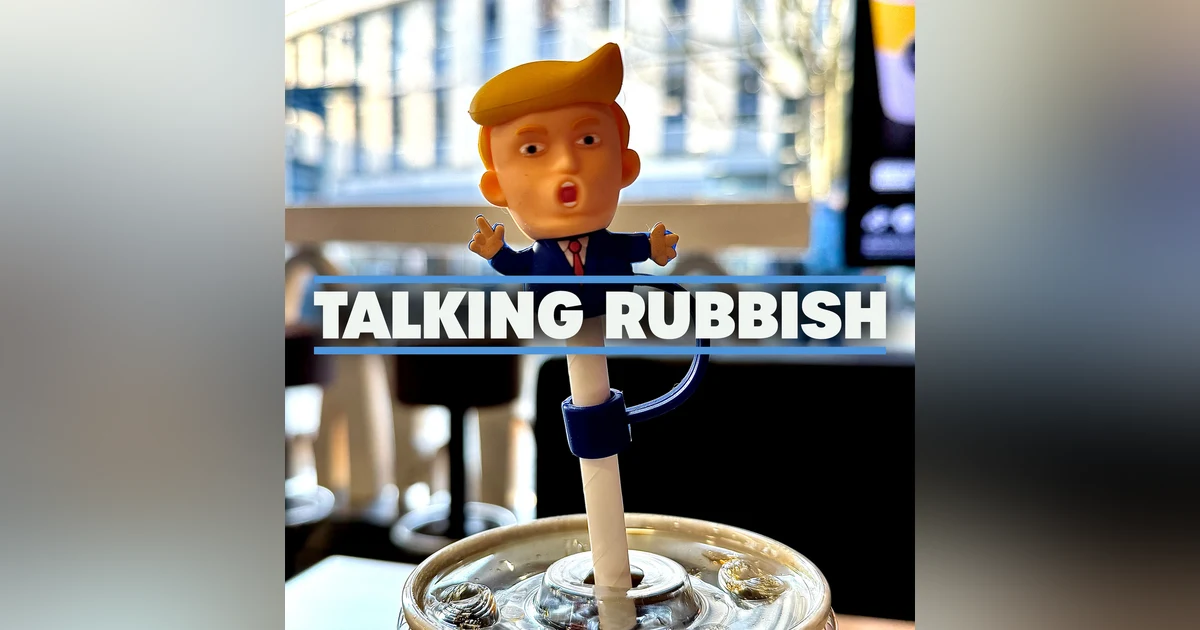

It was only a matter of time before a Trump policy made its way onto Talking Rubbish, his ‘BACK TO PLASTIC’ post on social media sealed the deal. This week, we’re diving into the much-vilified drinking straw. What’s the best material for it? Is there any logic in returning to plastic? And why are we so strangely obsessed with straws in the first place? Plus, how are tyres recycled, are glass candle holders rubbish or not and what plastic should we use as a bin liner?

 Apple Podcasts
 Spotify
 YouTube
 Amazon Music
 Castbox
 Podcast Addict
 PocketCasts
 It was only a matter of time before a Trump policy made its way onto Talking Rubbish, his ‘BACK TO PLASTIC’ post on social media sealed the deal. This week, we’re diving into the much-vilified drinking straw. What’s the best material for it? Is there any logic in returning to plastic? And why are we so strangely obsessed with straws in the first place? Plus, how are tyres recycled, are glass candle holders rubbish or not and what plastic should we use as a bin liner?
Join hosts James Piper and Robbie Staniforth as they delve into the world of recycling, hopefully having fun along the way. One thing is for sure, they will talk absolute rubbish from start to finish.
We would love you to join our community on Discord
Special thanks to our sponsor, Ecosurety
To get exclusive videos and clips, follow us on Instagram, TikTok, X, Threads or Facebook; @rubbishpodcast or YouTube: @talkingrubbishpodcast
Or you can contact James and Robbie with questions or just general rubbish musings using the email address talkingrubbishpodcast@gmail.com or by texting them via WhatsApp
Relevant links and reports mentioned in the programme can be found on the Talking Rubbish Linktr.ee
Transcripts and episodes can be found on the Talking Rubbish website
Timestamps:
How are tyres recycled? - 13:58
Is Trump right to bring back plastic straws? - 22:27
Rubbish or Not: glass candle holders - 47:40
What plastic should you use as a bin liner? - 50:34
Music licence ID: 6WPY8Q4O2RPFIOTL
Hello, welcome to Talking Rubbish, a weekly podcast delving deep into the world of recycling and discussing the truth behind snappy headlines and one-sided stories. In this episode, we will discuss how tyres are recycled, explore whether Trump is right to bring back plastic straws, are candle holders rubbish or not, and what should the Cornish guest house of episode 28 do now that they've removed their OXO bags? I'm James Piper, author of the rubbish book, and I'm joined by Robbie Stanenforth, my far from rubbish friend. Morning, Robbie. Hey, James. I'm fuming. I'm absolutely fuming.
SPEAKER_00Really?
SPEAKER_01Yeah, the council missed my food bin. Oh, wow. Okay. What, just this week? Just this morning. You know it's bin day. Oh, of course, happy bin day, as always. Thank you. Thank you. Yeah, walked out, I had a look. I thought, well, they've collected the paper, the cardboards. Yeah. They'd left some of the envelopes. They seem to think envelopes aren't recyclable, but that's a whole nother episode.
SPEAKER_00What, they left it in your paper bin?
SPEAKER_01Yeah.
SPEAKER_00Okay.
SPEAKER_01Taking all the plastic. I looked at everyone else's house. They'd all had their food waste collected, but for whatever reason, mine hadn't been.
SPEAKER_00Oh, you're not contaminating your food, are you, James? Uh no. Okay.
SPEAKER_01I don't think so. No, they're just in, you know, co compostable bags. Anyway, I know a lot of Bristol waste listen to this, so if you could come round to my house, I'll d I'll just leave the address. They do have a very annoying reporting system because I think they make you wait like 24 hours.
SPEAKER_00So it's like they might come back. They might be tipping the truck and coming back.
SPEAKER_01They're not going to. They might be. No, because they took my neighbours. It's not like they got like halfway down the street, went, Oh, our food waste bin's full. We need to, you know, we'll come back and do the other half of the street. I am the only person on the street that didn't get their food waste collection.
SPEAKER_00Okay, so it was just an oversight. They just missed it.
SPEAKER_01So I've got to now wait 24 hours before I report this. And then I've got the carbon of someone coming to collect.
SPEAKER_00And you can't just wait till next week. It's that full.
SPEAKER_01Do you not think food waste gets a bit grim if you leave it longer?
SPEAKER_00Well, it does, but I mean, come on, do you really want to haul someone out just for one collection? All right. You may be against it.
SPEAKER_01I might put it in your food waste bin. You can hold the food waste. I could take it to the dump patchy, couldn't I? Anyway, I look, we don't need to talk too much about my collections, but this is what happens, right? This is true. This is what people are living with. This podcast has the potential to become just my rant of my weekly bin collections. And on more positive news, let's be more positive. I cannot tell you how many people sent me this news story. People, everyone sent me this new story. It was on Discord, I got WhatsApps, I got Instagram messages, I had family members messaging it to me because they thought this is the kind of story that talking rubbish is going to talk about.
SPEAKER_00And you know how little research I do, and even your co-host sent it to you.
SPEAKER_01You did. You did. That's the sign, isn't it? So a big shout out to Teddy, who is six from Netley. I know Netley very well. I have friends who live in Netley, just in Hampshire, and he collected up 2,598 of those chocolate tubs that we talked about on our Christmas episode. That's a crazy amount. I know. And it produced a lovely picture of Teddy just surrounded by chocolate tubs. And of course, they didn't like stack them with the lids off, they put the lids on, made it look like a mountain. It was incredible. It was a very, very cool photo. So you if you haven't seen this, just look up what Teddy and Chocolate Tubs, and I'm sure you'll be able to find it. This year he went for a big number. He was like, I'm gonna write a letter to school. They sent it out to parents. Yeah. Here's my negative bit of the story. I've got to, you know, we've got to pull apart all these stories a little bit, and we even went into six-year-olds, so I'm sorry. I'm really hoping Teddy's not listening.
SPEAKER_00But Oh, the scrutiny, James.
SPEAKER_01His grandfather went to the tip to ask if they had any, and I was thinking and they store it out for him, and I was thinking, but if someone's taken it to a tip, surely they've put it in the plastic recycling bin. Surely. So we've now got the grandfather having carbon emissions of driving to the tip to pick up the plastic things out of the plastic bin to give Teddy his photo shoot. So I'm not look, if I had to find one criticism, it would be let's not go to the tip to find the rubbish to take the photo with, like get it from people's houses. But anyway, other than that, wonderful story. I think it always astonishes me, because this is Hampshire, and Hampshire do not collect pots, tubs, and trays. They collect uh bottles, but not pots, tubs, and trays. This is why my mother-in-law brings me all this plastic, because it's the pots, tubs, and trays. So I just think, come on, guys, like in Bristol, this would be collected from a finger out. It should not take a six-year-old to uh to collect this up. Presumably under simpler recycling, they're gonna have to collect up this stuff.
SPEAKER_00Must do. Yeah, exactly right. But I think you know, it is a specialist scheme. We mentioned that tubs to pubs, didn't we, in our Christmas episode? And uh, you know, it's probably got the best chance of being recycled through this scheme that Teddy's collected for. So well done, Teddy.
SPEAKER_01Well, and it's raised money for charity. Yeah, amazing. Tubs to pubs raises money for charity, so just incredible. Teddy, if you're listening or your parents are listening, well done. My favourite bit is the last sentence, which does tell us that simpler recycling needs to come in quite fast. Um, he's retired. He has literally said in the last sentence of the article, I'm going to have a break. I've done it for two years in a row. So Hampshire, you've got a year. Teddy's not doing this next year. It's time to step up. Of course, we do need to remember that in our Christmas episode, we did decide the best thing to do is probably to keep your tub.
SPEAKER_00That's right.
SPEAKER_01Use it through the year. It's food contact approved. So what we would do is use it to store cakes. I've certainly got a cake currently in one right now. And then each year you can buy the refill pouches. And we decided environmentally that was probably the best thing to do. So while I do completely admire what Teddy's done, I guess there is an argument to say that reuse is better than recycling. So we would probably advise keep your tub, even if a six-year-old boy's asking for it for his photo shoot. God, that feels bad, doesn't it? Maybe we should. I don't know what I'd do actually if a six-year-old knocked on my door and said, Can I please have your tub? It's for charity and for my photo shoot for the BBC. I'd be like, uh actually I'm keeping it. Fill it with a pouch.
SPEAKER_00It's probably got a cake in it, I'm sorry.
SPEAKER_01God, I hope Teddy's not listening. I feel like I'm raining on his parade. Anyway, congratulations, Teddy. Well done. We love it. And you know, anything that encourages news stories about recycling is great. And anything that encourages councils to collect things they should be collecting is probably great too. Addition to corrections. I have a really exciting addition because my friends who I mentioned on episode 29 who don't recycle their food waste.
SPEAKER_00Yes, I remember. I was very surprised to hear you have friends such as these.
SPEAKER_01Yeah. Well, keep your friends close and your non-recyclers closer. That's the uh that's the full advantage, absolutely. Yes, unfortunately, I do have friends who are not as good at recycling, and I have to go around their house and try and help them, but they will not naturally do it, and I cannot live in their houses, unfortunately. They were telling me that their council, because they don't live in Bristol, their council has gone to three-weekly collections. Oh, okay. They literally were like, James, it's awful. We're having to recycle.
SPEAKER_00And you absolutely loved it, didn't you? You loved to hear it.
SPEAKER_01Yeah, absolutely. So just to show you that three-weekly collections work, if you're listening to Bristol Council, here are some very resistant recyclers who were like, oh God, we're having to do it now.
SPEAKER_00So here's the evidence.
SPEAKER_01It's all about those people rather than you and me. And you know, that's what three-weekly collections is about, forcing people to recycle rather than encouraging them. And it clearly works. And I got some feedback on our oxo-biodegradable episode. I've got quite a lot of feedback on our oxo-biodegradable episode, which I'm working through. And some of the companies who make the product have been in contact just with some additions and corrections of their very own. So I'm working through that. Um, I've had a look through papers they've sent me and uh texts and documents and all sorts of things, and I still think our two main points stand, which is at some point in a breakdown of an oxobiodegradable plastic, it will turn into a microplastic, but it may continue to break beyond that, but in that life cycle it will. And I don't think recyclers really want them. So those two things, still true, everything's still true, but there were some technical details that everyone was like. Do you want to be a bit more specific on this thing? So uh let me just do one of them for now, and then we'll get, you know, over time I'll keep I'll keep additioning and correcting this as we go just to make sure because there's lots of things in the standard. So for example, I rather flippantly said uh PAS 9017, which is one of the standards, was for compostable plastic. And friend of the podcast, Ian, got in contact on Discord to say, I'm sure that was just a slip, because PAS 9017 is the biodegradation of polyolephins in an open-air terrestrial environment. And he's absolutely right. That is less snappy than it's a standard about combustible plastic.
SPEAKER_00Absolute stickler. Oh, that's so good.
SPEAKER_01Guys, this is the problem. I'm just gonna have uh you know, we are a bit more flippant on this podcast, aren't we? Because we're just like, look, we're not going into detail on the standard, so we'll just call it the combustible plastic standard. And then absolute experts who are amazing in this field write in and say, uh, you need to use the correct words. But using the correct words takes up a long time.
SPEAKER_00No, it does. And that whole the the like pass, the publicly available specification, the whole thing is like a fast-tracked uh standard anyway. It's very different to like a BSI standard or an ISO standard. So the kind of whole thing, if you really scratch below the surface, we the podcast could be lasting for two hours, and I think we wouldn't have many listeners left by the end of it. Did you just look up what PAS stands for? Is that uh I was talking about it yesterday, actually, at the conference. Yeah. Well, not in the live episode. I know. Not in the live episode. No, no. But um in the co I did actually talk to other people outside of our podcast, you know.
SPEAKER_01Other podcasts. So as always, we'd like to take a moment to thank our sponsor, EcoSurety, who are on a mission to rid the world of unnecessary packaging. They help brands navigate a tricky world of extended producer responsibility, but that is not all. They also collaborate on some incredible recycling projects and are massive in the consumer awareness space and really, really want to help consumers understand how to recycle, what to recycle, and where to recycle, which is why they're supporting our podcast. If you're an organization looking to make smarter packaging choices, they've got your back, so check them out at ecosurity.com. And as always, if you have any additions or corrections or anything that you want to say to us, the best place to find both of us is on Discord. The link will be in our show notes. You can follow us on social media, which is at rubbishpodcast. You can email talkingrubbishpodcast at gmail.com, and everything, our WhatsApp and everything you need to find us will be in our show notes. Rubbish Process. So today we are talking about tires. Last week we talked about how to collect them and Robbie was telling us all about garages and places that take our tires, and now we need to send them off for recycling. So Robbie, how are or rubbery? Rub rubbery?
SPEAKER_00I don't think there's a joke in there, James. Try as you may.
SPEAKER_01Can that be your name for today?
SPEAKER_00Rob Rubbery.
SPEAKER_01So, rubbery, how are tires recycled?
SPEAKER_00Uh yeah, so basically we've got these tires, they're in a pile. Where the heck do they go and what happens to them?
SPEAKER_01I've just realized when we do an episode on windscreen wipers, that's when you'll get revenge on the uh James Wiper. You missed that actually on the wipes, the wet wipes, yeah. That was your opportunity.
SPEAKER_00Oh, okay, I could have got you. Right, I'm gonna be on the lookout for now. Absolutely on the lookout for these. So the first place that they don't go anymore in the UK is landfill, because they've been banned since 2006, where they haven't been able to be landfilled. So people have been looking for alternative options for what to do with tires once they've reached the end of their life. And in my course of doing the research for this segment, I went on the British Tire Manufacturers Association website and also the Tires Recycling Association website, where I got some really great information about some of the statistics about where it goes and how it's recycled. So the first thing to say is they they some of them do get reused and re-tread. Uh so about 14% in the UK get reused or re-tread, and I'll talk about that in a second. About 17% go off to be to create basically a rubber crumb, which then is used for like playing surfaces, and I'm sure people will have seen molded rubber components and things where um rubber crumb is used.
SPEAKER_01Robbie crumb would be your like murder mystery name. If I was writing a murder mystery and I was like, who did it? I'd be like, it's Robbie Crumb.
SPEAKER_00It's Robbie Crumb with the tire in the garage.
SPEAKER_01Yeah, absolutely.
SPEAKER_00Uh so six percent goes to incineration in cement kilns. I'll talk about that very quickly. And then sixty-three percent is actually exported outside of the UK. So the vast majority of tyres actually, at the end of their life, end up getting exported.
SPEAKER_01Mostly I am genuinely shocked by that. That is that's a very high, I did not know that. That's a very high export percentage.
SPEAKER_00And UK tire recyclers are really worried about this too, because obviously the due diligence when you send it abroad is probably not so good as the UK. Do they end up in landfills abroad? Are they incinerated? It is unclear at the moment. And there are places around the world that chemically recycle them using a pyrolysis method, and we'll talk about that very quickly. But of that 63% export, it's very hard to know how much gets goes to a landfill, gets incinerated, goes through a pyrolysis process. You know, it may seem like just a simple circle of rubber, but actually a tyre is made up of up to 200 different raw materials, which I couldn't believe when I did this research, which include things like natural and synthetic rubber, carbon black and silica, reinforced fibers, uh, there's textile reinforcements too, and steel and chemical agents. So it's actually a bit more complicated than just a circle of rubber. So let's go through first of all the tire re-treading process. And this is something definitely that needs to be an approved process because it can be very dangerous. You don't want to be using re-treaded tires that haven't been properly dealt with. So basically, the tire inner itself is very durable, and once the grip goes on the outside, it actually can retain its shape and um is often still usable. It's just that there's no tread left on it. So it goes through an inspection process, which is a mixture of visual inspection, they send electric currents to check for cracks and things, and then finally there's also a laser process where they literally laser scan to see are there any defects in the tyre or can it be used. They manually go through and remove any foreign objects from that, the the sort of inner, the tire inner, if you like, and they remove the tread layer. So they they they sand it back so that it's ready to bond and cure a new strip of grip onto the outside of the tyre. So these are the kind of things there are lots of processes out there, you know, different types of processes, but it's it is quite common that you can get retreads, and I'm sure people have seen them on the marketplace. You just need to try and be a little bit careful when you're shopping around to make sure that it's done through a process that's actually scrutinized and high level as opposed to someone doing it in the back of their garage. Um that's not really what you want. But when it comes to the recycling, I thought the first when I was looking at these videos, one of the really interesting things is how the steel, you know, the steel is valuable inside the tire, and that's generally the thing that people are trying to get out so that they can recycle the steel. So there's two ways of doing that. The first, and this was amazing, the video that I watched, there's like a pneumatic hook that they puncture into the tyre and it grabs the steel wires, and then they pull, they literally pull all the wires in a solid sort of circles, if you like, around the tyre out of the tyre, and then just leave the rubber component, and you've got basically a whole load of steel wires that you can then bundle up and bale up and melt. Um, and it looked, you know, pretty impressive. I'm sure it's uh very high pressure grab to try and pull it straight out of the tyre. And the other option is to use uh magnets to pull steel out at a later stage. And what is that later stage? Through mechanical recycling, they shred tires and then they pulverise those tires into more of a powder and can separate things by particle size and using magnets, and that's where they might pull out steel. So that's the other option. And mostly the output is obviously some textiles that can go off to be sort of downcycled into various textile applications, but mostly rubber, which will be used in flooring, sports surfaces, for kids' playgrounds. You know, you've seen the kind of rubberized uh asphalt or whatever. And those are the kind of things that it can be used for. Finally, the last sort of recycling option is pyrolysis. And there's a big race on at the moment to try and prove that you can turn these tires, or at least once you've got rid of the steel, turn it back into oil using a high temperature reactor. We've talked about chemical recycling and pyrolysis previously, and it's the heat that breaks down the chemical bonds in the rubber and turns it back to a mix of oil, gas, which is often used to power the process itself, the recovered char and the carbon black, which is like the reinforcing agent that they use inside the tires. So those are the sort of two main mechanical and chemical recycling processes. Finally, people ask, I'm sure, like, what's this thing about using it in a cement kiln? Well, actually, rubber burns pretty well. And so in a cement kiln, where they're making cement, it's at high temperature, they can have a certain amount of tyres go into a cement kiln. It is sort of energy from waste type application, and the steel itself is incorporated into the cement, which gives it a bit of extra durability. But obviously, that's a sort of last resort. We really want to be looking more at re-treading and some of these other recycling processes.
SPEAKER_01I really enjoy that you've taken over the rubbish process. I don't know when it happened. It just sort of you know, sometimes these things just evolve accidentally. That is what happened here. Just somehow, one day, the rubbish process, in your words, just became you monologuing.
SPEAKER_00I'm just really into it. I find it very interesting.
SPEAKER_01I love listening to it. I'm just sat there like, oh, right, okay, this is how you be saglatre. And you know, I think the listeners have realized you're adding value to the pod. You have finally you've taken over a section. I don't have to do it. It's wonderful. So thank you so much, Robbie, for that. That was great. Rash talk. So I did say in episode 17 that our discussion on straws would not be the final straw. We did get a lot of people right in to say they enjoyed that joke, so thank you. Use it again. Yeah, here we go. I'll I'll use it at the end. That's how I'll end. I'll just say this will not be the final straw. We can't repeat jokes, Kevin. Well, um, Trump wanted to ensure that became true. So thank you so much, Donald. Very rarely you're gonna hear that on this podcast. He wants to bring back plastic. And, you know, we have lots of views on that, most of them negative, but it's an opportunity for us to talk about plastic versus paper straws and how this has come about and what the US are doing and whether we think a plastic straw or a paper straw is better. So let's get into that detail, Robbie.
SPEAKER_00Don't you think it's crazy that this has made the news? How is this the number one topic at the beginning of his like presidency, or at least one of the topics?
SPEAKER_01Well, I think yeah, in the top ten, probably. I mean, Paris Climate Agreement probably well, I don't know. That is interesting, isn't it? Which more coverage? Right. Guys, how are we gonna find that out? I'm right, you search in Google Plastic Straws Executive Order.
unknownOkay.
SPEAKER_01And I will search in Google Paris Agreement Executive Order, and then go to news and tell me how many results you get.
SPEAKER_00Okay, right. Plastic straws executive order. I'm onto news now, and search results at the bottom saying to be clear, I have searched in Google Paris Agreement Executive Order.
SPEAKER_01I have 13,100 results.
SPEAKER_00Oh my word. I have 71,800 results. What the heck?
SPEAKER_01That's crazy, isn't it? That is crazy, isn't it?
SPEAKER_00That was straws gets more airtime than climate. Mad.
SPEAKER_01I'm glad you asked that question. That was a really nice live.
SPEAKER_00Can we do more of that? Like more live research? I mean, I'll try to say something interesting if I can, James.
SPEAKER_01Thank you, Robbie. So let's start with why we're even talking about this. So straws may seem small, which they are, but they became this major symbol of the fight against plastic. And it all stems from this viral video from 2015 where a sea turtle was found with a straw stuck up his nose. And it was found by someone called Christine Figner. I'm sorry if I'm saying your name wrong, Christine, if you're listening. She was on a fishing boat, a marine biologist on a fishing boat, and she was examining an Olive Ridley turtle. She noticed something in its nose and decided to film as a marine biologist to work out what it was, while her colleagues helped work out how to remove it. And it basically produced an eight-minute long video that documented them removing a straw from this turtle's nose. And you know, it's a if you haven't seen it, it's a very dramatic video, a bit of blood drips out of the nose. It's very emotive.
SPEAKER_00Really? I've not actually seen it. Yeah. I mean, I know of it, but I've not seen it.
SPEAKER_01Yeah, it's very emotive. And it's had over 110 million views on YouTube. The original video, I found other versions that have been hosted by like Lad Bible, where they've had 50 million views. So, you know, I don't know how many views this has had in total, but certainly that original is over a hundred million. And interestingly, she was quoted, I found a quote on BBC News where she was saying, I wasn't an activist, but we scientists can't stay in our ivory tower. We see and document things that need to be communicated more broadly. It's not just about understanding, it's about getting people to care and explaining what we can actually do. Just looking at tons of plastic floating in the ocean can be a bit abstract. It's not the same as feeling the pain of another creature. It carried the message to non-scientists, showing what the statistics and plastic actually mean.
SPEAKER_00Aaron Powell Yeah, I mean, she's absolutely spot on with that analysis, isn't she?
SPEAKER_01Yeah, I think so. I mean there's we haven't actually talked about plastic in the ocean. I think we've mentioned it a couple of times now, and I I think we're going to do it for our next episode. Let's talk about what plastic's actually in the ocean is our next episode, because I think that's a question we get asked a lot, and it's something we can we can go into in a bit more detail. But um yeah, in this example, what probably happened is the turtle uh swallowed the straw, and then what they tend to do is expel seawater that they've eaten or that they've drunk with it when they were eating. It would have expelled it, and then it went up the wrong passageway on the way out and out the nose. And so that's how is how you end up with a turtle with a straw in its nose. And you know, that video was so emotive that it led to plastic being straws being banned in many, many countries, um, notably the EU and UK both ban plastic straws alongside other countries. And if you need more information on the UK bands, I would head over to episode 12. Those bands saw a huge growth in paper, metal, and glass alternatives as straws. So let's talk about plastic straws to start with, Robbie. I mean, what are they made of? Why are they hard to recycle?
SPEAKER_00Yeah, so plastic straws, they're too small and lightweight to effectively be processed by recycling machinery. It's like one of those things that it often falls through sorting screens, it's mixed with other materials, and it can contaminate recycling loads if it gets into the wrong place. And really they're non-recyclable and destined for landfill. However, they are made from polypropylene, PP, and sort of technically they can be recycled. In terms of the material, they're actually a very straightforward material. But it's really the fact that they're small and difficult to collect and and and don't really go through the recycling process very well. Trevor Burrus, Jr.
SPEAKER_01Yeah, and I think one of the things that annoys me about straws and other things, and we'll talk about this in another episode, is like colour. So colour in plastic reduces the value of the plastic. We talked about that, about how you have this kind of jazz plastic where when you recycle coloured plastic, you create jazz and that's worth less than clear. And so companies like Coca-Cola, I think Coca-Cola moved their sprite bottles from green to clear, didn't they? That's right. And that was in an effort to make it worth more at the end of its life. And for whatever reason, I mean, straw's just a the classic example of something that's multicoloured. You know, whenever you buy them, there's loads and loads of different colours, or they're striped, or whatever it is, or they're white. And it's like it was the perfect material for just making clear so that if it does end up in the recycling process, you're not reducing the quality of your output. But as you say, unlikely to get there, more likely to get incinerated or landfilled because it because they're just so small. Having said that, there are ways of getting them recycled. And you know, we did talk about Capri Sun in our ban episode with your famous line now, Pierce the Pouch. Or my famous who said it.
SPEAKER_00I think it was you who said it first, yeah. What was it? But you liked it. I just liked it. I just liked the way it sounded. It rolled off the tongue, didn't it? Pierce the pouch.
SPEAKER_01Pierce the pouch, yeah. So um you know, we talked about Pierce the Pouch, we talked about pushing the straw back into the pouch, and then that being a way of getting it recycled. Because ultimately, all you're trying to do, like with our tennis ball discussion that we always have, it's much better to make small things bigger. So it's like, well, how do I make a straw bigger? I put it in something plastic that's bigger, I wrap it in my plastic wrapping or whatever it is. So there are ways to get them recycled, but of course, few and far between. So we are more well, because of bands, we are definitely more likely to see alternatives. But there are significant problems with paper straws, bioplastic straws, anything that isn't just polypropylene, and that is PFAS. And I'm going to hand over to Robbie to give us a quick intro to PFAS.
SPEAKER_00Yeah, so I found a great BBC article, a couple of great BBC articles actually from 2023 and 2024 on PFAS, because this is something that's come into the minds of people because of this paper straw. And they are present in most organic-based straws, you know, things that are made from bamboo, paper, etc. Um PFAS is either a poly or perfluoro substances. Easy for me to say. That's what PFAS stands for. And it's a large group of synthetic organofluorines, is technically what they are. Have a done with that, James. Does it make sense? Did you see me shaking my head? So did you stitch me up with the pronunciation again? Well, keep going. And these are chemicals that have been widely used since the 1940s, and by definition, they all have at least one fully fluorinated methyl or methylene uh in the group, and that's a carbon fluorine, I should say. So consequently, these PFAS can resist chemical attack and it they can withstand high temperatures, and they're sometimes referred to as forever chemicals. And this is the thing that I saw time and again when I was looking into it, this term forever chemicals, that they just don't naturally disappear over time. And they're used in many food contact applications. In fact, they're used in some reusable plastics. They're a group effectively of synthetic pollutants, and they're known to cause potential harm to wildlife, to humans, ourselves, and the environment, um, as they might migrate basically from food contact materials to be consumed by humans. And so, as a replacement for plastics, paper and other plant-based materials that are used, such as in things like straw or straws, needed to use this PFAS to try and give it many of the properties that plastics have, such as water repellents being one of the main things.
SPEAKER_01It's why plastic takes a long time to break down the environment. The whole point is that our packaging to get our product to us safely needs to be durable. And so if you're using plastic, you don't need to add anything because the plastic is already durable. If you're using paper, then you need to add something to make it more durable. So you're basically giving paper the properties of plastic by adding a coating or a layer or a liner. And we're going to talk about coffee cups as well in the very soon. You know, you're adding a pl a liner that basically gives it the durability of plastic.
SPEAKER_00Yeah, no, and this is a common thing. You know, PFAS isn't just about straws, it's in lots of different products. But for now, uh let's concentrate on those straws. And we found a study that looked at 39 different brands of straws that were all available on the Belgian market. And these were straws made from five different materials. So paper, bamboo, glass, stainless steel, and plastic. And what this study did was it used a targeted approach to evaluate how much PFAS was in each of these. And what the study effectively found was that they were present in almost all types of straws except for those made of stainless steel. So there was some presence in plastic also, uh, plastic itself, but really stainless steel is the one where they weren't present. And they were very much more frequently detected in plant-based materials such as paper and bamboo. And I'm sure in the additions and corrections we'll get people writing in saying, we've developed a bamboo straw or a paper straw that doesn't need to use PFAS. And the the reason to sort of caveat this is that this was just a study that randomly took 39 different available straws in a Belgian market and just did genuinely find that the there was presence of PFAS in those plant-based straws, and that they were not necessarily biodegradable as a consequence, because as we mentioned at the top, these are forever chemicals that could potentially contribute to human and environmental problems. Lovely. Thank you, Robbie.
SPEAKER_01That was a great explanation of PFAS. So a chemical that sticks around like plastic potentially sticks around, but potentially for longer, as it's called forever chemical, it just doesn't break down. I guess one of the challenges with making straws that are like, I don't know, poster child for the environment, which is sort of what happened with this viral video, is it's just such a small part of the problem. And if we focus on the small stuff, then we all feel like we're making a really big difference, but actually we're not making a difference at all. But it's this kind of distraction of okay, if I switch to my reusable straw, I'm doing loads of really good stuff. And actually, you know, because it's such a small part of what we get through every day, it's that's just not the case. And I found a really interesting statue from uh Shelley Miller, professor of sustainable systems at the University of Michigan. And she said avoiding one car trip totalling 36 kilometres each way, so not very much, 72 kilometres total, is the equivalent of giving up a plastic water bottle for four years.
SPEAKER_00Oh wow. Okay, in terms of carbon impact, emissions or whatever, yeah.
SPEAKER_01Yeah. So the journey we did to Birmingham yesterday, Robbie, one way. In an electric car. We were in an electric car, so a bit different. But if we were in a fuel car, a normal petrol car, you know, that that is four years worth of plastic bottles.
SPEAKER_00Wow, yeah. It does put things in perspective, doesn't it?
SPEAKER_01It's crazy. And and that's what happens. You know, we focus on these really small things and it it just doesn't make the difference. When actually the biggest things you can do is take that one less flight in a year, go, actually, I'm not gonna fly, I'm gonna do a staycation, or go veggie, or something like that. You know, those will have much bigger impacts than the packaging choices you make. Now, having said that, none of us I mean, turtles are my favourite animal. I love diving, I love turtles. I do not want to see straws up their noses. So, you know, there is an emotive aspect of this that's really important. And I'm really glad straws are banned. You know, really, really glad. But I'm not glad for environmental reasons. I'm glad for ecological reasons. I was like, turtle safety is environmental, but what am I gonna say other than Different type of environmental reasons? Exactly, thank you. You know, and the BBC there was again a BBC article about this that sort of tried to put this in perspective. They didn't really go specifically into stores, but it estimates that 380 million tonnes of plastic waste is produced globally, with around 23 million tonnes of that finding its way into the environment. Around 1.7 million tonnes of that could end up in the ocean, although different studies have different numbers. Um, and of the 380 million tonnes of waste produced, plastic waste produced, about 43 million tonnes comes from consumer products that include single-use plastics from food and beverage. Roughly 14 million tonnes of this, or 3.7%, is made of polypropylene. So what they're saying is uh of 380 million, 14 million is polypropylene food contact. And so that's not even straws. So less than 4% is food contact polypropylene. When you then applied straws to that by weight, I mean you're gonna be like 0.1% of the plastic that's put on the market is a straw or was a straw before they were banned. And so, you know, uh they are a unique item in that they're super small, so they don't really enter the recycling stream, so they are somewhere we should focus, but they're not weighty enough to have a significant impact.
SPEAKER_00Aaron Powell Sure, yeah, on those total tons, if you're really worried about plastic and plastic in the ocean and et cetera, then uh you really need to look elsewhere as well as straws.
SPEAKER_01Aaron Powell Exactly. And I found a study from Thailand actually that suggested that traditional plastic straws made from polypropylene had a smaller carbon footprint than bioplastic uh PLA straws, which is definitely true. I mean bioplastics are basically normal plastics, but made from plants rather than oil. We haven't really talked about this much, but normal plastic, oil-based plastic is a byproduct of the oil industry. It's you know, it happens anyway just by us generating petrol. The side product of that is something that can be made into plastic. We'll talk about that another day. Bioplastics require you to grow plants and require land. And so typically they will have a bigger carbon impact than a normal oil-based plastic, similar with paper. So, you know, we should just recognize that. Whether look, just to be clear, we're glad they're banned. We're glad plastic straws are banned. I really don't want that ecological disaster, but they are a small part of our waste stream, and I think paper straws aren't necessarily a good alternative, and we'll come on at the end to to what we really would say about that. In fact, maybe we should just say that now. Look, the reality is don't buy a straw. Don't get a straw. Don't get a straw, don't get a free straw. Why have we got straws? Why are people giving me straws? It's so infuriating. We'll just cover that at the end, but I needed to say it now because there might be people who just drop off and go, but they never actually said don't get a straw. So I just felt the urge to say that. And then at the end I'm gonna wrap up with that. But like just as a little side note for the middle of our conversation, don't get a straw.
SPEAKER_00Insert a good spoiler alert. I think that's good. Yes.
SPEAKER_01And look, let's be serious. Paper straws do not function in the way they are designed. They are such a subpar product in terms of delivering us. And I said before we have double straw James, my friend, not me, my friend who had two straws at the cinemas because they broke halfway through the film. So you've got the carbon with double the straws. I mean, they're just not a good alternative product, I think. If I was buying one, I'd be buying a reusable stainless steel straw. It doesn't have PFAS in it, and I can just keep using it and washing it out.
SPEAKER_00And dare I say it, the best paper straws in terms of their function are probably the ones with more PFAS in them. And we don't want those. So yeah, it's a crazy situation that we're in.
SPEAKER_01And I do laugh every time because I just think when people put a paper straw, what do they do? They put it through a plastic lid. You know, you go into a McDonald's and it's like plastic lid, paper straw. It's like, oh my goodness, you've only solved the one that was banned. Yeah. You know, why haven't you gone, oh well, this is a big environmental problem. I should also develop a paper lid. Yeah. Because no one's told you to. It's mad.
SPEAKER_00We talked about that in episode 12, didn't we? How it's just sort of pot shot bans of various things in the UK, and it doesn't seem to have that much rhyme or reason to it. Yeah, absolutely. Let's leave the UK, let's talk about the US.
SPEAKER_01Let's talk about Trump. Is this the first time we've mentioned him on the pod? Probably. I suspect it will not be the last. I don't know which leaning our audience has in terms of their politics, but you know, uh I think it's fair to say that you'd be hard-pressed to find a Trump policy that Robbie and I agree with.
SPEAKER_00Yeah, very difficult. On environment affairs for sure. You know, it just seems to be uh going into reverse. Trevor Burrus, Jr.
SPEAKER_01Et al. It's not just environment affairs. Um So in the US it's estimated that you could they could be using up to 500 million straws a day, and we know that huge quantities are found in beach cleanups. That 500 million number is fascinating because in the in the intro we had Teddy, who was six, and here we've got Milo, who was nine. And Milo wrote to three of the main straw manufacturers to ask how many straws they made, and he calculated the 500 million number and then started a movement called Bee Straw Free. So we agree with that. Bee straw free, don't get one. There you go, another spoiler for the end. And like I was reflecting, because when I went diving in Jordan, quite recently, like a year ago, I went out to Jordan to go diving, and we needed, you know, on the boat, it's really hot, obviously, in Jordan, and we need water, and ev they didn't have like reusable bottles, they didn't have reusable cups, they didn't have jugs. They would give us like a I don't really know how to describe it, like a plastic, the weakest, most horrible plastic you've ever felt in like a cup type thing with a plastic lid with a straw.
SPEAKER_00Oh, really? That sounds like awkward to have to ship around the place on a boat.
SPEAKER_01Yeah. But that's what all their water was like water, you know, it was like it it wasn't bottles, it was just this very horrific plastic. And you were like, I'm out in the sea diving, and everyone's got a plastic straw. And you're drinking like ten of these a day as an average person because you're boiling and there's not much water in any of them. And I just thought, this is the kind of thing we need to ban. You know, why have we not got a policy of like reusable and then filtered water? It's just, you know, or filter the water enough, then you're buying bottled water rather than these pou, you know, these like um I don't know what they are. I don't even know what to call them. Like cups with a lid, but sealed lid. Yeah, very odd. And so Biden um we moved away from the US to Jordan there, just for my holiday. Um Biden had a plan to phase out federal purchases of single-use plastic, including straws, from food service operations, events, and packaging by 2027, and from all of its federal operations by 2035. Um but Trump, who we know is a big fan of drinking Diet Coke, I I don't know if you saw this for me, but he has a button in the Oval Office that was taken out when Biden moved in and he's put it straight back again, which um calls someone to bring him a Diet Coke. So there's a button in the world. Are you serious? Oh my god. Okay. Are you thinking that sounds like a good idea? I'm gonna get one of those buttons. What drink would you have them bring?
SPEAKER_00There's gonna it's definitely would be sparkling water. That's my that's my tip or when I'm when I'm uh at work for sure. Uh but I think I would have colleagues just looking at Robbie's button and going, uh-uh, I'm not doing anything about that. I'd just be laughing at the other end of it. Who's actually gonna bring me a drink?
SPEAKER_01Yes. And when attempting to gain re-election in 2020, his campaign actually sold straws. So they sold 10 straws for $15 that had the word Trump on them. Richard. Yeah, yeah. Yeah, he loves a bit of fake news. So they had on the website the word these are recyclable, which I can tell you they're not. I mean, they they are technically, but they're not going to get recycled. So great. There you go. And so Trump said when writing that he was going to bring back plastic that it's a ridiculous situation, and we're going back to plastic straws. I'm not going to attempt to do his voice. He told reporters at the White House as he signed the order, these things don't work, talking about paper straws. I've had them many times, and on occasion, they break, they explode. Explode. Actually. Have you ever had a paper straw explode?
SPEAKER_00I think explode is possibly the Donald is taking it a bit too far there. I should have got you to do the accent.
SPEAKER_01Do you want to try?
SPEAKER_00No.
SPEAKER_01Can I do that guy?
SPEAKER_00That's as much as I can do.
SPEAKER_01It's interesting though, because one area that America would not be able to get away from straws is with NASA. I was I start I went down a rabbit hole of NASA. What they have to do under the International Space Station. Really? Yeah, they have to use straws to get liquid out of pouches to drink it and to I think to get food out as well to stop it floating away. The straw obviously just directs it straight in their mouth. I I have spent quite a long time trying to work out what these straws are made of. I found a picture, I think it's metal.
SPEAKER_00Okay.
SPEAKER_01But I'm not sure. I was trying to like find out.
SPEAKER_00It could be some element that we've never heard about that NASA have developed, synthesized some new form of straw.
SPEAKER_01There we go. So NASA has straws, and I wish I hadn't spent an hour researching that. So look, just to summarize, and uh we said we'd do this in the bit, you know, as in you know this is coming, but just to summarise, we don't like straws. Obviously, there are people who do need straws, and certainly for people with disabilities, they may need straws to help them drink. And so this is not a blanket, you know, you don't need a straw. We do think there are people who need straws. And I feel that if you need a straw or if you just love them, you have that opportunity to get a reusable one. You can avoid PFAS, which is a forever chemical, it does not disappear. Um, you can avoid that by getting a reusable one as stainless steel, and you can use that and then wash it out and keep reusing it. But I think in the main where people do not need a straw, where they're like, actually, I don't need one and I could just drink this without one, I just think we should refuse them and we should keep telling bars that we don't want them. Because I am increasingly finding bars and restaurants giving me a straw without asking and deciding that I probably want one because hey, it's paper and it's environmentally friendly. And you know, I said this before. I really think when you demonize plastic and then you create an alternative that people perceive to be eco, they are more likely to chuck it in your drink. And the only way that's going to stop is if we all go up and say, Can I have this drink, please? And please don't put a straw in it. And then people will get used to the idea that maybe people don't want them.
SPEAKER_00Yeah, absolutely.
SPEAKER_01Refuse the straw. I'm going to end with a quote that I really love from the satirical website, News Thump. So just to be clear, this is satirical. Um, animals across the world have welcomed President Trump's executive order to reinstate plastic straws, insisting that the odd straw stuck in their nasal pastages is a price worth paying if it means the president can have a slightly more convenient soda experience.
SPEAKER_00Very good. It puts in perspective, doesn't it? We love a bit of satire, don't we, Robbie?
SPEAKER_01Rubbish or not. So I uh I had a request from Lou who had some used candles and was wondering whether the glass around the candles of like the holder basically could be recycled. And we have talked about different types of glass on this podcast. We talked about like toughened glass, where it's like Pyrex, which you can't recycle, and regular glass like a bottle, which you can recycle. So Robbie, where does a candle holder fit?
SPEAKER_00Yeah, the candle holder, they're they're just like a jar. You know, your jar of mayonnaise that you finish and you wash out and you can recycle. Uh candles absolutely uh the the glass container can be recycled like any other clear glass jar. The key thing though is you want to get all the wax out of it. And that means that, you know, burn the candle down, make sure you use the whole candle. But sometimes there is a bit of residue stuck in there, isn't there?
SPEAKER_01Yeah, and obviously there's an opportunity to make new candles. I mean, I found lots of people who were giving advice on this. Uh someone put their used candles in the freezer, and once they're frozen, you can just like pick it with a knife and it breaks up, and then you can pour that somewhere else to melt it down. So, yeah, really, I mean, basically, you're always going to end up with a tiny little bit of wax, and it's how do you get that wax out safely without burning your fingers? And freezer seemed to be the best opportunity to do that. Gather all your wax together and then melt it into a new candle. And very quickly, a few old candles could become a new one. You can get a wick from a craft store, and you know, you can use up all that residue. But yes, in terms of the glass, it's just like a jar. So you can recycle it.
SPEAKER_00And then just a quick addition on the tea lights, you know.
SPEAKER_01This is not the section for addition.
SPEAKER_00Oh no. Do I have to wait till next week? I'll let it pass. So if you've got tea lights, you know, they have the little aluminium foil at the end. It's exactly the same thing. Just take out the last of the wax, and all you need to do is scrunch all of those up into a ball, uh, something the size of a tennis ball, and it can be recycled with other aluminium foils. So what I tend to do with tea lights that I've used when they come to the end of their life is just put it inside a uh a piece of aluminium foil that I've used for baking or something, roasting, uh scrunch it up to the size of a tennis ball, and those tea light foils can be recycled.
SPEAKER_01Very nice. I particularly always like the way you say foil. You say it weird. It's like Stewie Griffin saying cool whip. Say it again. Foil Foil. Foil. I don't know. I can't foil. Foil. Foil. I don't want to make you self-conscious. You can keep doing it, but it's weird.
SPEAKER_00Uh I have quite a few funny words, so that's another one to add to the list.
SPEAKER_01Yeah. When I first met you, you insisted on what were you? Data and Project. Project. Very weird. Rubbish question. So I have mentioned a couple of times that I went to this house in Cornwall and we talked about them in the Oxo Biodegradable Plastic episode, because I said they lined their bins with oxo-biodegradable plastic. I actually haven't named them to date because I thought they might actually not want to be named because we were talking about oxo-biodegradable plastic. And they were like, Why haven't you named us? We're very happy to be named. So it's the Cornish Place in Cornwall. And they were kind enough to say, if any of our listeners want to book a stay at the Cornish Place, they will give you a discount on behalf of Talking Rubbish.
SPEAKER_00So if you want really how nice is this? That's amazing.
SPEAKER_01So if you want a 10% discount, just put the promo code TR10, as in Talking Rubbish. Yeah, TR10 into the promo code, they'll give you a 10% discount. If any other brands or retailers want to give our listeners discounts, just send me a note. I'm always happy to share. Oh, that's great. Anyway, Andy from the Cornish Place was looking for new bags to replace the OXO biodegradable ones. So she was messaging me asking, she sent me links saying, is this bag good enough? Is this bag good enough? And I thought, this is a really great question because I have an opinion and it would be worth sharing it. And it would be interesting to talk about what kind of plastic you would buy to line a bin. So I think that's the first thing to remember. We're talking about lining a bin here.
SPEAKER_00Yeah, just a general waste bin, yeah. Exactly. Non-recyclable rubbish.
SPEAKER_01Aaron Ross Powell So it's probably going to landfill or incineration. For sure. And so why? I guess my question to Andy was: why would you line it with a compostable bag? Because all the links she was sending me were home compostable bags or industrially compostable bags or alternatives to oxo-degradable, basically. And I was thinking, well, why would you line something with a compostable bag that's just going to end up in landfill or incineration? It's not going to compost. And maybe it will if it's home compostable. Maybe in landfill. But I I don't think it will. And so you're just all you're doing is paying more money.
SPEAKER_00Yeah. No, it's just it is most likely to get burnt. That's the reality. This will go and most likely be thrown into a energy from waste facility and generate a bit of energy and get burnt.
SPEAKER_01Aaron Ross Powell And it is interesting because I don't think the Cornish place are like this. I know these guys. They want to do the right thing. But I bet there are lots and lots and lots of hotels, B ⁇ Bs, all sorts of places who think it's got to have the worker possible one. People will think we're more environmentally friendly. And they couldn't care less about whether it actually is more environmentally friendly. Whereas Andy, I think, has listened to my advice, which is I would just go for the bin line if it has the highest recycle content in it. You know, I would go for one that's made with 50, 60% recycled content or 100% recycled content if you can find it. Because then you've got something that is just made from recycled old bags, and that's actually giving them a second life. And we need, you know, that market needs to exist. A lot of the shrink film from the back of store, so the stuff they're removing from pallets, ends up going down that route. It ends up being made into bags for life, or black bags, or new bin liners. And we need to keep that market going so that there's a justification for recycling that film and flexible.
SPEAKER_00Yeah, no, exactly right. I think the black bag is the perfect candidate for lots of recycle content because it being black hides a multitude of sins coming back to the different colours and jazz that we talked about earlier. It can all be masked by the fact they just put some black in the master batch and uh knock out loads of recycled content bags. So I think I'm with you, James. Great. Thank you, Robbie.
SPEAKER_01That will not be the final straw. I promised, I said I'd say at the end. Considering we had a lot to go through, I really enjoyed that.
SPEAKER_00Yeah, no, it was great to actually look at something topical. And it just goes to show rubbish is coming up in the news all the time, isn't it? You know, when the president of the US is talking about something that's right in our wheelhouse, it's definitely on the pulse, isn't it?
SPEAKER_01And I hope it's still topical. I mean, we are recording a little bit early because you are just about to- That's my fault. You're about to head off to South Africa. So um, well, you've got like a month in South Africa. You're you're gonna keep us updated on what you're doing out there, because there's uh quite a lot to do with this kind of space. I'm not I'm being so cryptic, but I'll let you tell everyone when we get to these episodes what you're out in South Africa doing. But also a huge opportunity for you to go and explore waste management in another country and a country that I think will be super interesting in terms of how they deal with waste, how much OXO you're seeing, all those kind of things. I really am looking forward to you feeding back. So part of the reason we're a bit late to the table on plastic straws, possibly, is because of this. We're just kind of doing a few episodes quite early. Soon we will be just a week in advance, as we promised, and that would allow us to do that. Once Robbie's back from South Africa, I think. I'll never have a holiday again. Yeah, you won't. No, you've got to take your work with you everywhere. That's you can always have a holiday. You've just got to give up an hour in a week to me. I've got to do the same. I mean, it's a trade-off.
SPEAKER_00No, no, it's fun. It's absolutely no chore. Great to chat again. Lovely.
SPEAKER_01Thank you so much, Robbie. And if you want to contact us, as always, the best way to get hold of both of us is Discord. The link will be in our show notes. You can follow us at rubbishpodcast. You can email talkingrubbishpodcast at gmail.com. And any other way of contacting us or anything we talked about in this episode, you can find in our show notes, particularly our link tree, where you will find links to any reports or news stories that we've talked about. Other than that, we will see you next week. Robbie from South Africa, me from Bristol. Bye. Bye.